


Corpus Christi, Year A
First Reading: Dt 8:2-3, 14-16
Second Reading: 1 Cor 10:16-17
Gospel Reading: Jn 6:51-59
After the flood, God told humans that “every creature that is alive shall be yours to eat; I give them all to you as I did the green plants” — except for “flesh with its lifeblood still in it.” Since “the life of every living body is in its blood, I have made you put it on the altar, so that atonement may thereby be made for your own lives, because it is the blood, as the seat of life, that makes atonement.”
The Jews of Jesus’ time were familiar with this command. From the time synagogue schools were established during the Babylonian captivity, Jewish boys especially spent five years studying the law and the prophets.
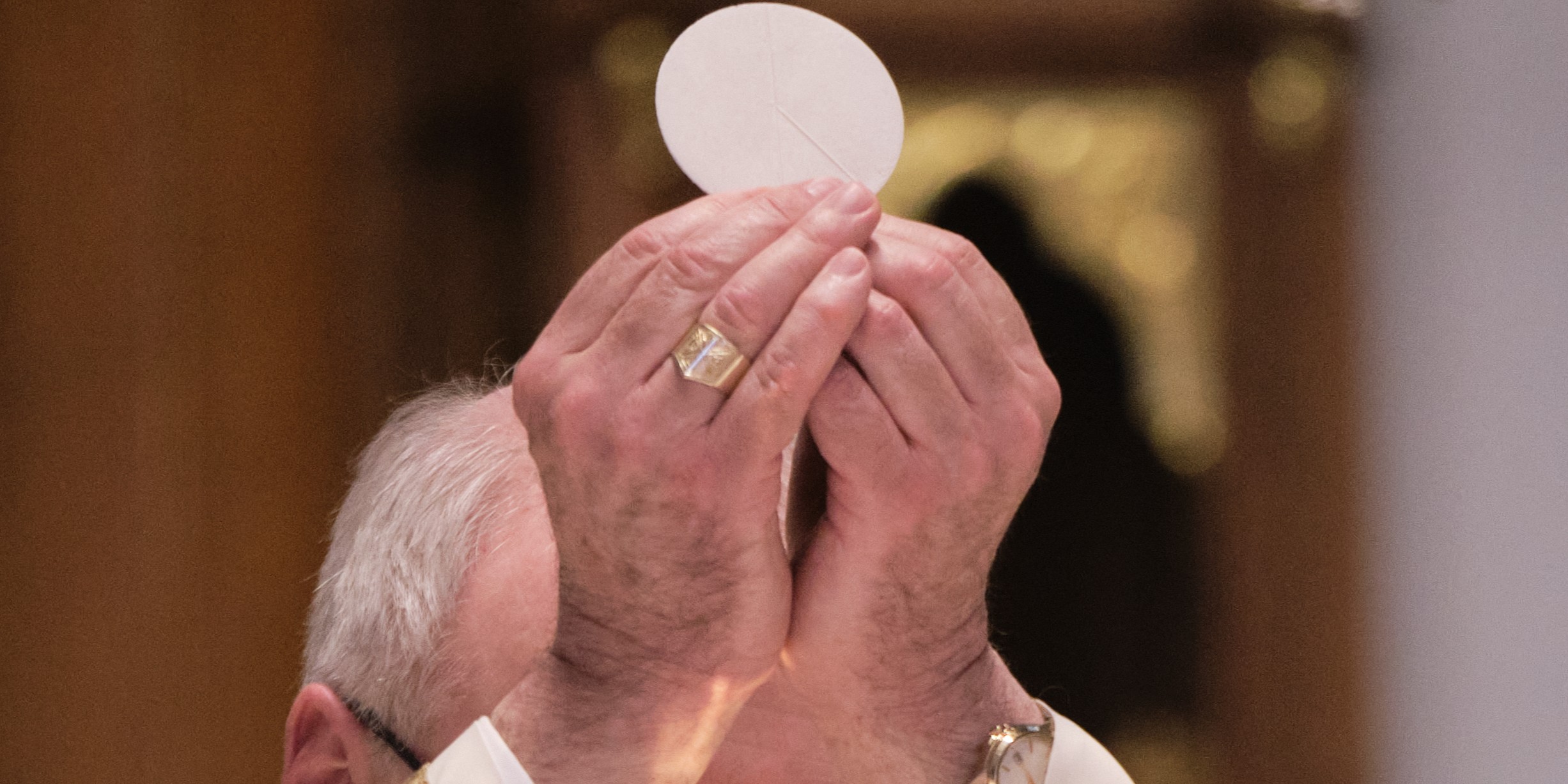
Imagine the shock, then, when they heard Jesus say, “Unless you eat the flesh of the Son of Man and drink his blood, you have no life in you. Whoever eats my flesh and drinks my blood has eternal life…. My flesh is true food and my blood is true drink.”
Throughout this passage, the Greek word used by St. John for “life” is zoë, not the more usual bios. God had forbidden the Israelites to eat “flesh with its lifeblood still in it,” for “the life of every living body is its blood”; but Jesus told us not only to eat his body, but also to drink his blood, in order to possess his life: divine life, eternal life, zoë.
Zoë is the life Jesus himself continued to live even when death had separated his human body and soul, says the Catechism of the Catholic Church, for his body, like his soul, remained united to the person of God the Son.
In promising to raise those who eat his body and drink his blood, Christ anticipated the Resurrection, said Pope Benedict XVI. This is not “cannibalism, but union with the living, risen Christ,” for Christ, “precisely as sacrificed, is living.”
Accordingly, we lose nothing by receiving only the Host at Mass. The “whole Christ” is present either under the appearance of bread or under the appearance of wine, says the Catechism.
Zoë is what Christ offers us through his Church. When the priest first welcomes unbaptized people in the Rite of Acceptance, he says, “What do you ask of God’s church?” and they answer, “Faith.” Then he asks, “What does faith offer you?” and they answer, “eternal life” — St. John’s zoë.
“Eternal” means “everlasting,” with no end or beginning. Eternal life “is not an endless sequence of moments, in which we would have to try to overcome boredom and anxiety in the face of what cannot be ended,” said Pope Benedict. It is not a matter of time at all, but “a new quality” of life, in which we are free from “the fragmentation of existence in the accelerating flight of moments.”
Nor is it simply the life that comes after death, he noted. “It can be already present in the midst of this earthly life and its fleeting temporality as something new and different and greater.”
Even the apostles did not know what Jesus meant by eating his body and drinking his blood. However, they knew and trusted Jesus. Accordingly, when he asked whether they were going to leave him like the others, Peter replied, “Lord, to whom shall we go? You have the words of everlasting life.”
Not until the Last Supper could they begin to understand, when Jesus said over the bread and the wine, “Take, eat, this is my body…. Take, drink, this is my blood.” Only a few hours later, “they could have seen in the cross of Jesus, if they could have borne the weight of it,” what those words had meant, said Pope Francis.
Perhaps then, too, they could have seen how Christ’s Blood, “as the seat of life,” foreshadowed by the blood of the Old Testament sacrifices, had made “atonement” for the world’s sin.
Father Hawkswell has now finished teaching The Catholic Faith in Plain English. The whole course is available on YouTube in both written and audio form at beholdvancouver.org/catholic-faith-course and will remain available until the end of August. Father will teach the whole course again, with new insights, starting Aug. 30.
Your voice matters! Join the conversation by submitting a Letter to the Editor here.







