

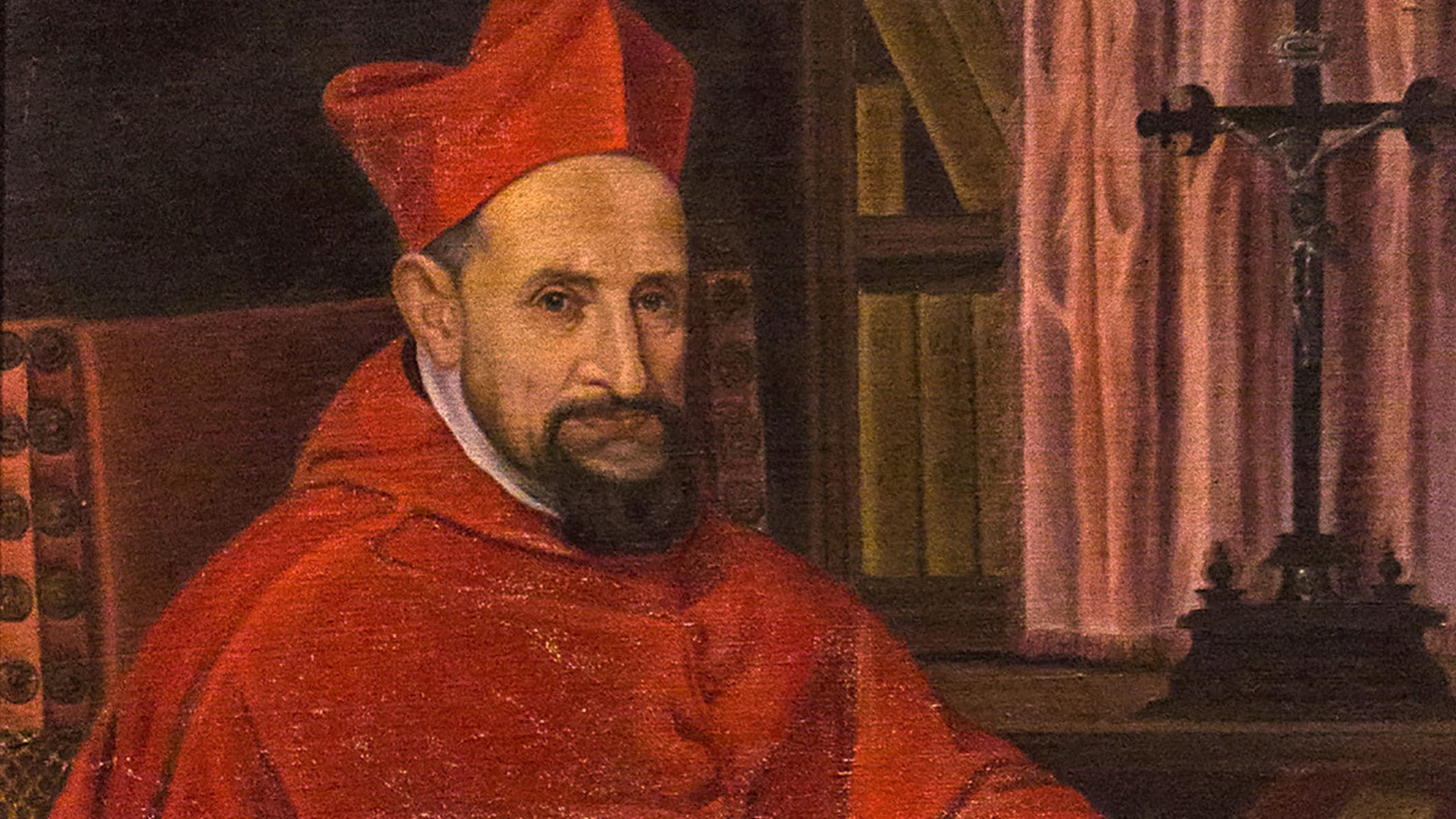

Saints Peter Canisius (1521-1597) and Robert Bellarmine (1542-1621) were both Jesuit theologians who wrote catechisms and were involved in apostolate works. They were both declared Doctors of the Church by Pope Pius XI.
Peter Canisius was born May 8, 1521, in Holland. After making the spiritual exercises under the guidance of St. Peter Faber, he entered the Society of Jesus on May 8, 1543.
Peter earned a doctorate in theology in 1549 and St. Ignatius of Loyola assigned him to carry out the apostolate in Germany.
Before he set out for Germany, Peter Canisius received the apostolic blessing from Pope Paul III. He had a profound spiritual experience, which he described in these words: “Eternal High Priest, you allowed me in your boundless goodness to commend the fruit and confirmation of that blessing to your apostles, to whom men go on pilgrimage to the Vatican and who there work wonders under your guidance. It was there that I experienced great consolation and the presence of your grace, offered to me through these great intercessors. They too gave their blessings, and confirmed the mission to Germany; they seemed to promise their good will to me as an apostle of that country. You know, Lord, how strongly and how often you committed Germany to my care on that very day: I was to continue to be solicitous for it thereafter, I was to desire to live and die for it.”
Pope Benedict XVI commented: “We must bear in mind that we are dealing with the time of the Lutheran Reformation, at the moment when the Catholic faith in the German-speaking countries seemed to be dying out in the face of the fascination of the Reformation. The task of Canisius – charged with revitalizing or renewing the Catholic faith in the Germanic countries – was almost impossible. It was possible only by virtue of prayer. It was possible only from the centre, namely, a profound personal friendship with Jesus Christ, a friendship with Christ in his Body, the Church, which must be nourished by the Eucharist, his Real Presence.”
Peter reformed the University of Ingolstadt and administered the diocese of Vienna for a year. He visited hospitals and prisons and wrote catechisms. Pope Benedict XVI said, “There were at least 200 editions of this Catechism in his lifetime alone! And hundreds of editions succeeded one another until the 20th century. So it was that still in my father’s generation people in Germany were calling the Catechism simply ‘the Canisius.’ He really was the Catechist of Germany for centuries; he formed people’s faith for centuries.”
As superior, Peter established a dense network of communities of Jesuits in the Germanic countries, which contributed greatly to the renewal of the Catholic faith.
St. Robert Bellarmine was born on October 4, 1542, and entered the Society of Jesus on 20 September 1560.
Robert focused on St. Thomas and the Fathers of the Church in his theological studies. He was ordained a priest on March 25, 1570. He taught at the Roman College in Rome and was the spiritual director of St. Aloysius Gonzaga.
Benedictine author Father Augustine Kalberer described the life of St. Robert: “Despite poor health during most of his sixty-eight years, he seemed to have energy and talent for everything: studies, teaching, the pulpit, writing, spiritual direction, administration, and – during four years as Archbishop of Capua – pastoral care.”
Pope Benedict XVI said, “The burdensome offices of governance did not prevent him from striving daily for holiness, faithful to the demands of his own state as a religious, priest and bishop. From this fidelity came his commitment to preaching assiduously. Since as a priest and bishop he was first and foremost a pastor of souls, he felt it was his duty to preach diligently.”
Robert wrote the four-volume Disputationes de Controversiis explaining and defending the Catholic faith. His most popular work is a short catechism written from 1597 to 1598. In the catechism, the saint pointed out that the faith of Christ chiefly consists “in two principal mysteries, which are included in the Sign of the Holy Cross, that is: in the unity and Trinity of God, and in the Incarnation and Death of our Saviour.”
We welcome letters to the editor about articles in The B.C. Catholic.
耶穌會聖師寫教理書
聖伯多禄、卡尼修斯(1521-1597)和和聖羅伯、白敏(1542-1621)兩位都是耶穌會神學家。篇寫教理答並投身宗徒業務。他們都被教宗比約九世稱為『教會聖師』。
伯多祿、卡尼修斯於 1521 年 5 月 8 日出生於荷蘭。在聖伯多禄、費伯的指導下進行神操後,他於 1543 年 5 月 8 日進入耶穌會。
伯多祿於1549年獲得神學博士學位,聖依納爵指派他在德國進行使徒工作。
在啟程前往德國之前,伯多禄、卡尼修斯接受了教宗保祿三世的降福。他有深刻的屬靈體驗,他用這些話來描述:
『永恆的大司祭,你允許我以袮無限的良善,表彰你的使徒們降福的果實和確實,人們為使徒們去梵蒂岡朝聖,並在你的指導下作出奇妙的事工。正是在那裡,通過這些偉大的忠保,給我體驗了極大的安慰和你的恩典。他們也送上他們的祝福,並確認了對德國的任務;他們似乎在向我、他們國家的使徒,承諾他們的善意。主啊,你知道,在那一天,你是多麼強烈和頻繁地將德國交託給我照顧:從那以後,我要繼續關心它,我渴望為它而生,為它而死。』
教宗本篤十六世評論:『我們必須記住,我們正在處理路德派改革的時代,當時德語國家的天主教信仰似乎在宗教改革的魅力面前消亡。卡尼修斯的任務 — 負責振興或更新日耳曼國家的天主教信仰 — 幾乎是不可能的。只有通過祈禱才有可能。只有從中心才有可能,即與耶穌基督深厚的個人友誼,與基督在祂的奧體內、教會中的友誼,這必須由聖體聖事,祂的真實臨在來滋養。』
伯多祿改革了英戈爾施塔特大學,並管理維也納教區一年。他訪問了醫院和監獄,並撰寫了教理問答。教宗本篤十六世說:『僅在他一生中,至少有200個版本的教理問答!直到 20 世紀,數百個版本相繼而來。因此,在我父親那一代,德國人仍然簡單地稱教理問答為“卡尼修斯”。幾個世紀以來,他確實是德國的教理問答師,幾個世紀以來他塑造了人們的信仰。』
作為長上,伯多祿在日耳曼國家建立了一個密集的耶穌會團體網路,為天主教信仰的復興做出了巨大貢獻。
聖羅伯、白敏出生於 1542 年 10 月 4 日,並於 1560 年 9 月 20 日加入耶穌會。
羅伯在這項神學研究中專注於聖多馬斯和教會的教父。他於1570年3月25日晉釋為司祭。他在羅馬的羅馬學院任教,是聖類思的神師。
奧斯定·卡爾伯勒神父描述了聖羅伯特的一生:『儘管在他六十八年的大部分時間裡健康情況不佳,但他似乎在任何事情上都有精力和才能:學習、教學、講壇、寫作、精神指導、行政管理,以及 — 擔任卡普阿總主教的四年 — 牧職關懷。』
教宗本篤十六世說:『繁重的管治職位並沒有阻止他每天為成聖而奮鬥,忠於自己國家作為會士、神父和主教的要求。從這種忠誠中,他承諾勤奮地講道。由於作為一名神父和主教,他首先和最重要的作為一位靈魂的牧者,他覺得勤奮地講道是他的責任。』
羅伯寫了四卷本的《爭議》,解釋和捍衛天主教信仰。他最受歡迎的作品是1597年至1598年寫的簡短教理問答。在教理問答中,聖人指出,基督的信仰主要包括『兩個主要的奧秘,包括在聖十字架的標誌中,即:天主三位一體,以及我們救主的降身和為救贖我們的死亡。』
We welcome letters to the editor about articles in The B.C. Catholic.







