

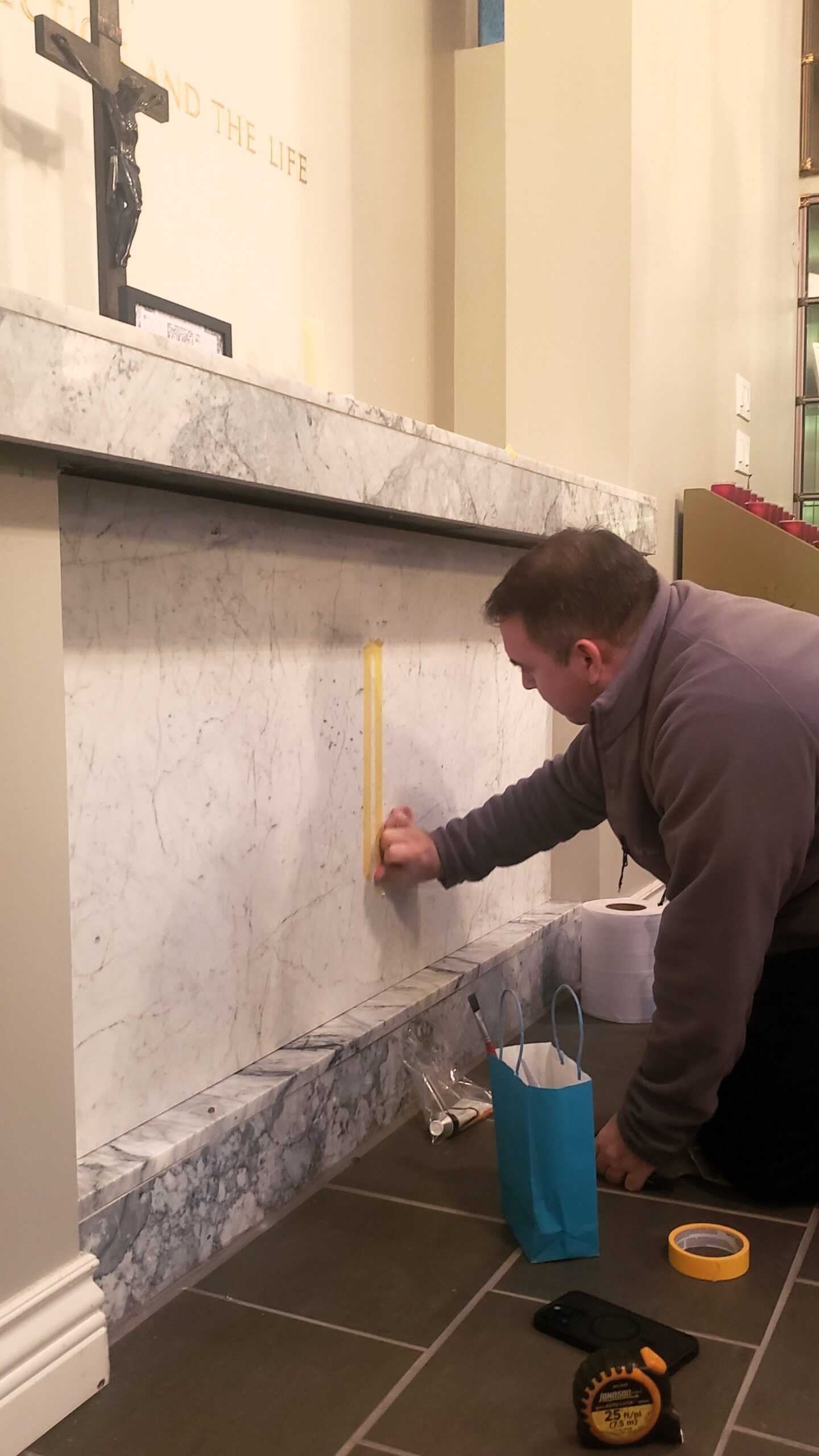

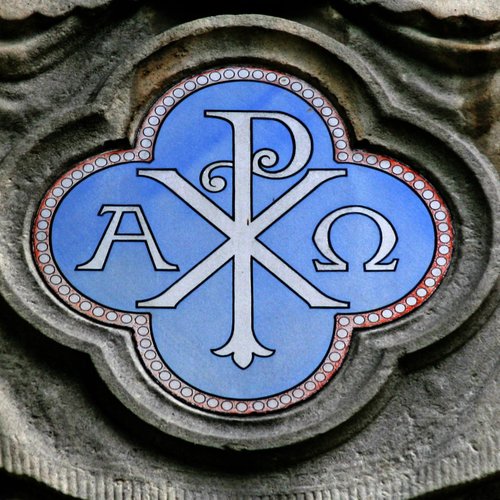
On a tour of Gardens of Gethsemani cemetery last year, Holy Rosary Cathedral’s Father Pablo Santa Maria was drawn to the cemetery’s Resurrection Mausoleum, with its crypt containing the remains of Vancouver archbishops. Father Santa Maria offered to apply his interest in sacred liturgy and altars to making some refinements to the crypt altar, including the addition of a stylized Chi-Rho symbol, ☧. Here he offers background on the tradition of crypt chapels.
Since the time of the first Christians, the Catholic Church has always surrounded the dead with an atmosphere of sacred respect. This is why we bury bodies and honour them at the time of death: the funeral honours the body of a deceased, and with it we foster a certain veneration of the faithful departed.
This veneration is not understood in a theological sense, but rather more broadly, as sacred honour and respect for the dead while we, with faith, await the resurrection of the flesh and in the life to come.
St. Augustine explained to Christians of his day how external honours would bring no benefit to the dead if they were not accompanied by prayer: “Without these prayers, inspired by faith and piety towards the dead, I believe that it would be of no use to their souls if their dead bodies were laid in a holy place. This being so, let us be convinced that we can only favour the departed if we offer for them the sacrifice of the altar.”
This is why in many cemeteries, especially Catholic ones, we find crypts and altars for the celebration of the Holy Sacrifice of the Mass.
The origin of crypts comes from the need to guard the memory of a sacred space. The first crypts appeared in places that commemorated important moments in the life of Our Blessed Lord, such as the location of his birth, or the Holy Sepulchre where his body was buried.
Later examples are those associated with the early Church and the catacombs, for instance St. Peter’s Basilica. Crypts came to be associated with places linked to the relics of a saint or sacred burial place of Christians. These altars were usually reserved for the celebration of Requiem Masses.
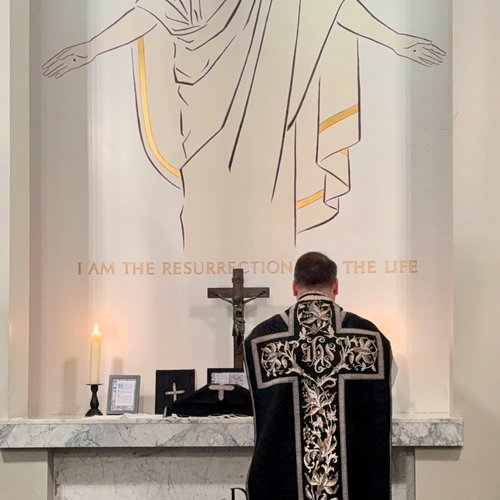
With the liturgical reforms in the late 1960s many of these crypt chapels and altars fell into disuse. One such crypt altar is at Gardens of Gethsemani, in the Resurrection Mausoleum where the archbishops of Vancouver along with other faithful of the Archdiocese are buried. The altar was likely used many times for the celebration of Requiem Masses for the people buried there.
These crypt chapels usually would have a great deal of symbolism, with the use of simple art, or a black wooden crucifix. Design features would be devoid of much coloration or use only black, in keeping with the mourning of the faithful departed.

The Catholic ritual uses black to express mourning and the sadness of death, which is why black liturgical vestments can still be used for funeral Masses and for the Commemoration of the Faithful Departed on Nov. 2.
In ancient Western culture, black had an ominous connotation, associated with the darkness of the night and fear of the unknown, but on a material level black was the colour of the humble. For this reason some religious orders wore dark garments as a sign of renunciation to the world, simplicity, and austerity. Although we do not forget the resurrection of the dead and the new life promised by Christ, the use of black is meant to remind us that mourning for our loved ones is natural.
The Church today remembers the faithful departed in a special way during the month of November. Chapels like the Resurrection Chapel at Gardens of Gethsemani afford the possibility for the celebration of suffrages for the Holy Souls, a reminder that with death “life is changed not ended,” and that it is good and praiseworthy to be close with those who have finished their earthly pilgrimage.
Share your thoughts with us. Send a Letter to the Editor and contribute to the ongoing conversation.







