

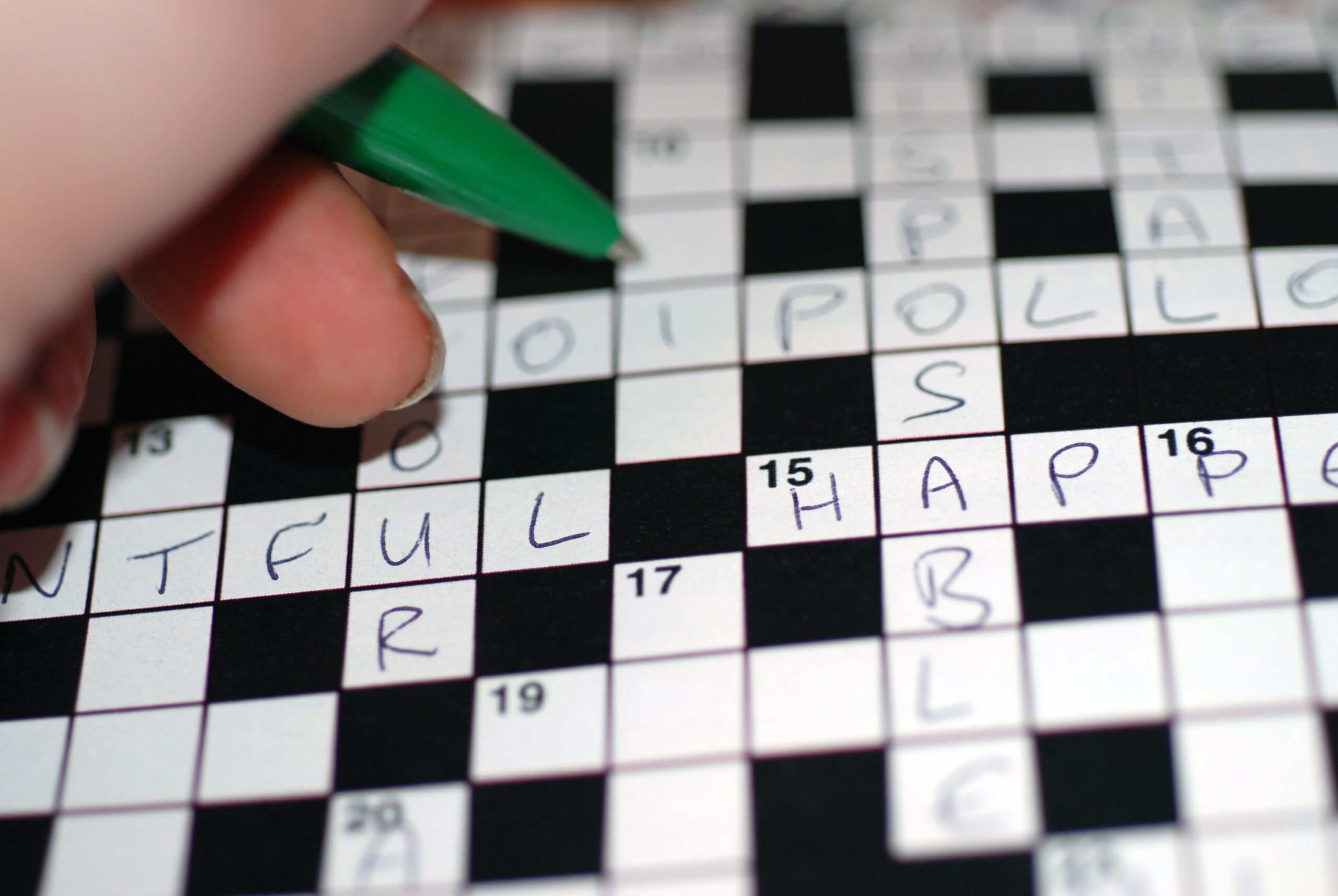

Despite being a word nerd, I was never drawn to crossword puzzles—until recently. My daughter introduced me to The New York Times Wordle game, which in turn led me to what was, I hoped, a healthy interest in their apparently famous crossword.
What began as a curiosity quickly turned into an addiction, initially a source of relaxation that became a tense competition with myself to solve the challenge faster each time. In the end, I had to take a step back and remind myself it was all just a game. Then I started researching the subject and realized this was no laughing matter. People take these extremely seriously.
Last week, B.C. Catholic editor Paul Schratz issued an apology for the paper’s accidental misprinting of the weekly puzzle, which he ironically referred to as a “crossword crisis.”
In the course of preparing the issue, incorrect information was apparently included. “Somehow we managed to publish the wrong DOWN clues in the paper—although the ACROSS clues were perfectly fine for any puzzlers who enjoy solving just half a crossword.”
Needless to say, the error was brought to the attention of the paper by concerned, though playful, readers, but as Schratz pointed out, “At other newspapers when there’s a problem with the crossword … it’s not uncommon for editors to find themselves de-escalating angry calls.”
Since mistakes are anathema to the puzzles’ readership, it is interesting to note that the very name of the game was itself an error. A fascinating article by Adrienne Raphel explains that the first such puzzle was invented by Arthur Wynne in 1913 just before the outbreak of World War I. Searching for a relaxing activity at a stressful time, he compiled a simple version of what is now the classic game, which he called a Word-Cross Puzzle. A typographical transposition error a few weeks later led to it being listed, erroneously, as a “Cross-Word puzzle,” and the name stuck.
Raphel notes that as the news of the war grew more sombre, the distracting nature of the puzzle became ever more appealing: “As World War I ramped up, so did cruciverbal production, and the activity’s popularity only grew after the Armistice. During the 1920s, the crossword boomed: from crossword-patterned stockings to crossword-themed musicals to comic strips.”
Even more fascinating, despite the explosion of interest, one paper staunchly refused to lower itself and include a trivial puzzle within its pages: The New York Times. The paper maintained this stance until the bombing of Pearl Harbor: “Suddenly the puzzle was not a frivolous distraction but a necessary diversion, something to keep readers sane with the rest of the news so bleak.”
I am nothing if not predictable, so I immediately turned my sights to the question of religiosity, only to discover that there are indeed multitudes of crosswords in the Catholic and Christian universe.
From Pinterest to Google to Amazon, the web is awash with titles such as 350 Bible Puzzles for Kids to an intro to biblical literature course textbook that promises: “Working on these puzzles will increase your knowledge of the Bible and perhaps even improve your grade in this Bible class!” Wish they’d had this when I was struggling through physics. But I digress. Suffice to say that there are pages of references to crossword puzzles featuring the popes, with an especial focus on Pope Francis.
While it’s a different genre, many have described the Bible itself as a puzzle—a jigsaw perhaps—that demands the same kind of focus and concentration in order to solve its secrets.
Yes, there is a superficial understanding that many carry about the Good Book, but it is one that is often framed by second-hand knowledge of the text. Indeed, many who have never actually read the work itself call on it to make pronouncements; others read the work selectively to support a position or a cause. Surely, such an approach is akin to the errors cited earlier and should garner furious condemnation. And yet, all too often, we allow the Bible to be misused or let its profoundest clues go undetected.
A puzzle, though, especially one so precious, is a magnificent gift, and one that we do well to apply ourselves to understand. There’s a reason we speak of the sacred text, or the birth of Christ, or the Mass itself, as a mystery. Here before us is a puzzle of great complexity, but we have been provided with all the clues. Christ’s words are resonant with meaning, and we need to study and apply, value and defend, the core of a magnificent teaching.
In the end, the answers to DOWN and ACROSS add up to one thing: He is risen.
Isn’t that the answer we’re all looking for?
Your voice matters! Join the conversation by submitting a Letter to the Editor here.







