


Following each of the two municipal
elections before the one just conducted, The
B.C. Catholic dispatched a reporter
to Coquitlam to profile me, largely on the grounds that I was happy to identify
myself as a practising Catholic during what turned out to be successful
campaigns for a seat on the city’s council.
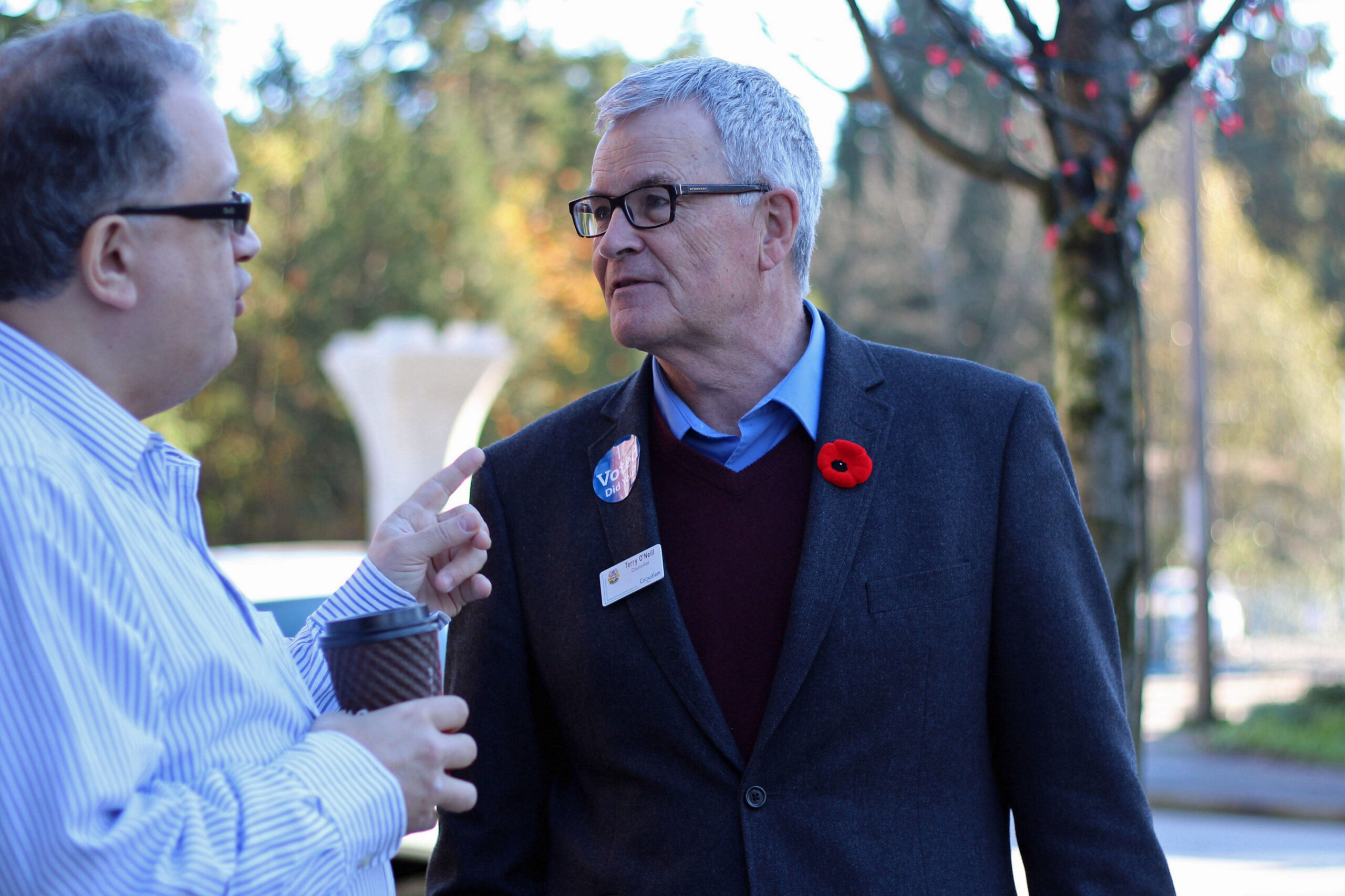
And so it is only natural that, upon my retirement from municipal council last week, I should be asked to reflect on those two terms in office, specifically on my experiences relating to the intersection of Catholic faith and politics.
How exactly does a Catholic like me bring his religious and moral beliefs to life in a world that is often hostile to those beliefs? How has the experience affected me – was it uplifting or discouraging? What have I learned? What advice might I pass on to others?
Let me start by saying that never once during my seven years in office did anyone ever accuse me of attempting to foist my beliefs on the public; on the other hand, I was often praised for taking a direct approach to issues, for clearly and unapologetically stating my case, for being open to changing my mind, for injecting humour into proceedings, for not launching ad hominem attacks, for being rooted in common sense, and, above all, for making principled decisions.

I credit much of the above to the
confidence of heart and clarity of mind given me by my Catholic faith. And I
would say that the crucial manifestation of that confidence and clarity was and
is my rejection of relativism and my embrace of the belief that “truth” really
does exist.
But what, in practice, does that mean? Here’s an example: Because I had a long career in journalism before entering politics, I possessed a great many, already-formed positions on subjects I was being asked to consider as a councillor. Upon reflection, I ascertained that those positions came from one of three sources: a prejudice, a policy, or a principle.
Reflecting further, I concluded that, if I identified that my position were based on a prejudice, I had better be prepared to change that position rather quickly; some prejudices can be correct (just as a broken clock shows the correct time twice a day), but many will dissolve in the face of common sense and facts.
And what if I identified my position as being based on a policy I had developed? Again, I concluded that I should be prepared to change that policy, but only in the face of new and relevant information that updated or overturned the information upon which my initial policy had been based.
Finally, if I identified that my position were rooted in a principle, then that was the end of the matter. My principles were not and are not up for debate, negotiation, overturning, or upsetting (especially at this stage in my life), and any position I hold that has, as its foundation, one of my principles, is a position that must remain in place.
You might be asking at this point how this approach impacted my consideration of the political consequences of my vote. Well, it is certainly true that many of my colleagues worried about how their votes might be interpreted, which groups might be offended or supported, and how many supporters might be lost or gained.

Me? I tried to do the political equivalent
of “dancing as if no one were watching;” that is, I voted as if I didn’t care
if I were re-elected or not (even though, deep down, I did). After all, I know
that a far more important judgment awaits me eventually.
It’s an approach that ended up working fairly well. When I was first elected, my popular vote stood seventh of eight councillors elected. Three years later, my vote grew more than any other incumbent councillor, and I vaulted from seventh to second in popular support.
Nevertheless, my intermittent council-chambers intransigence sometimes cast me in the light of a pot-stirrer, iconoclast or curmudgeon – labels away from which many politicians might sprint. But those were always characterizations that I embraced. And, anyway, I knew I was in good company because one of my heroes is G.K. Chesterton, the great Catholic apologist, popular writer, public figure, and pot-stirrer/iconoclast/curmudgeon par excellence.
A master of the pithy yet profound pronouncement, he wrote, “The whole truth is generally the ally of virtue; a half-truth is always the ally of some vice.” Check!
Another quote: “Impartiality is a pompous name for indifference, which is an elegant name for ignorance.” Check again.
And: “He is a very shallow critic who cannot see an eternal rebel in the heart of a conservative.” Check, check, check!
All this is not to say that my sole intent and practice in office was to spit into the wind of relativism, to stand apart and above, or to wag a know-it-all finger at my fellow councillors. Quite the contrary. The longer I stayed in office, the more I grew to appreciate and, in the end, cherish the community-building aspects of my job.
In fact, as I transition into a new form of semi-retirement (which will see me take a more active role in support of several non-profit organizations), I know I will miss the unique opportunities that I had as an elected city councillor to serve the people and help build a better city. I will miss my colleagues and our staff, and will be forever grateful for the opportunity the people of Coquitlam gave me to serve them. Thank you.
I could continue at length on what I have learned, on how the job has enriched me, and on the positive impact it has had on my faith, but I’ve got to help babysit my grandson now. And with twin grandchildren also on the way, there’s sure to be plenty more of that to come.
A former editor, writer and broadcaster, Terry O’Neill served as a Coquitlam City Councillor from 2011-2018. He currently sits on the board of Signal Hill, is founder of Blooms into Rooms: The Easter Flowers Project, and assists the Talitha Koum Society with its marketing and communications. He and his wife, Mary, are members of St. Joseph’s Parish in Port Moody.







