


At a time when destructive flooding on farmland and supply chain disruptions are making headlines, it seems timely to take a look at what the future of commercial agriculture might have in store.
Recently I attended an event in the so-called agri-tech sector. To be sure the event was driven by a company eager for media and investor interest, but, that aspect aside, the various presentations and on-site demonstrations underscored changes we may see in commercial agriculture in years to come.
CubicFarms Systems is a start-up in the local chain, or short chain, agriculture technology space. A basic tenet for companies in this sector is to produce agricultural commodities close to where they are sold and used. In short, grow the food close to where it is consumed. A small-scale version of this is to be found in some supermarkets in the form of self-contained cabinets that grow items such as alfalfa sprouts.
Of course, the presentation highlighted certain negative aspects of long-chain farming, such as nutrient loss when commodities are trucked thousands of kilometres to consumers, pesticide use, and waste, particularly of water.
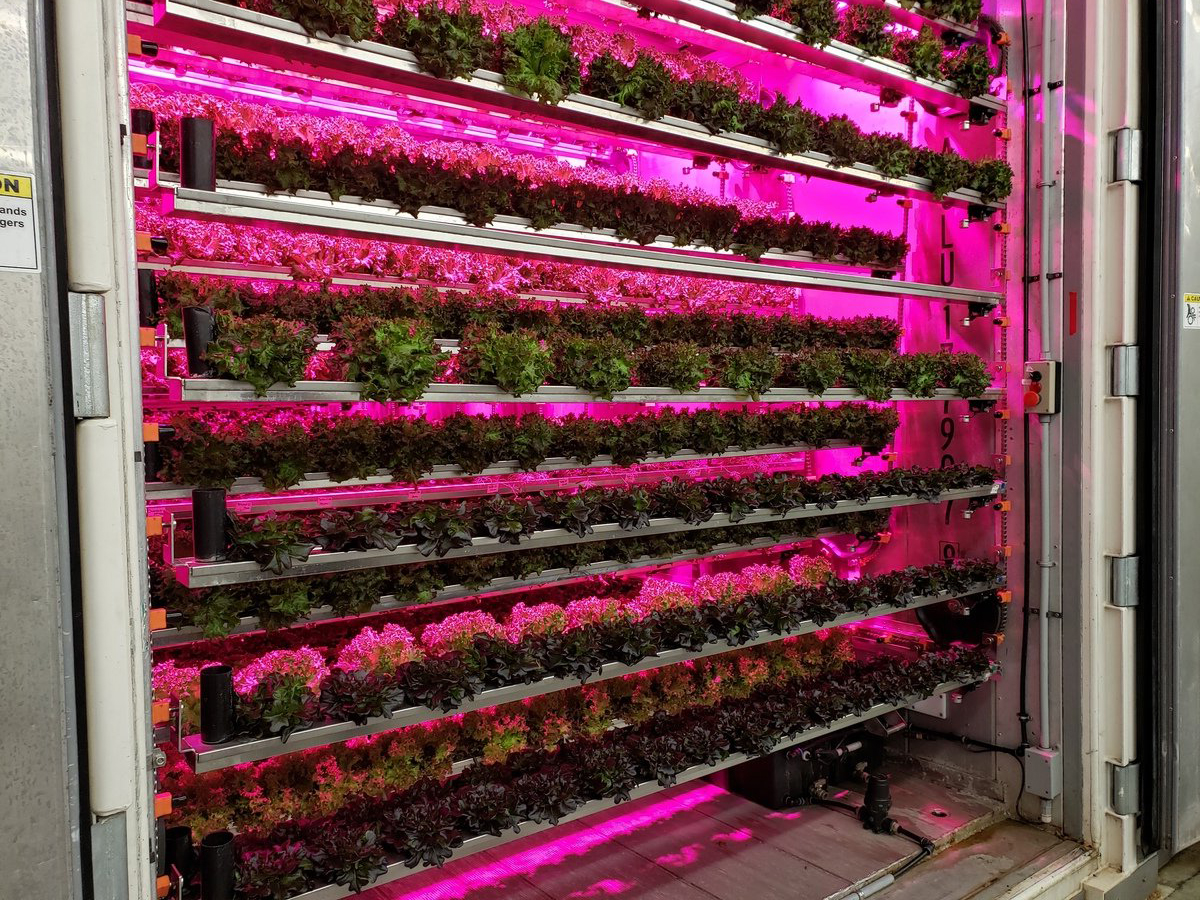
Although B.C. has been somewhat of a pioneer in indoor growth systems, primarily in greenhouses on agricultural land, CubicFarms has a different approach. Essentially it grows items in custom-built shipping container units. A small cluster of a dozen or so containers, along with a preparation and harvesting area might occupy an acre or so.
Such a container cluster does not need to sit on agricultural land because soil doesn’t come into play. CubicFarms says its system is such that a one-acre operation is equivalent in terms of output to a hundred-acre traditional farming operation for the growing of vegetables.
Nor does such a cluster need to sit on flood plain land that, as we have seen recently, can be prone to environmental devastation and lead to supply chain issues.
It is early days for high-density local or short chain ag-tech farming, be it for food or for animal feed. CubicFarms demonstrated both aspects at its October event. It first showcased a demonstration container cluster in Pitt Meadows that is already producing specialty lettuce varieties for local grocery outlets.
In the CubicFarms approach, the products are grown on a conveyor belt system that moves both vertically and horizontally through the custom containers, which are insulated for very tight temperature control. Plants are grown from seed through to harvest inside these containers, where they are fed liquid food under strictly controlled temperature and light conditions.
One container is dedicated to storing the control systems, and the nutrients that are mixed into the water delivered to the growing containers, each plant getting just the amount of water it needs.
A second case, which CubicFarms bills as Hydrogreen, was showcased at a dairy operation in Abbotsford that produces high-quality green matter which is dried and mixed in with hay as part of the regular feed for a large dairy herd. The feed, basically sprouted wheat and barley, is produced in a mechanized, automated manner and is ready for harvest in just six days, the system running continuously.
Well-known Canadian astronaut Chris Hadfield, an adviser to CubicFarms, was part of the presentation. He referred to his childhood growing up on a farm and made passionate references to the need for change in how agriculture works. He related the CubicFarms technology to the confines of the International Space Station, of which he was a commander.
Hadfield made specific reference to how climate change requires the basic tenets of agriculture to be revisited and to have a focus on local production and consumption. His view is that the work CubicFarms is doing is helping push agriculture in a direction it needs to go.
Harkening back to his time in childhood working on the family farm, and the improvements from mechanization then, Hadfield referred to the CubicFarms systems approach of low-impact, high-quality food production as Tractor 2.0. In particular he noted how this high-density vertical automated farming could be used anywhere in the world.
Whether or not the CubicFarms approach to local or short chain agricultural technology can be easily replicated and scaled remains to be seen. Potential adopters, as well as investors, will want to check out some of the claims made, for instance, those made about water usage and nutrient content.
As for buzz phrases such as “to save the planet we must grow where we live,” well, it is difficult to say that this sort of vertical farming is the only way to accomplish that somewhat lofty, and laudable, goal.
For now, this is a very interesting and novel technology that is producing specialty vegetables, mainly high-end lettuce and, separately, feed supplement for cattle, both dairy and ranching.
We can expect to see more innovation and developments in this sector over the next several years.
Follow me on Facebook (facebook.com/PeterVogelCA), on Twitter (@PeterVogel).
pvogel@outlook.com







