

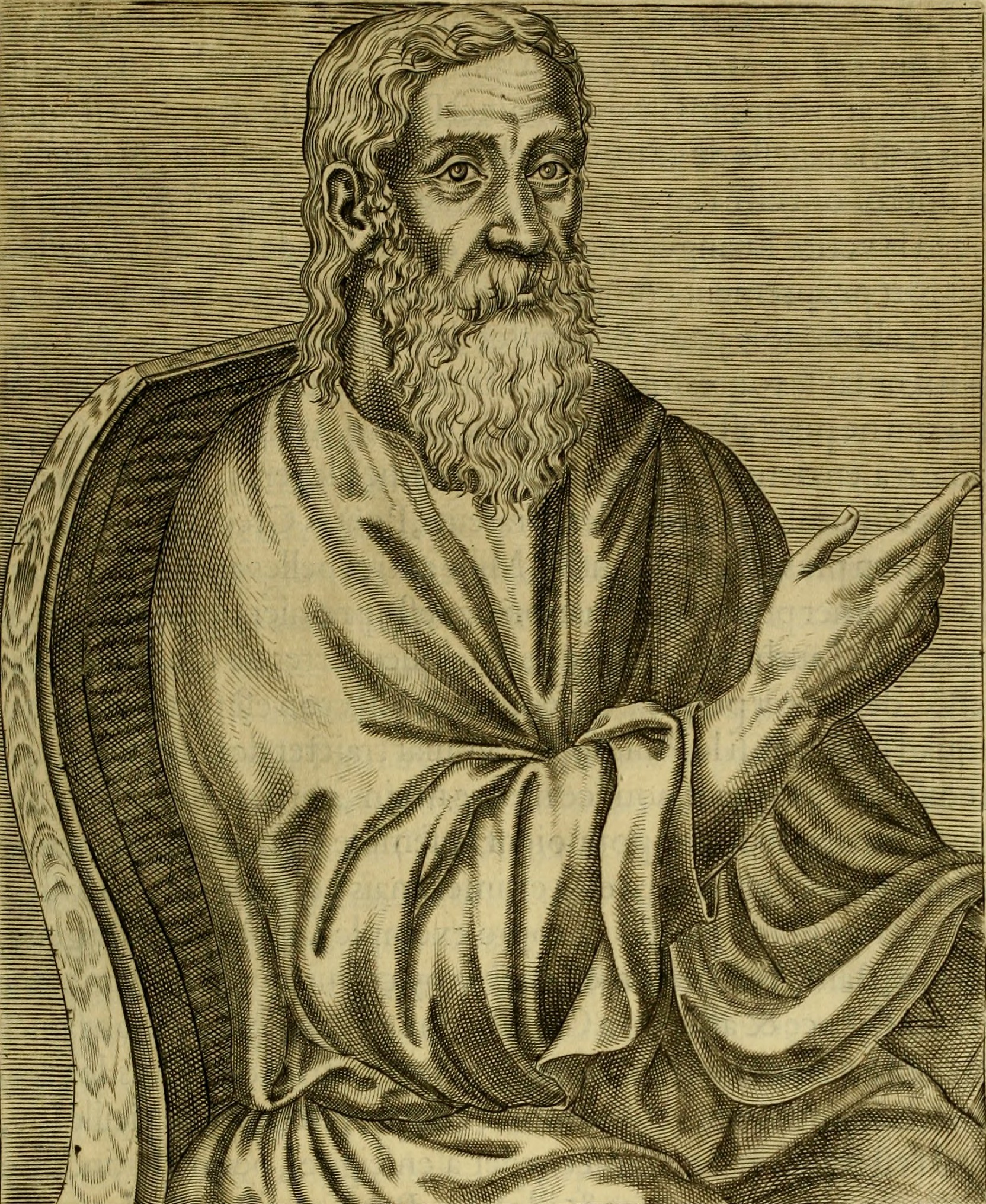

Clement of Alexandria was probably born in Athens at around the middle of the second century. He arrived Alexandria as a young man.
Pope Benedict XVI said, “[Clement] was a disciple of Pantaenus until he succeeded him as head of the catechetical school. Many sources testify that he was ordained a priest. During the persecution of 202–203, he fled from Alexandria, seeking refuge in Caesarea, Cappadocia, where he died in about 215.”
Clement was the first Christian to attempt a thoroughgoing synthesis of the Bible and Greek philosophy. St. John Paul II wrote in his Encyclical Fides et Ratio: “Clement of Alexandria called the Gospel ‘the true philosophy,’ and he understood philosophy, like the Mosaic Law, as instruction which prepared for Christian faith and paved the way for the Gospel…. For Clement, Greek philosophy is not meant in the first place to bolster and complete Christian truth. Its task is rather the defence of the faith”.
Clement is known primarily for his three important works: Protrepticus (Exhortation), Paedagogus (The Tutor), and Stromateis (Miscellanies). Benedict XVI said, “Although it does not seem that this was the author’s original intention, it is a fact that these writings constitute a true trilogy, destined to effectively accompany the Christian’s spiritual growth.”
Protrepticus (Exhortation) presents the Christian faith in contrast with paganism. It is an invitation directed at educated Greeks to the Christian faith. Benedict XVI said, “The Protrepticus, as the word itself suggests, is an ‘exhortation’ addressed to those who are starting out and seek the path of faith.” Clement taught that God would not allow idolatry to pass unpunished. Clement pleaded to the heathen to give up their idolatry, and not to despise the chastening of the Lord.
Paedagogus (The Tutor) is a moral treatise on the elementary stages of the Christian life. It encourages Christians in the disciplined pursuit of holiness. Benedict XVI said, “Jesus Christ himself becomes the Paedagogus, that is, the “tutor” of those who, by virtue of Baptism, have henceforth become children of God.”
Clement wrote, “The all-loving Word, anxious to perfect us in a way that leads to salvation by progressive degrees, makes effective use of an order excellently adapted to our education: first He persuades us, then He educates, and, after all this, He teaches.” Clement explained that the Word of God loved all people; all who seek the truth are children in God’s eyes. He also wrote about detachment from riches, cultivation of true beauty, discipline in food, drink, talk and sleep.
Stromateis (Miscellanies) is a work in eight books which discusses various theological and moral topics. Benedict XVI said, “Lastly, Jesus Christ himself is also the Didascalos, the ‘Master’ who presents the most profound teachings. These are gathered in Clement’s third work, the Stromata, a Greek term which means “tapestries”: indeed, they are a random composition of different topics, direct fruits of Clement’s customary teaching.”
Benedict XVI pointed out: “On the path to perfection, Clement thus attaches as much importance to the moral requisite as he gives to the intellectual. The two go hand in hand, for it is impossible to know without living and impossible to live without knowing.”
Benedict XVI concluded the General Audience on Clement of Alexandria by reciting the “prayer to Christ the Logos” at the conclusion of Paedagogus: “Be gracious … to us your children … Grant us that we may live in your peace, be transferred to your city, sail over the billows of sin without capsizing, be gently wafted by your Holy Spirit, by ineffable Wisdom, by night and day to the perfect day … giving thanks and praise to the one Father … to the Son, Instructor and Teacher, with the Holy Spirit. Amen!”
克勒孟以哲學維護信德
亞力山大德里的克勒孟,在第二世紀,可能出生於雅典;年輕時遷居到了亞力山大德里。
教宗本篤十六世談及克勒孟說:「他是潘泰尼的門生,後來繼承他為要理學院的主監;多方面證實他被祝聖為了司鐸。公元202年至203年的宗教逼害時,他從亞力山大德里逃難到凱撒肋雅;大約公元215年,死在卡帕多西亞。」
克勒孟是首位基督徒,嘗試徹底融匯聖經和希臘哲學。教宗聖若望保祿二世在有關信德和理智的通諭中寫道:「亞力山大德里的克勒孟稱福音為『真正的哲學』。他懂得哲學就像梅瑟法律那樣,為準備基督信仰作指導,為福音舖上坦途 …。克勒孟認為希臘哲學,並非首先是加強及滿全基督信仰,而是維護基督信仰。」
克勒孟有三本重要箸作:「宣道」、「訓道」和「多項」。教宗本篤十六世說:「也許並不是作者的原意,但這三部箸作,有效地成了伴隨著基督徒增長靈修的三步曲。」
「宣道」一書,用基督信仰對抗異教,把基督信仰傳遞給希臘人。教宗本篤十六世說:「『宣道』一書,正如它的題目一樣,向那些開始尋找信仰道路的人講道。」克勒孟教導:天主不會對膜拜偶像視若無睹;他敦促異教徒放棄偶像,不要忽略天主的責備。
「訓道」是針對基督徒初步的道德生活寫成的,鼓勵基督徒矢志成聖。教宗本篤十六世說:「耶穌基督本身就是訓導者,受洗者會成為天主的兒女。」克勒孟說:「至愛的聖言,切望把我們領入救恩,恰到好處地、有序地教化我們,使我們逐步滿全成聖。祂先敦促我們、然後教育我們,最後是教化我們。」克勒孟解釋,天主聖言愛所有的人,任何有意尋找真理的人,在天主眼中都是孩童;克勒孟亦談到棄絕俗世的財富、培養真正的美善,和要在飲食休談上要有節制。
「多項」一書共八冊,細談不同的神學及道德領域。教宗本篤十六世說道:「最後,耶穌基督是深層教導的宗主。這些都收集於克勒孟的第三部箸作… 它們是由不同的主題所組成的,是克勒孟慣常的教導的果實」。
教宗本篤十六世指出:在成聖之路上, 克勒孟對倫理和學識同樣重視。兩者是相扶相持,認識不能沒有生活,生活亦不能沒有認識。」
在接見信眾談及亞力山大德里的克勒孟時,教宗本篤十六世以「向基督聖言誦禱經文」作結論:「請親切對待我們—-祢的兒女 … 賞賜我們在祢的平安內過活,把我們移居到祢的聖城,翻過罪惡的洶淘,不致傾覆;以祢聖神和不可言喻的智慧日以繼夜使我們柔揚,直至滿全的一天 … 我們感謝讚美唯一的聖父、聖子 ── 導師、及聖神。亞孟。」







