

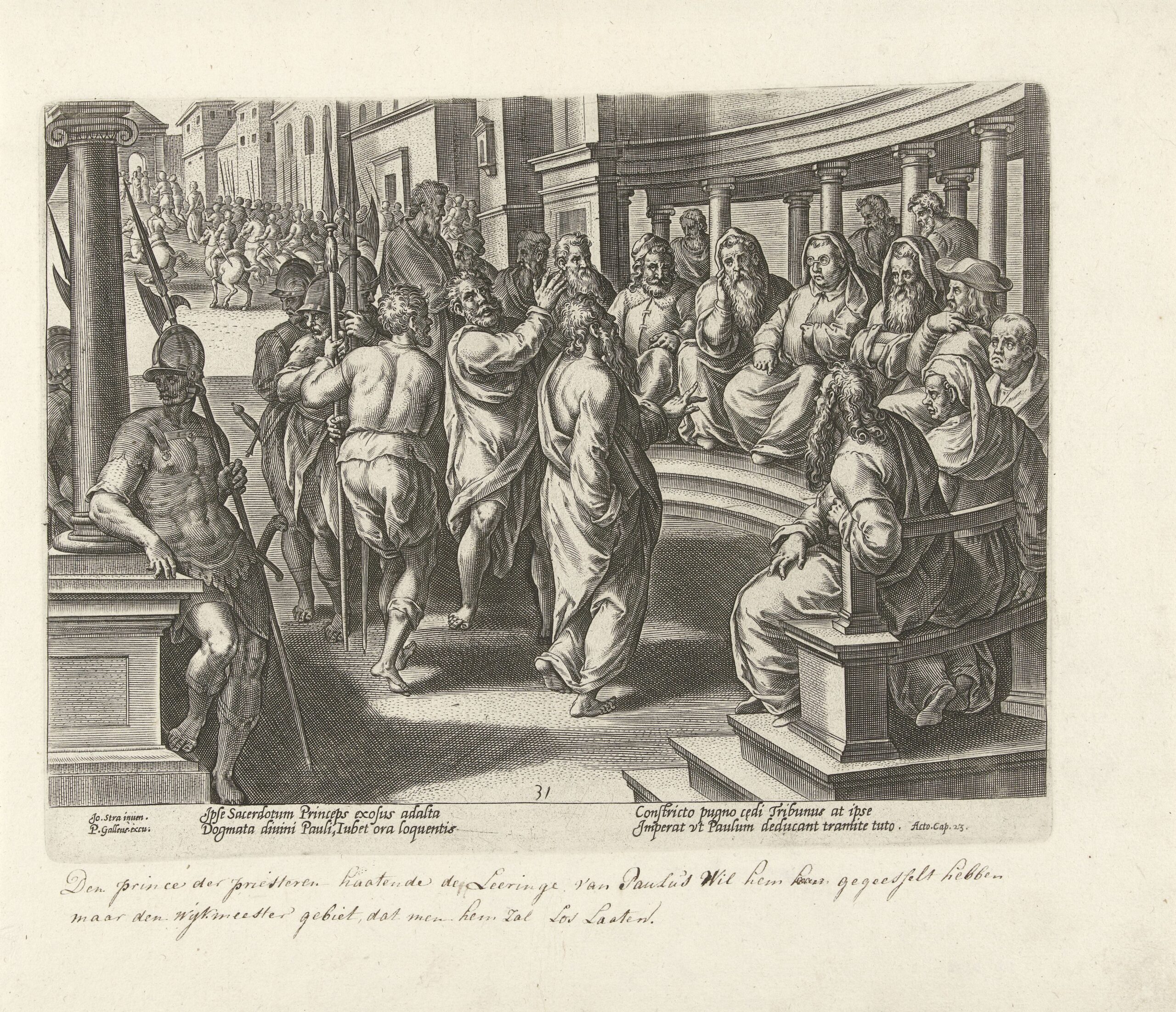

In Acts chapter 23, Paul stands trial before the Sanhedrin. But no scheme, however devised, can obstruct God’s plan for his witness. God had a plan for Paul, and what had to happen would happen. Paul was destined to go to Rome to bear witness for God, and he declared, sincerely and simply, that he had always lived with a clear conscience. This, in fact, is a recurring theme in Paul’s letters — that he consistently served God and did God’s work with this same integrity of conscience.
At one point, the high priest ordered someone to strike Paul on the mouth, and Paul responded that God would strike this high priest. Paul did not know at the time that the man was the high priest, but some saints have seen this as prophetic, since what he foretold did in fact come to pass — in AD 66, this same high priest was assassinated, seemingly fulfilling Paul’s words. When someone objected that he should not speak that way about the high priest, Paul humbly admitted his fault, revealing his humility of heart.
Later, Paul made a statement that struck at the heart of the matter. During this trial, he declared himself a Pharisee, the son of a Pharisee, on trial precisely because of his hope in the resurrection of the dead. At this, the assembly split: the Sadducees deny the resurrection, deny angels, and do not believe in spirits, while the Pharisees affirm all these. The scribes then said they could find no fault in Paul — perhaps, they said, a spirit or an angel really had spoken to him.
They reasoned that if it could be said an angel had spoken to Paul, then by that same logic, the risen Lord himself could have spoken to Paul — yet they refused to accept that Paul was an apostle sent by direct revelation from God. This shows that their accusations against Paul truly sprang from malice, unlike Paul, who acted in complete sincerity.
That night, the Lord himself came to encourage Paul, telling him to be courageous and not to be afraid — for just as he had testified for the Lord in Jerusalem, he must also testify for him in Rome. It was precisely in the midst of this hardship that God came to console him, and Paul drew strength from God to face every trial.
At that time, more than forty men bound themselves by an oath to neither eat nor drink until they had killed Paul. Such a plan was utterly unreasonable, yet it also brought out something very human — when Paul’s own relative heard of the plot, he went to help him, enabling him to escape the conspiracy. Though Paul had received revelation from God assuring him of special divine help, he still made use of practical, human means to resolve the problem. God’s providence does not replace the prudence we as human beings ought to exercise; God works together with us, and we too must work together with God — entrusting our efforts to God while also relying on his care. In the end, Paul was indeed rescued.
Afterward, the Gentile magistrate declared that Paul had committed no crime deserving death or imprisonment. Just as the Gentile governor once found the Lord Jesus Christ innocent, so too did this Gentile magistrate now find Paul innocent. Paul made full use of every lawful means available to protect his apostolic mission. This reminds us that, as Catholics, we too must often make use of our rightful political and legal rights in society — to defend our own religious freedom, and also to defend the religious freedom of those believers who may not be able to defend themselves.
So the example Paul the Apostle leaves us is twofold: on the one hand, to bear witness courageously; on the other, to make prudent use of legal and human means to safeguard the mission God has entrusted to us, and to safeguard religious freedom.







