

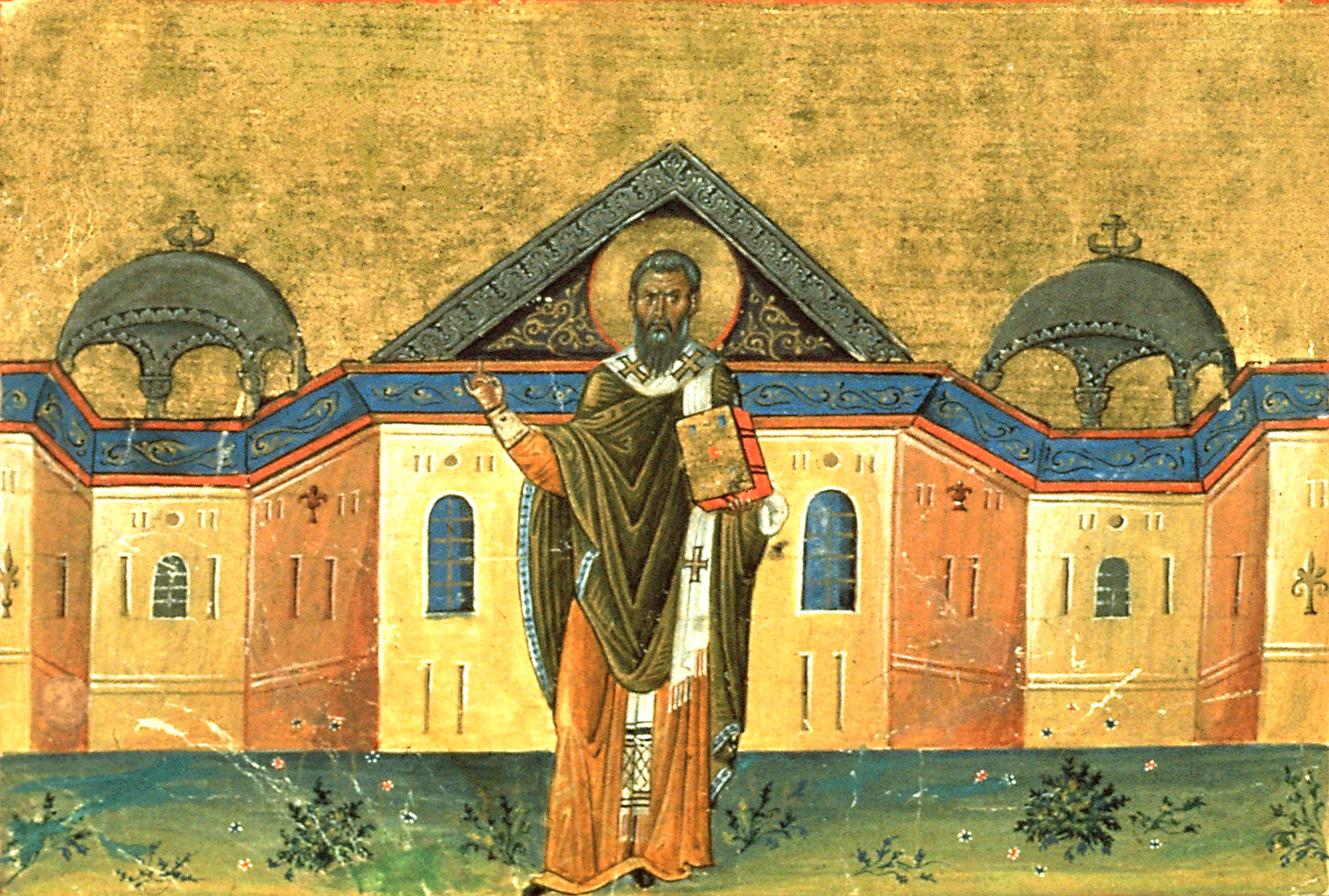

St. Gregory of Nyssa (ca. 330-395) was raised by his elder brother St. Basil and his sister St. Macrina. He called Basil his “father and master.”
Gregory became a rhetorician and was married to Theosebeia. He was persuaded by St. Gregory of Nazianzus to renounce the world and to embrace the ascetic life and later was made bishop of Nyssa by his brother Basil.
Gregory of Nyssa was a philosopher and a great mystic. He was one of the most philosophic Greek Fathers and contributed heavily to spiritual theology. Gregory was heavily influenced by Origen, whose allegorical interpretations of Holy Scripture he largely adopted.
In his Lives of the Saints, Father Augustine Kalberer wrote, “[Gregory’s] many writings belong almost entirely to the period of maturity after Basil’s death. He was considered the leading theologian at the First Council of Constantinople.”
Gregory was regarded as “the common mainstay of the Church,” and to be on Gregory’s side was considered proof of orthodoxy.
The book Ascetical Works: Gregory of Nyssa, points out: “Of the three Cappadocian Fathers of the Church – St. Basil, St. Gregory of Nazianzus, and St. Gregory of Nyssa – the last is the least well-known and until recently the most neglected. His brother, St. Basil, called the Great, is famous as the founder of monasticism in the East and as a forceful opponent of the Arian heresy. Their close friend, St. Gregory of Nazianzus, is renowned for the glory of his eloquence and the sweetness of his poetry. And yet at the Ecumenical Council of 787, St. Gregory of Nyssa was given the title ‘Father of the Fathers.’ Modern writers agree that ‘he surpassed the other Cappadocians as a philosopher and theologian,’ that he was ‘more learned and profound’ than the others, that he was ‘possibly the most versatile theologian of the century,’ and that ‘as a speculative theologian and mystic he is certainly the most gifted of the three.’” (V.W. Callahan, Gregory of Nyssa Ascetical Works, Introduction)
Pope Benedict XVI said, “Gregory expressed clearly the purpose of his studies, the supreme goal to which all his work as a theologian was directed: not to engage his life in vain things but to find the light that would enable him to discern what is truly worthwhile.”
Gregory was a mystic who wrote ascetical treatises. Scholars pointed out that Gregory might have written his four outstanding ascetical treatises from about 371 to 391. The first treatise was On Virginity. Gregory stressed the unity of the virtues and defined virtue as the perfection of human nature. The second treatise was On What It Means to Call Oneself a Christian. The third treatise, On Perfection, was the continuation of the second. In these treatises, Gregory explore the nature of true Christian. In the second treatise Gregory emphasized that it is necessary for a person who calls himself a Christian to reflect in his life the nature of Christ. He defined Christianity as “an imitation of the divine nature.”
In the treatise On Perfection, Gregory gave a detailed analysis of some 30 references to Christ in the writings of St. Paul, exploring Christological themes such as Christ the Redeemer, Christ the paschal victim, Christ as propitiation, and Christ as the corner stone.
Scholars believe On the Christian Mode of Life may be the last work of Gregory. This treatise was a response to a request from a group of monks who wanted a written guide to the ascetic life.
Ascetical Works says that in this treatise, Gregory stressed “the importance of Baptism as a source of grace, and on prayer as the confirmation of grace in the Holy Spirit.” Gregory also singled out the virtues of humility and charity, and gave practical advice on community life. Gregory pointed out that prayer and fasting are of no use unless the gifts of the Spirit follow along with them.
卡帕多西亞的潛修者寫下規條
聖國瑞.尼散(公元330-395年)是在他的哥哥、聖巴西略及姊姊聖瑪頡娜培育長大;他稱兄長巴西略為「父親兼師尊」。國瑞長大後娶妻,成為一位修辭學者。後來,聖國瑞.納祥勸他棄俗修行。不久,他從兄長巴西略手中,領受牧職,成了尼散的地方主教。
國瑞.尼散成了一位哲學家及修行者,更是一位希臘教父,最能把哲學融入靈修神學中。他深受奧利昂影響,以寓言體去演譯聖經。
思定.卡伯勒神父在他的「聖人行實」一書,形容「國瑞的著作,承接著巴西略去世後的成熟期。在君士坦丁第一次大公會議時,他是首屈一指的神學家。」
國瑞.尼散被認為是教會的中流砥柱在那個時期;國瑞被標誌是正統教會的佐證。
「國瑞.尼散的神修著作」一書的序言指出:「三位卡帕多西亞的教會教父中:聖巴西略、聖國瑞.納祥,和聖國瑞.尼散,聖國瑞.尼散是最不為人所知的和直到近代是最被遺忘的。他的哥哥聖大巴西略,因創建東方潛修、及對抗亞略異端而聞名。他們的好友、聖國瑞.納祥,因他雄偉的口才和優美的詩詞,而著名的。不過,787年的大公會議,國瑞.尼散被冠以『教父中的教父』尊號。現代作者均同意『他在神、哲學超越了所有卡帕多西亞教父』;他又被認為比其他卡帕多西亞教父『更有學問和更高深』,甚至他是『當世紀中最多才多藝的神學家』,而且『作為推想的神學家和神修家,他是三位教父之冠』」。
教宗本篤十六世說:「國瑞清楚說明他學習的目的,他作為神學家工作的最終目標: 不是讓他的生活投入於虛榮的事,但要尋求真光讓他辨認真正價值之所在。」
國瑞作為神修家,寫下靈修的著作。學者估計,國瑞在371年至391年,寫下他那四個傑出的靈修著作。第一個著作是關於「貞潔」:國瑞強調各種德行的聯系,確認德行滿全人性。第二個著作是關於「堪為基督徒」:自詡為基督徒的人,必須以他的生活,反映出基督的本性。第三個著作是緊隨第二著作,是關於「成全」。國瑞指出基督徒精神在於效法天主性。
國瑞在他關於「成全」的著作中詳細分析聖保祿書信內有關三十點對基督的教導。國瑞探討「基督學」的主題,例如:救主基督、基督為巴斯卦祭品、基督作贖罪祭,及基督為基石。
學者推測「基督徒生活偕模」是國瑞最後的著作。此著作是應一群隱修者的要求,寫下靈修生活的指引。有作者指出,國瑞強調「聖洗聖事作為聖寵之源的重要性,祈禱是確實了聖神內的聖寵。」國瑞著重謙遜和貞潔的德行,並因應團體生活提出實質的建議;他又指出祈禱與齋戒必須有聖神之恩伴著才能有用。







