


It is a sad reality that, even in these days of earnest, if not always successful, attempts at international cooperation, from time to time a country is subjected, by internal conflict, to the horror of extreme political suppression, resulting in the deaths of thousands of law-abiding citizens.
While we are all somewhat familiar with the Holocaust, the Chinese Cultural Revolution, and the tragedy of Rwanda, many of us live in almost complete ignorance of other examples of so-called “ethnic cleansing.” And, apart from having seen the movie The Killing Fields, many of us, including myself, are largely unaware of the details of the horrors inflicted on the people of Cambodia.
We may know that the Communist regime, under the heinous leadership of Pol Pot, attempted to establish a dictatorship. That ruthless campaign resulted in the deaths of hundreds of thousands of Cambodians, the pitting of friend against friend, and a series of horrors the extent of which will never be fully known.
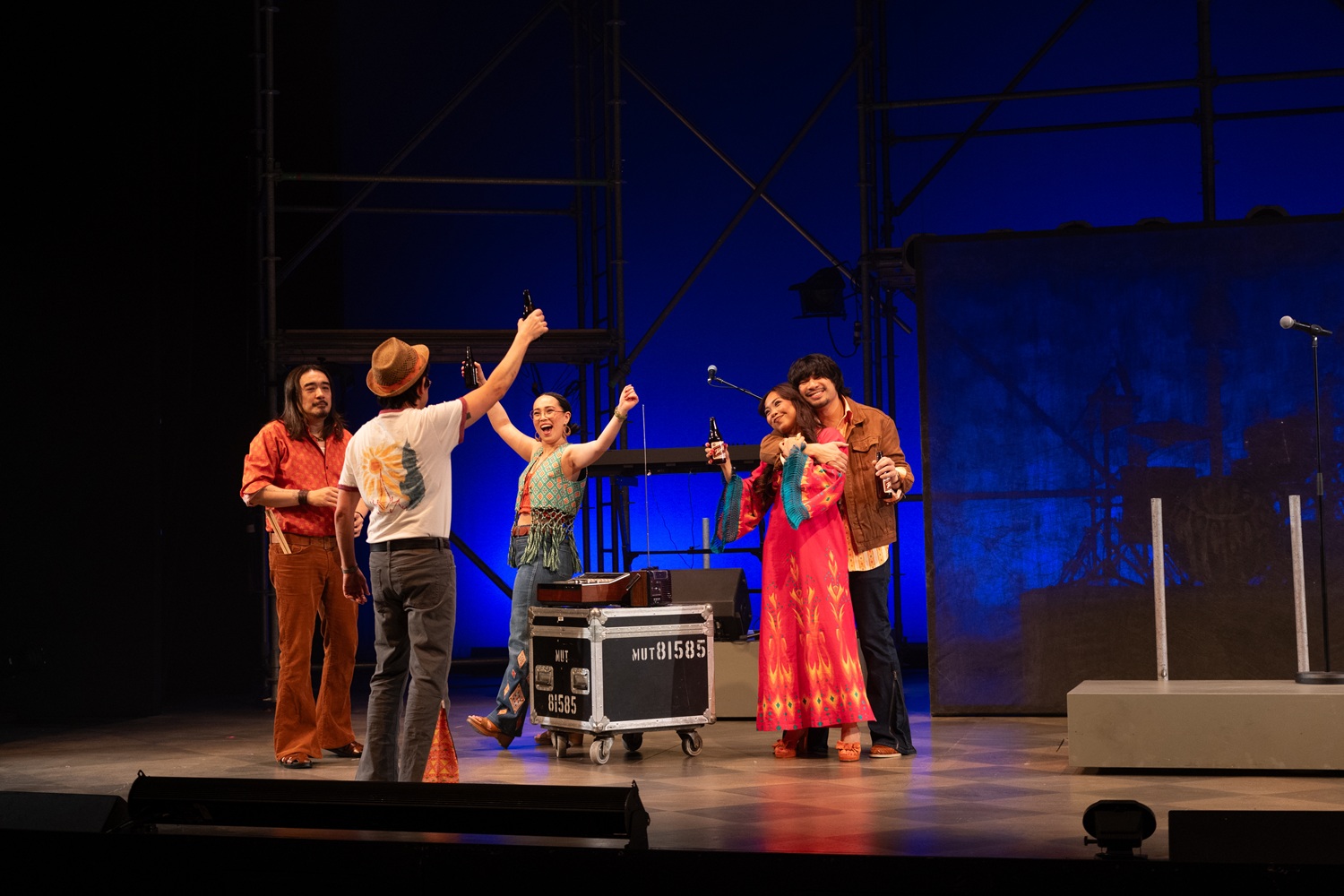
It is against the backdrop of this tragedy that the current Arts Club production of Cambodian Rock Band is set. Let it be clear immediately that the Arts Club deserves applause for undertaking a production that is at once a testimony to the spirit of the Cambodian people, a grim reminder of historical tragedy, artistically demanding, emotionally draining, and yet, oddly, entertaining at the same time.
The latter element is made possible by having the drama set against the backdrop of the rock music that forms an integral part of the work.
In essence, the rock music becomes a symbol of the enduring spirit of the Cambodian people who, despite the terrors through which they have passed, somehow manage to find the will and determination to re-establish a nation that somehow thrives. This determination to rebuild is paramount, despite the memory of the conflict through which the nation has suffered.
That conflict and the attempt to resolve its aftermath are illustrated by focusing on one family, the father of which, after many years away, wishes to re-establish ties with his daughter, who, like her father had been, is a member of a rock band. By learning the father’s history and by witnessing the daughter’s attempts at bringing past terrorists to justice, the audience gains some understanding of the Cambodian tragedy and its ongoing burden.
The result of all this is a play that is rather awkward in its structure. The first half is a series of interactions between a small group of characters. The conflicts in which they engage are a reflection of the complexities of a people attempting to resolve the issues that remain as they grapple with the guilt, the betrayals, and the tragedies they have experienced and inherited.
The second half, far more dramatically straightforward, shows how those people remember with burdensome clarity the horrors that were the ruthless reality of the failed attempt to establish a permanent Communist dictatorship.
Throughout, there are energetic, well-executed performances of rock music—music that reflects the link between past and present, the undying self-assertion of the true Cambodians.
It is a complicated evening of theatre. Of necessity, there are a number of challenging aspects to the production—performative, technological, and dramatic. First and foremost, the six-member cast manages to bring alive the complexities of the entire piece as the evening is punctuated by song after song and the dramatic interactions are played out. Even if one is not a fan of rock music, one will enjoy the skill and artistic effectiveness this brings to the work.
At the same time, the production team manages to present a flawless, technically challenging work that involves leaps back and forth in time and from place to place. With the aid of a skillful stage manager, sliding screens, multiple projections, a complex lighting plot, and a challenging soundscape, Cambodian Rock Band becomes a mesmerizing piece of theatre that serves as a timely reminder to the free world of the need to come to the assistance of countries subjected to the tyranny of power-hungry and ruthless dictatorships.
Even if one is not a fan of rock music, any theatre-goer will applaud the courageous Arts Club for such a daring undertaking—one in which the company has triumphed yet again. What a vibrant blessing the Arts Club is in Vancouver’s cultural life!
Your voice matters! Join the conversation by submitting a Letter to the Editor here.







