

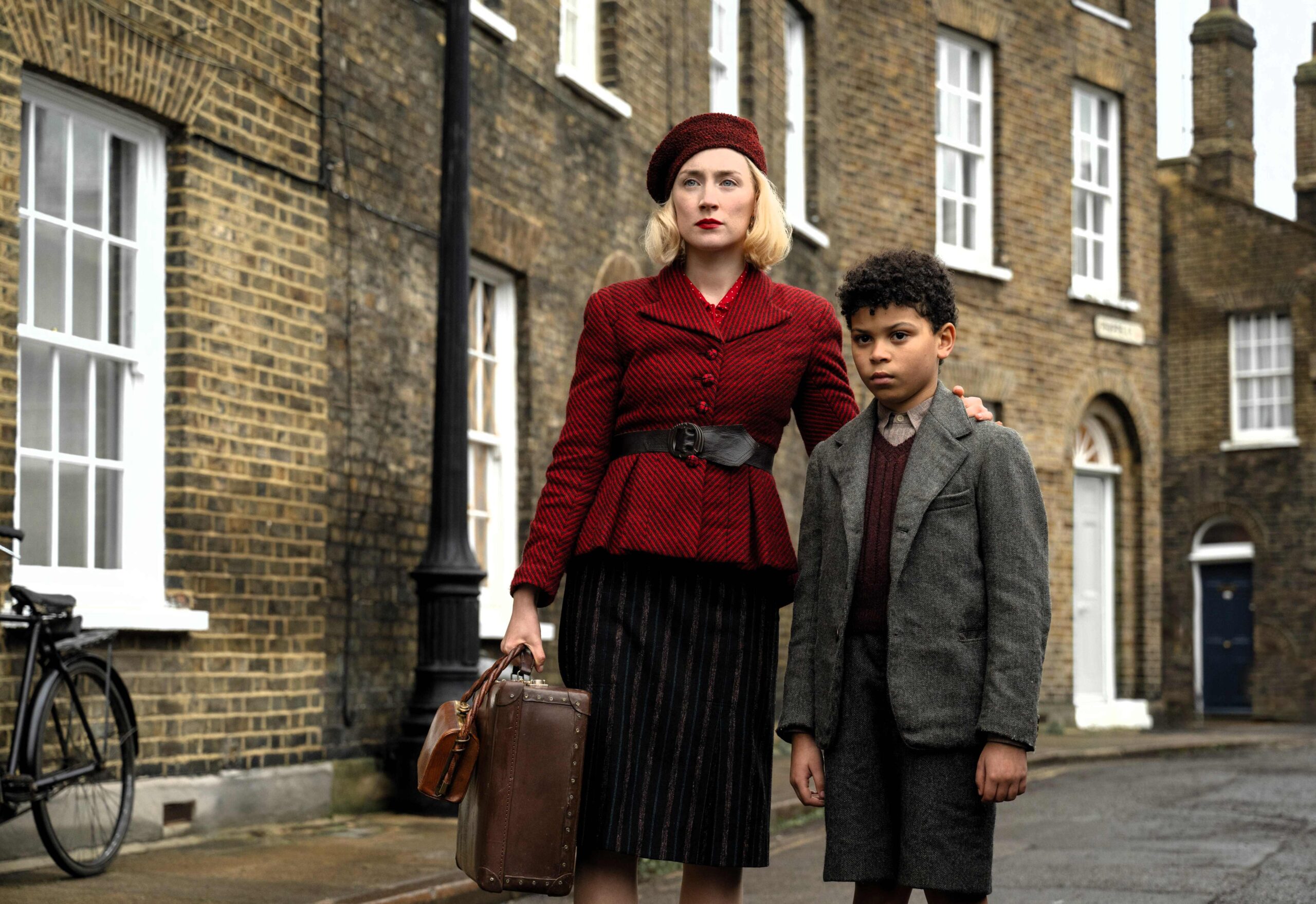

As daily, we hear reports of ongoing wars in various places around the world, it would seem that a movie entitled Blitz might have some relevance – if nothing else, to make us more aware of what the victims are enduring. However, to a large extent, director Steve McQueen’s movie avoids what many might consider essential in a film set during World War II, when the citizens of London and other cities endured devastating destruction by Nazi bombers.
The film begins by introducing Rita (Saoirse Ronan) and her mixed-race son, Ife (Benjamin Richardson), facing the horrors of the Blitz. Determined to protect her son, Rita decides (as did many other parents) to have him evacuated to a safer region of the country. This becomes the main thrust of the narrative, but instead of showing what happened to evacuees – many of whom found safe harbour with strangers, while others were tragically abused – McQueen tells the story of Ife jumping off the train before reaching his destination and trying to find his way back to his mother. The result is that the Blitz is reduced to a background setting, rather than being a portrayal of the terrible tragedy it was. Indeed, the movie seemed to retell a film I remember seeing during World War II – Lassie Come Home – with a boy, rather than a dog, as protagonist.
The narrative is a series of vignettes as Ife encounters various characters on his journey, including a gang of thieves in a scene reminiscent of Oliver Twist and a kindly Black Air Raid officer. Strangely, this latter moment becomes an opportunity for Ife to embrace his racial identity, though there had been no previous indication that this was a concern for him.
While all of this is diverting enough, the film repeatedly reminds viewers of aspects of the Blitz that might have been of greater significance and interest. Rita, an unmarried white woman with a Black son, would surely have encountered moral disapproval and racist attacks, yet she, her son, and her father are portrayed as living an idyllic, trouble-free life. There is some portrayal of Londoners coping with the horrors of air raids, but this is relegated to narrative background.
As someone whose childhood was spent during the war, though mercifully away from the worst horrors, I found the film accurate in parts of its depiction of daily life in wartime Britain – the drab clothing; women, unable to get stockings, drawing lines down the backs of their legs; officious Air Raid Precaution officers enforcing blackout rules; nights and days spent in air raid shelters while bombs fell; and lunchtime entertainment broadcasts from factories to boost spirits. However, where were depictions of food and clothing rationing; the constant queuing (often without knowing what the queue was for); the gas masks carried everywhere; the unrelenting listening to the radio; the intense focus on Winston Churchill as he brilliantly led the war effort; and, above all, the camaraderie and black humour that sustained people’s spirits? Surely one has a right to expect these elements in a film set in Britain in 1940.
Writer-director Steve McQueen, lauded for 12 Years a Slave, has chosen to offer an incident-filled narrative with the Blitz as a backdrop. Of course, an artist has the right to tackle any subject, but it is disappointing that such a huge and tragic event as the Blitz of 1940 is reduced to mere background scenery. Blitz might instead have been a significant and timely account of the dreadful toll modern war takes on the innocent. While Blitz is entertaining, it is, above all, a tale of missed opportunity.
Your voice matters! Join the conversation by submitting a Letter to the Editor here.







