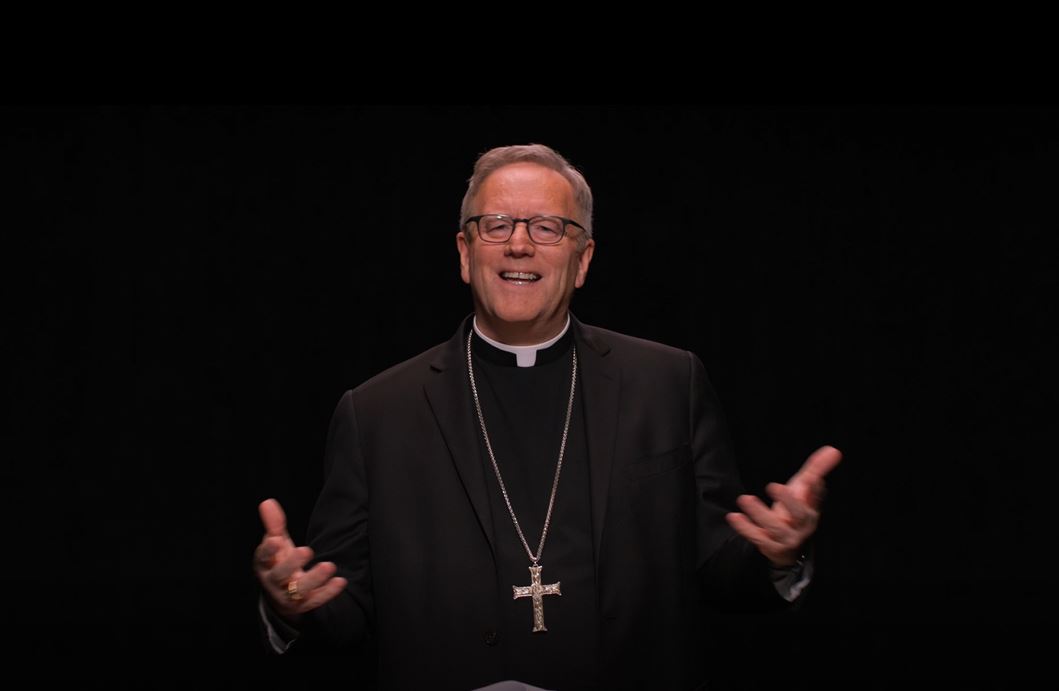

More than 1,600 participants logged on to the first virtual Catholic Educators’ Conference by the Catholic Independent Schools of the Vancouver Archdiocese Feb. 11. One of the keynote speakers was Los Angeles Auxiliary Bishop Robert Barron, whose presentation is excerpted here.
In the beginning of the life of the Church, there were no parishes, schools, hospitals, chanceries, or Vatican, but there were evangelists.
I want to look at what I still take to be the number one concern of everybody at every level of the Church’s life, very much including religious educators, and I’m talking about evangelization. I’m talking about this crisis of evangelization that I think we all have to respond to in our own way.
To get at this I wonder if I might take you back to June of 2014 and Presbyteral Day in the Archdiocese of Chicago. That’s where I’m from originally. At that point I was a priest of Chicago, I was rector of the seminary at Mundelein [in Illinois] and it was Cardinal George’s last opportunity to speak at Presbyteral Day. He was actually in the waning months of his own life, but we didn’t clearly see that. He died just about a year after that talk.
Cardinal George gathered with 600-700 Chicago priests. He talked about his many years as a priest and bishop, a review of his life. He then went into the institutional issues we were facing on our parish levels, our schools, our finances, etc. But then he said something that I consider truly prophetic.
Speaking to all the priests of Chicago, he said, “Brothers, remember something. At the beginning of the church’s life, there were no Catholic parishes. There were no Catholic schools. There were no Catholic hospitals. There were no chancery offices. There was no USCCB. There was no Vatican. There was no institutional structure in the earliest days. However,” he said, “there were evangelists.”
I think it was a prophetic remark and not because the Cardinal was somehow denigrating parish life or saying that our institutions aren’t important or we shouldn’t worry about them. He, in fact, had just told us how worried he was about them. I think what he was doing was this: he was reminding us of the priority.
What has been true up and down in the life of the Church from the beginning to today? What is the one thing that is absolutely essential? It’s not the institutional structures, as good and effective as they might be. They are not the most basic thing. The most basic thing is evangelization.
Go back to the church of Peter and Paul and James and John and Mary Magdalene and all those hundreds and thousands of others whose names have been lost to history who proclaimed Jesus risen from the dead. They are the reason why there is a church at all.
What’s our priority? I’ll use the cliché at this point: are we into maintenance or mission?
We always have to worry about maintaining our institutions. But if the maintenance of our institutions takes priority of the mission of evangelizing, something’s gone wrong. There weren’t any of those things in the beginning, but there were always evangelists. To this day, there must be evangelists.
I would say, given this crisis of disaffiliation we’re going through, especially with the young, this must be the priority at every level of the church’s life. Who comes to mind here of course is Pope Francis, who from the very beginning of his papacy has insisted on a church that goes out from itself. When a church is turned inward, it becomes sclerotic and sick. The church is meant to go out in evangelizing spirit.
Look at the word evangelization, from the Greek euangelion. “Good news.”
Can we distill from the great religions and religious philosophies of the world, a sort of generic spirituality? Yeah I think so. If you look at Hinduism and Buddhism and Judaism and Islam and Christianity and the great religious poets and mystics, can you distill from that a general spiritual perspective. Watch anything from the New Age. There is a generic spirituality that we can talk about.
But that’s not evangelization, because evangelization has to do with good news. Something happened and these first Christians wanted to tell the whole world about it. Something new broke through, which we couldn’t learn on our own. We couldn’t come up with in our own poetic and spiritual musings. God has done something that has turned the whole world upside down. That’s good news.
The best way to undermine all this is to turn resurrection into vague myth or symbol or literary device. When you do that, you undercut evangelization. You say, “oh it’s a nice myth or metaphor from the ancient world.” Who cares? Any poet can come up with that. That has no earth-shaking significance. They wouldn’t go careering around their world to announce a poetic metaphor.
Look at the New Testament now with this in mind. When we evangelize, we should bring that same energy and enthusiasm about the resurrection of Jesus.
In the presence of Jesus we can’t have a bland “live and let live” attitude. As he himself said, “you’re either with me or you’re against me.” You see how he compels a choice the way no other founder does?
Evangelization is not sharing information about Jesus. I think that’s an important thing, don’t get me wrong, but that’s theology or apologetics. Evangelization is sharing a relationship, sharing a friendship, and you say: “this friendship I have with Jesus the Lord is the most important friendship I have, and I want to share it with you.”
If you don’t have a living relationship with Jesus the Lord, you don’t make him central to your life, you can’t share that relationship effectively with others.
Teaching a sport or musical instrument or religion, here’s what people find compelling: when you’re passionate about your subject, and you know a lot about it.
You don’t have to be flashy, you don’t have to be relevant, you don’t have to be aping whatever the current popular culture is dictating. They get a sense that you think it’s really important, and secondly, that you know a lot about it. When those things come together, young people find you compelling.
The first part of that, that’s the Lordship of Jesus. That’s this personal relationship with him that’s the most important friendship of your life. I don’t care whether you’re a teacher, a priest, a preacher, or anywhere in the church. People have to sense that from you or you won’t evangelize.
It’s been – I’ll say it bluntly, I’m too old to keep avoiding this – it’s been a pastoral disaster. I know this from survey after survey after survey, when they ask the young people. They will come forward with intellectual reasons for why they left the faith. They will say my questions never got answered, or science and religion conflict, or I was never given a rational explanation.

What do we all need to do, all of us involved in evangelization? We’ve got to pick up our game. I think study and prayer.
We’ve got such a rich theological tradition. It’s one of the glories of Catholicism: we didn’t eschew the intellect. We’ve stubbornly from those earliest days, from Paul and Origen and Irenaeus, up to Josef Ratzinger, we’ve stubbornly thought about the faith. We’ve produced some of the greatest minds in Western civilization. Read them! Study them! Don’t leave them on bookshelves. A dumbed down Catholicism is not going to be compelling to people. We have the tools required to respond to the kinds of questions young people have.
Trust me when I tell you they listen carefully to the atheists old and new. Think of Christopher Hitchens or Sam Harris or Richard Dawkins. These men are very effective evangelists for their own position. We’ve gotta out-evangelize them. We got a better story, we know that, the story of Jesus risen from the dead. But we’ve also got a richly intellectual tradition that explicates that evangelical faith. So study.
When I was teaching and I was rectory in the seminary, young people came to me all the time, they said: “Father, I want to do what you’re doing. I want to get involved in social media.” I’d say: “Okay. Go to the library.”
Before you even think about new media, you need to be well versed in the old medium of books. You need to know what you’re talking about. You need to be grounded so you have something substantive to say when these questions and anxieties emerge. Study. That will give you the knowledge you need to be compelling.
Finally, and I’ll close the talk with this because it’s the most important thing, is to pray. I don’t mean piously mumbling prayers. What I mean is the cultivation of a deeply personal relationship with the risen Lord Jesus Christ.
I love parishes. Of course we want to bring people to our parishes, bring them to Mass, bring them to the Blessed Sacrament. But rigt now in the life of the Church, people are not coming to our institutions. We have to go get them, and we have to get them in the spirit of Peter and Paul, of James and John, of Mary Magdalene.
In the beginning of the life of the Church, there were no parishes, schools, hospitals, chanceries, or Vatican, but there were evangelists. So today there have to be evangelists if the Church is going to thrive.
Bishop Robert Barron is an auxiliary bishop of Los Angeles and the founder of Word on Fire Ministries.