

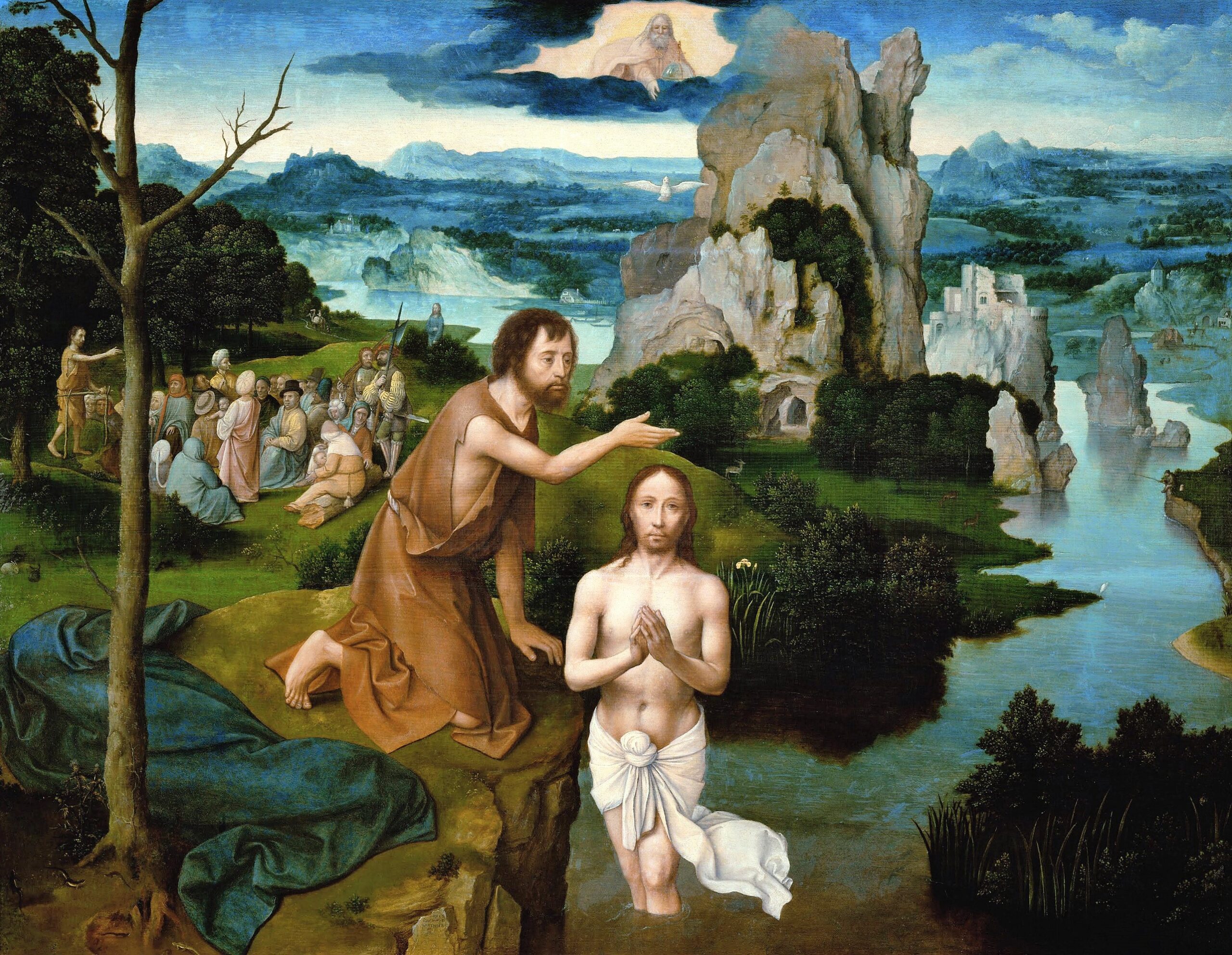

Baptism of the Lord, Year A
First Reading: Is 42:1-4, 6-7
Second Reading: Acts 10:34-38
Gospel Reading: Mt 3:13-17
At Christmas, we celebrate the fact that God has become man. This Sunday, by recalling the baptism of the Lord, we celebrate the fact that humans have become God.
If that sounds shocking, read the Catechism of the Catholic Church, which says God the Son became man so that “he, made Man, might make men gods.” Listen to this Sunday’s Opening Prayer: “May we who share his humanity come to share his divinity.”
At our conception, we receive human nature from our human parents. At our baptism, we receive divine nature from God. We are no longer merely his artifacts, for we share his nature. That is why we call baptism a rebirth, even a re-begetting.
“No one can enter God’s kingdom without being begotten of water and Spirit,” Jesus told Nicodemus. “Flesh begets flesh; Spirit begets spirit.”
Pope St. Leo the Great said that after baptism, “God calls man his son, and man calls God ‘Father.’”
After baptism, we can “dare” (as the Church says in her introduction to the Lord’s Prayer at Mass) to call God “our Father” – not in some vague sentimental sense, but in absolute sober fact.
This is why God made us. Pope St. John Paul II said that from the Trinity, where the Father-Son relationship originates, “rays of fatherhood” shine forth, “illuminating man and his history.”
They meet their “first resistance” in “original sin,” which “attempts to abolish fatherhood” and leave man with only “a sense of the master-slave relationship.”
Before we can be “reborn as sons of God,” therefore, we must be “freed from sin.” Accordingly, the first effect of baptism is to “erase” original sin and all personal sin, the Catechism says. “In those who have been reborn, nothing remains that would impede their entry into the Kingdom of God: neither Adam’s sin, nor personal sin, nor the consequences of sin,” the gravest of which is “separation from God.”
Now unlike us, Jesus had not contracted original sin or committed personal sin, and he already possessed God’s nature. Why, then, did he want to be baptized?
John must have wondered the same thing. The Catechism explains that Jesus’ baptism marked the “inauguration of his mission as God’s suffering Servant”: the one who Isaiah had prophesied would be crushed for our sins.
By submitting to baptism, Jesus allowed himself to be numbered among sinners. Accordingly, John described him as “the Lamb of God who takes away the sin of the world.”
“Everything that happened to Christ lets us know that, after the bath of water, the Holy Spirit swoops down upon us from high Heaven and that, adopted by the Father’s voice, we become sons of God,” says the Catechism.
We emerge from the baptismal font like Jesus from the Jordan: free of sin and a child of God. The heavens are opened to us, the Spirit descends upon us, and God the Father says of us, as he said of Jesus, “This is my Son, the beloved, with whom I am well pleased.”
At Jesus’ baptism the heavens, which had been closed to humans by Adam’s sin, were opened. As a prelude to the new creation, the waters were sanctified by the descent of Jesus and the Holy Spirit.
I once said impulsively after baptizing a baby, “This child now has as much right in heaven as Jesus Christ himself!” I stopped, shocked at what I had said. Was it blasphemy? No; it was absolute truth.
This Sunday, let us recall our own baptism, which we should celebrate even more joyfully than our birthday. Let us beg God, in the words of the Opening Prayer, to keep us, his “children, born of water and the Spirit, faithful to our calling,” so that, in the words of the baptismal rite, “when the Lord comes,” we may “go out to meet him with all the saints in the heavenly kingdom.”







