

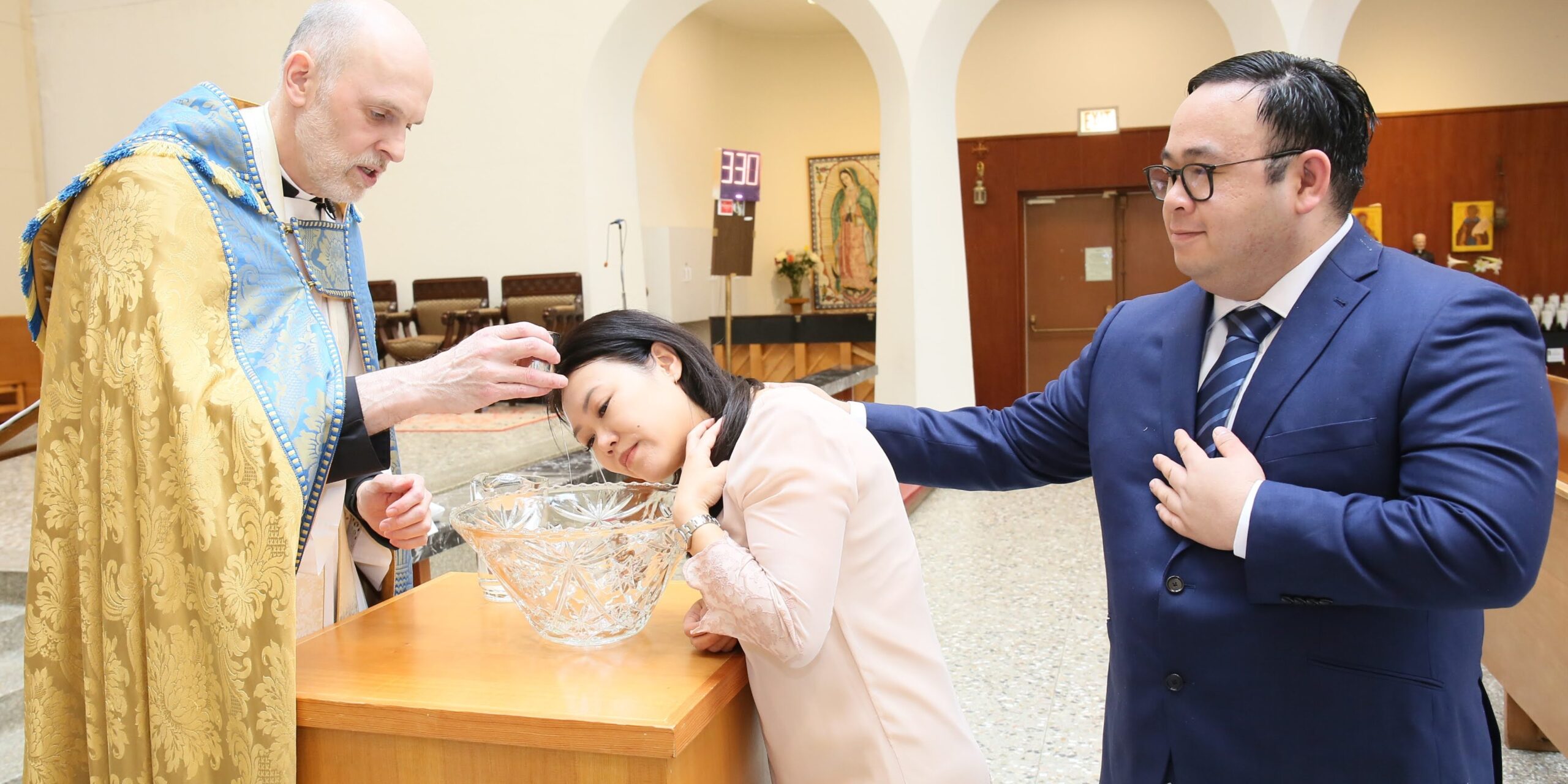

If all Christian parents knew what baptism is, they would not put it off so long after the baby’s birth.
“Baptism is the Sacrament of regeneration”—or re-birth—“through water in the Word,” says the Catechism of the Catholic Church. “Through baptism we are freed from sin and reborn as sons of God,” sharing in the life he lives as God.
Baptism is “the basis of the whole Christian life, the gateway to life in the Spirit, and the door which gives access to the other sacraments.”
The Church has always baptized infants. Indeed, when whole “households” were baptized, as we read in the Acts of the Apostles, they likely included babies.
St. Paul compares baptism, which initiates us into our new covenant with God, to circumcision, which initiated Abraham’s descendants into the old covenant, and God mandated circumcision for the eighth day after birth.
Infant baptism, especially, shows “the sheer gratuitousness” of salvation, says the Catechism. “As nurturers of the life that God has entrusted to them,” parents should present their child for baptism as soon as possible after birth. By delaying it, they deny him “the priceless” gift of being “a child of God.”
“The Baptism of children is not contrary to their freedom,” Pope John Paul I noted. In fact, Pope Benedict XVI said, it is only by presenting their children for baptism that parents can justify having given them the “highly debatable” gift of human life without their consent.
After baptism, an infant needs help and instruction, the Catechism notes. Here the godparents are especially important. On behalf of the infant, they reject sin and profess the Catholic faith. To make sure that these promises are fulfilled, they also assume the obligation to instruct the child in his faith if the parents die or neglect their duty.
At our natural birth, we all inherit original sin from our first parents. We are like Adam and Eve after their fall: deprived of their original holiness and justice; subject to ignorance, suffering, and death; and inclined to sin.
Baptism erases original sin and makes it possible for us to turn to God. It also forgives any personal sins we have committed if we are old enough.
Why, then, did Christ ask to be baptized? Like his mother, Mary, he had not inherited original sin. Like his Father, God, he was already living with divine life.
The Catechism explains. Jesus’ submission to John’s baptism, intended for sinners, was a “manifestation of his self-emptying.” He allowed himself to be counted as a sinner, accepting his role as the “Lamb of God” who would save us from our sins.
In Jesus’ baptism, all three Persons of the Holy Trinity were involved. God the Father confirmed Jesus as his dearly loved Son, and the Holy Spirit, whom Jesus had possessed fully from the moment of his conception, came to rest on him. The prophecy of the First Reading was fulfilled: “Here is my servant, whom I uphold, my chosen, in whom my soul delights; I have put my Spirit upon him.”
Accordingly, Christ commanded his apostles to baptize “in the name of the Father, and of the Son, and of the Holy Spirit.” In fact, any “baptism” that changes or omits this formula is invalid.
The Church has obeyed Christ’s command since the very beginning. When the Jews, “cut to the heart” on discovering that they had crucified the Messiah, asked Peter what they should do, Peter said, “You must reform and be baptized, each one of you.”
He continued: “It was to you and your children that the promise was made, and to those still far off whom the Lord our God calls.”
That includes us, as this Sunday’s Second Reading makes clear. Let us beg God, as we pray at Mass, to “keep us, your children born of water and the Spirit, faithful to our calling.”
Father Hawkswell is again teaching The Catholic Faith in Plain English with new insights, in print and YouTube form at beholdvancouver.org/catholic-faith-course. He is also teaching the course in person on Sundays (2–4 p.m. at the John Paul II Pastoral Centre, 4885 Saint John Paul II Way, 33rd Avenue and Willow Street, Vancouver) and Mondays (10 a.m.–noon in St. Anthony’s Church Hall, 2347 Inglewood Avenue, West Vancouver). The title of next week’s talk is Grace and the Sacraments.
Your voice matters! Join the conversation by submitting a Letter to the Editor here.







