


Recently, I have been talking to my students about the concepts of reciprocal actions. I gave them the example of the verb “to teach” and asked them if they thought I was teaching them by preparing a lesson, using words and examples. Most of them said that I was.
I challenged their response by asking, “If you haven’t learned anything from my lesson, did I teach you, or did I merely try to teach you?” This sparked an interesting conversation, which led to me drawing a triangle and arrows on the board to show that to truly “teach” I need to deliver a message and they need to receive it. Like a circuit, “teaching” is really mere “instruction” unless someone learns.
The relationship between instructing, learning, and teaching led to our discussion on the theme of Truth and Reconciliation, as we acknowledged Orange Shirt Day. I asked the students what they knew about the verb “to communicate.”
They all seemed to know that communicating means to deliver a message. What many tended to overlook was that the lines of communication are incomplete when that message has not been received.
People communicate all the time, through words and stories, through art and music, through facial expressions and body language. Sometimes their messages are received, and other times they are overlooked, unnoticed, ignored, or even misunderstood. Our discussion led to Truth and Reconciliation, as we talked about the importance of trying to listen and understand people, specifically those who attended residential schools. We need to have empathy, and we need to try our best to make a difference in the future.
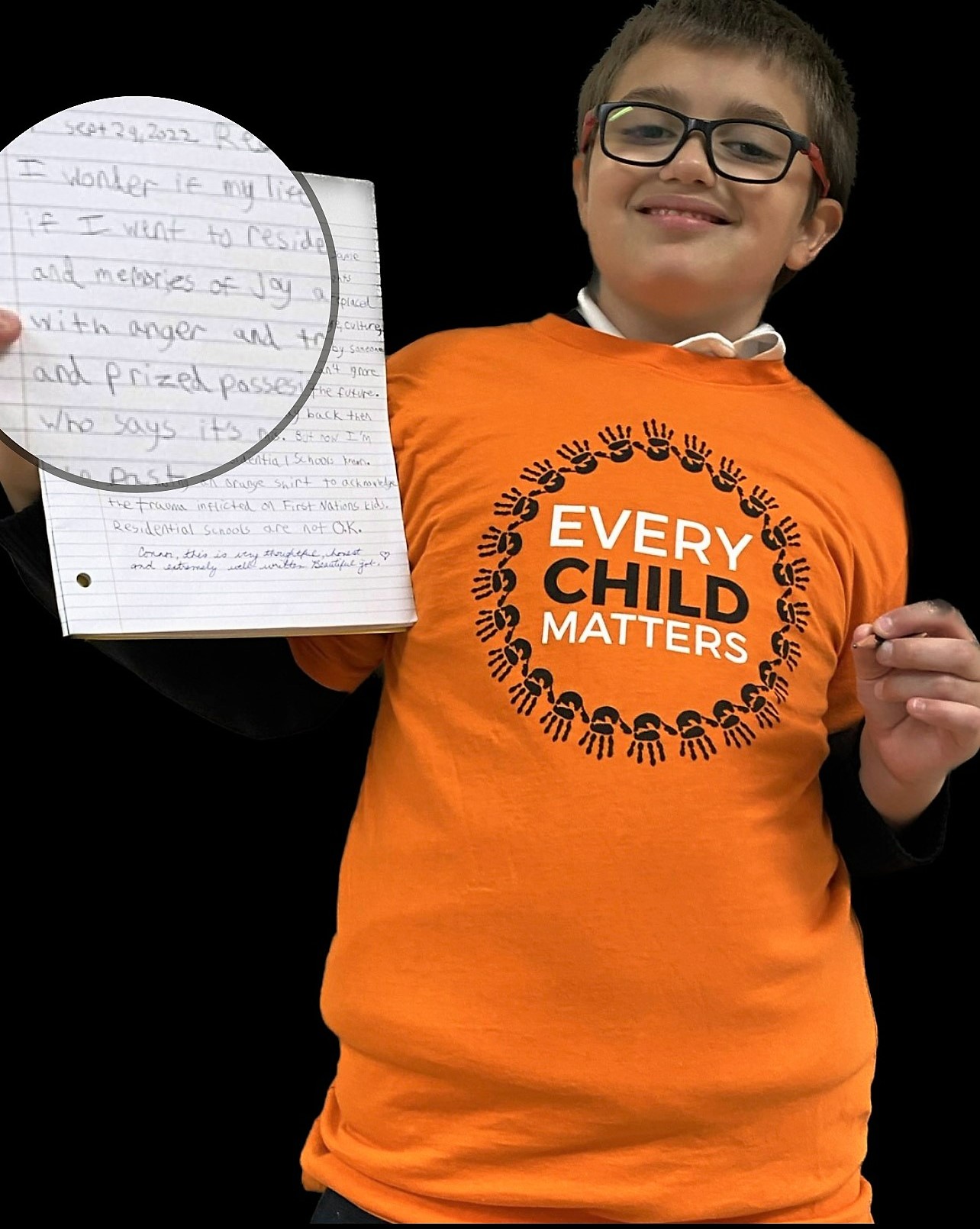
Following our discussion on the topic, one of my students, a boy – not yet 12 – named Connor, wrote the following journal entry:
“I wonder if my life would be the same if I went to residential school? Thoughts and memories of joy and satisfaction, replaced with anger and trauma. my language, culture, and prized possessions, thrown away by someone who says it’s not important. I can’t ignore the past, but I can change the future. I can’t believe that way back then, I didn’t know about this. But, now I’m going to make residentials schools known. I’m wearing an orange shirt to acknowledge the trauma inflicted on First Nations kids. Residential schools are not O.K.” — Connor Vine, Sept. 29, 2022
As I ponder Connor’s words, I recognize that underlying his empathy is a sense of gratitude. Although none of us leads a perfect life, we have all been blessed with gifts. When we are grateful for what we have, gratitude naturally emanates from within. Gratitude for our family leads to empathy with those who grieve. Gratitude for the food on our tables allows us to empathize with those who are hungry. Gratitude for friends brings empathy for those who feel alone. When we are grateful for our health, we empathize with those who are ill. Connor appreciates the blessings in his life and feels for those who were deprived of similar experiences.
To change the future, we need to listen to the stories of others. This concept is not just relevant on Orange Shirt Day, but always. We need to be attentive to the stories and body language of those with whom we interact daily.
I find it beautiful that, in Canada, Truth and Reconciliation Day comes just days before Thanksgiving. While we focus on learning, listening, healing, and empathy, we are simultaneously focusing on the blessings in our lives. We are encouraged to share those blessings with others, through our actions, through our smiles, through our words, and even through our monetary and food donations.
We are called to take the time to notice others, to listen to each other’s stories, and to complete circuits of communication. Likewise, when we ignore, overlook, or misinterpret, we are called to apologize, to re-evaluate, and to change our ways.
During this season of harvest, thanksgiving, and reconciliation, may we be grateful. May empathy and change stem from our willingness to listen to those who try to communicate with us. May we open our hearts, as Connor is doing, to try to learn from those who share the world – and this country – with us. For the act of teaching is only complete when an open heart and mind learns.







