

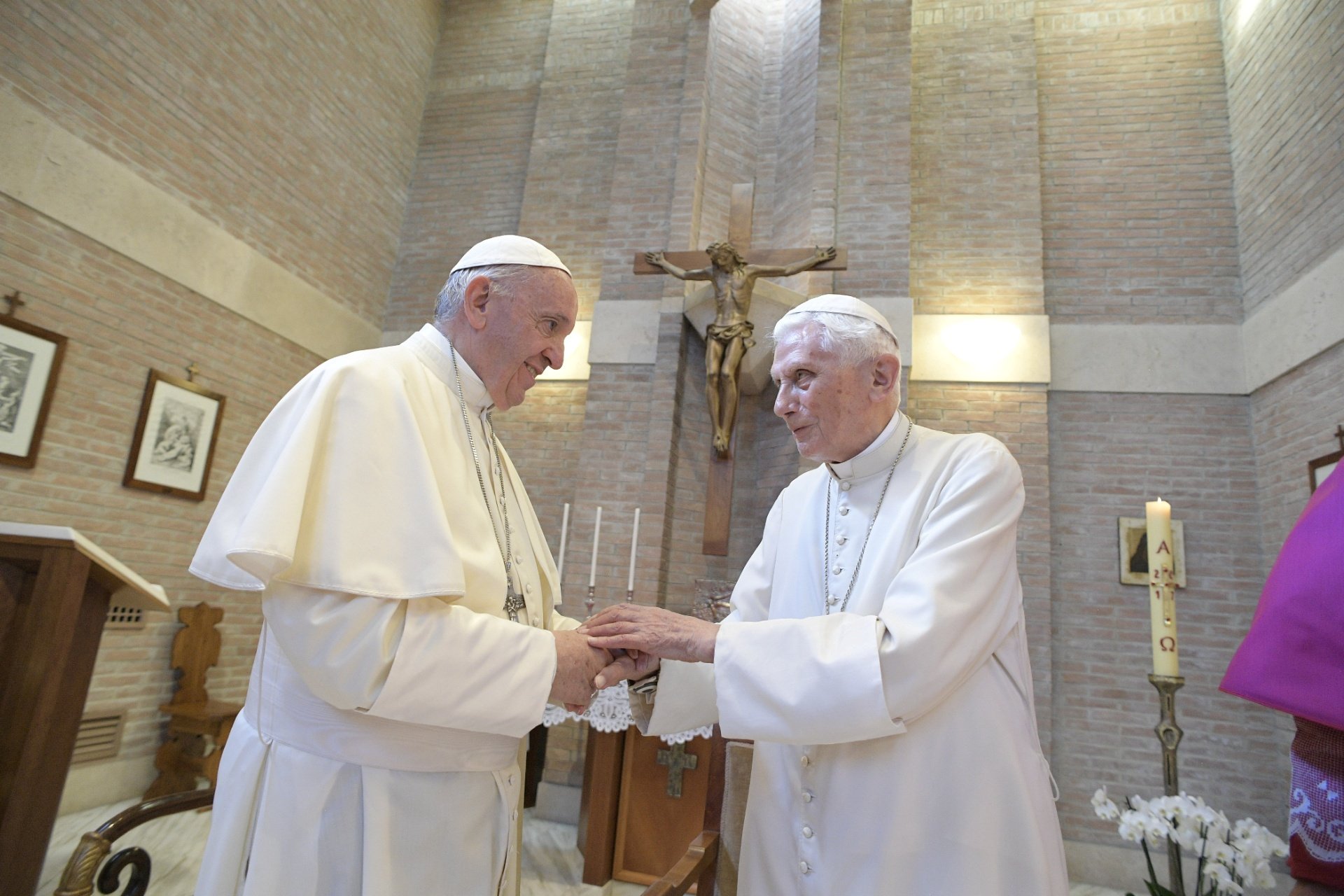

Surely it’s more than coincidental that the popes we get seem to coincide with the age we happen to be living in.
The passing of Pope Benedict XVI prompts memories and an assessment of how he seems to have represented an age of truth, which expired in the world just as he was retiring.
During his time in office it seemed like there was still a glimmer of hope that the world could acknowledge the existence and ideal of truth.
People still tried to engage in rational discourse, making efforts to look at all sides of an issue and treat them fairly. Even-handed debate, rational and balanced discussion – these might have seemed quaint, but they weren’t despised and trashed.
Much of the praise for Pope Benedict is based on his dedication to truth and reason, as opposed to the invective and feelings-based views that dominate today. This was a pope who so believed in dialogue that he established a Courtyard of the Gentiles in the manner of the Temple of Jerusalem for interreligious discussion with non-believers.
When Pope Francis arrived, the world had to recalibrate itself. After decades of the academic- and intellectual-based pontificates of John Paul II and Benedict, it was hard to adjust to a Pope who freewheeled, who gave interviews with unfriendly writers who didn’t take notes, who gave impromptu papal airplane press conferences, who made unscripted comments, and when confusion and controversy resulted, shrugged it off as the price to pay for discussion.
We got the “messy” Church that Pope Francis seemed to delight in, and the result was many people who formerly saw the Church as rigid, doctrinaire, and uncaring were given a new perspective. The messiness may have confounded those who thrived on precision and clarity, but for a world that was not only post-Christian but also post-rational, Pope Francis was the ideal shepherd. The age of reason had been replaced by the age of post-modernism, and logic by feelings. Pope Francis was the Pope the world could relate to.
It’s been said that Pope Francis preaches an evangelism of personal holiness, and he does, although the degree to which that differs from his predecessors is sometimes exaggerated. It was Benedict after all who wrote Deus Caritas Est (God is Love) in which he outlined the Church’s proper role in works of charity and in seeking social justice.
It was John Paul II who wrote, “The social message of the Gospel must not be considered a theory, but above all else a basis and a motivation for action.”
The scholarly approaches of Popes John Paul II and Benedict worked in a world where there was respect for truth. Now the world thrives on feelings and subjectivity. It will be interesting to see whether one approach produces more fruit than another, or whether each has its own time.
I hear numerous stories of people who have become Catholic during the time of Pope Francis. Perhaps some of them chose their path because of his Christian witness. But the conversion stories that stand out for me are those from individuals who are having questions answered. It often involves looking into Church history and discovering that the Church is older than a couple of hundred years.
Since the death of Pope Benedict, many converts have shared their stories about how his appeal to truth and reason was responsible for their coming into the Church.
Let’s pray that we continue to get Popes who are both intellectually rigorous and also convey a charism of Christ … sometimes in the same person.
Click here to send us a letter to the editor about this or any other article.







