

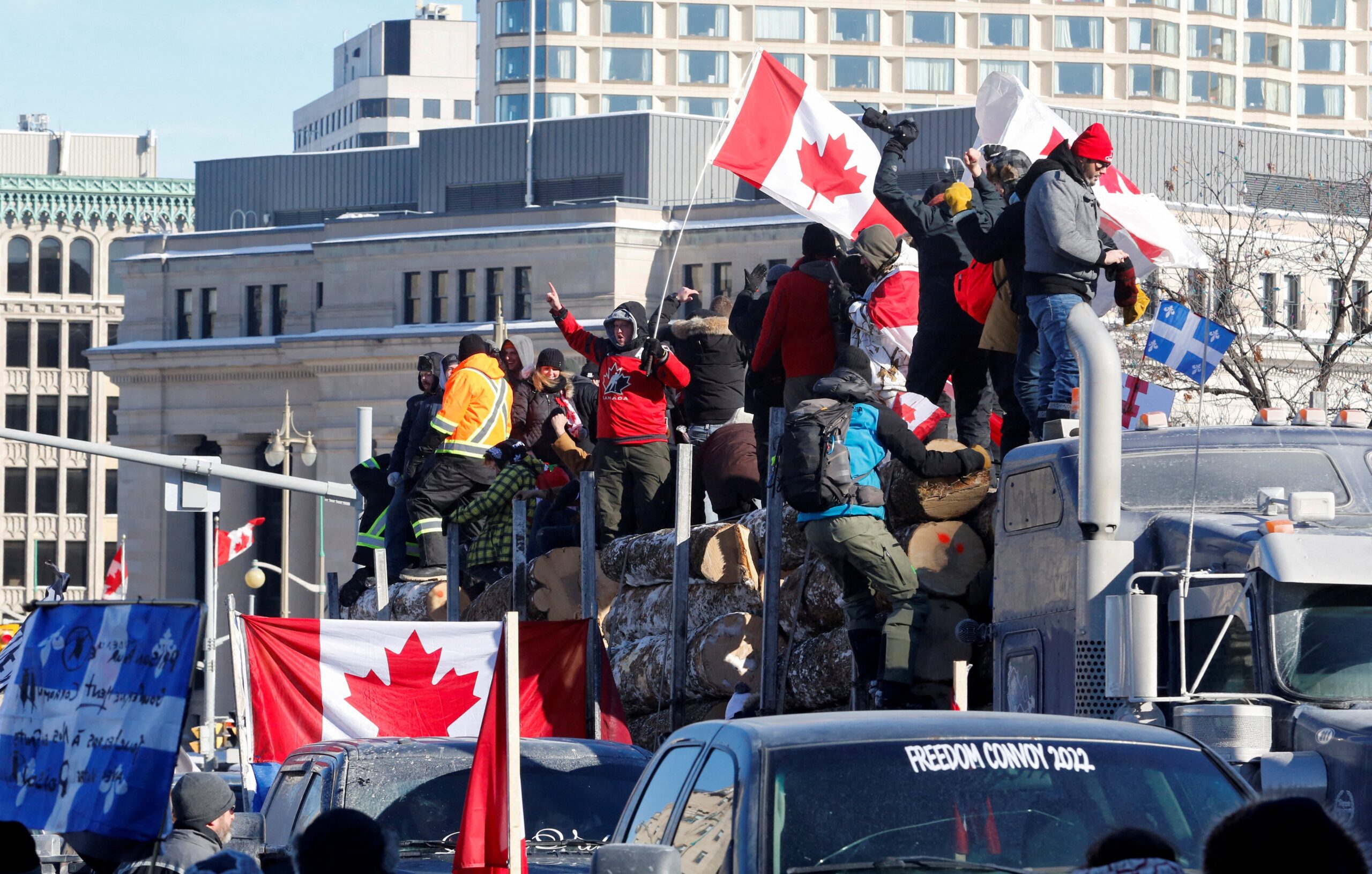

Can the Church’s social teaching tell us something about truckers, the protest movements they inspire, and the State’s actions in response?
In the light of subsidiarity, the answer is a resounding “yes.”
In his 1891 encyclical Rerum Novarum, Pope Leo XIII codified key principles underpinning the Catholic social tradition. He never actually mentioned the word “subsidiarity.” But he laid the groundwork for what would culminate in Pope St. John Paul II’s authoritative definition of the term a century later: “A community of a higher order should not interfere in the internal life of a community of a lower order … but rather should support it in case of need and help to coordinate its activity with the activities of the rest of society, always with a view to the common good.”
Phrased differently, subsidiarity holds that human affairs are most effectively and suitably managed at the lowest possible level of organization, closest to the affected persons.
What’s this got to do with the Freedom Convoy and the Emergencies Act that was invoked?
First, subsidiarity provides a lens for analyzing the appropriateness of convoy participants concentrating their protests on the federal level of government.
The recent report examining the use of the Emergencies Act acknowledges that the straw which broke the camel’s back for protest organizers was Ottawa’s decision in Fall 2021 to impose a COVID vaccine mandate on truckers crossing the Canada-U.S. border. Previously exempt from such requirements, many truck drivers found themselves facing potential loss of livelihood. Taking their grievances directly to federal policymakers therefore appears understandable.
That said, a subsidiarity-inspired argument can be made that many supporters who backed the convoy ought to have protested outside provincial legislatures, not the House of Commons. From vaccine passports to mask mandates, many (if not most) of the COVID measures which had the biggest impact on Canadians’ day-to-day lives originated from the provinces.
Admittedly, the convoy served as a singular, unifying means for restriction-weary citizens to voice opposition, and attempts by some protestors to park themselves in front of legislatures were thwarted by local police. All the same, an honest application of the subsidiarity principle would find that, for many of the non-truckers, their dissent should have been directed with equal if not greater vigour toward provincial authorities rather than federal ones.
A second observation is that the Emergencies Act itself is a “subsidiarity statute” par excellence. The legislation is anchored in respect for the competencies correlating to each level of government – municipal, provincial, and federal.
A few provisions are instructive in this regard. The act’s definition of “national emergency” is limited to situations that “exceed the capacity or authority of a province” and “cannot be effectively dealt with under any other law of Canada.”
Elsewhere, the statute stipulates that notwithstanding any emergency which is declared pursuant to its terms, the federal government is not authorized to exercise control over provincial or municipal police.
As the public inquiry report states, the act “is not a tool of convenience; it is one of last resort,” with profound implications for the division of powers within Canada’s federalist system. In its commitment to what Pope Pius XI called the “subsidiary function,” in which the graduated order among different levels of authority is observed and protected, the legislation bears the fingerprints of Catholic social tradition and thus attests to the wisdom and necessity of what Church teaching has to offer in contemporary public affairs.
The subsidiary character of the Emergencies Act is likewise operative in a third and final respect. As noted above, a key criterion to satisfy in any justified invocation of the act is whether an emergency exists “of such proportions or nature as to exceed the capacity or authority of a province to deal with it.”
On various grounds, the commission of inquiry found that the federal government met this requirement. However, early public commentary on the report is hotly debating this finding. And indeed, the inquiry’s analysis on this matter leaves much to be desired.
For example, the report’s discussion on whether any other federal law could have dealt with the protests is woefully thin. The commission itself accepts that effective enforcement of the Criminal Code could have brought the protests under control. However, it then asserts that the “practical realities of the situation” gave law enforcement concerns around enforcing the code, on account of unacceptable safety risks to police, protesters, and bystanders.
This statement seems oblivious to the irony that the streets of Ottawa were ultimately cleared only through the use of force, and raises questions around how the inquiry would have expected Emergencies Act safety risks to differ from Criminal Code ones.
Without a doubt, though, the biggest “what if?” question left unanswered by the commission – and which is prompted by subsidiarity – is whether events could have unfolded differently if the Government of Ontario had been more hands-on.
To be sure, the report finds that provincial leadership was AWOL during the early days of the Ottawa protests and only engaged meaningfully with other public authorities when the border crossing in Windsor was blocked. However, this observation is not accompanied by any discussion or expectation of possible solutions for the situation in Ottawa which the province could have put on the table and which may have borne fruit.
Within two days of Ontario granting itself additional powers through a provincial emergency declaration, the bridge in Windsor was re-opened. Why were those powers insufficient for making headway with protests in Ottawa? Moreover, why did this consideration not loom larger in the federal Cabinet’s deliberations on Feb. 14, 2022, when the Emergencies Act was invoked and the remaining protests were limited to a few streets in Ontario’s second biggest city?
Perhaps most fundamentally of all, why is it unreasonable to take the view that Ontario did indeed have the capacity to respond to the protests, but undermined its own efforts through self-inflicted errors and absentee leadership? And how can we ensure that future uses of the Emergencies Act will not simply be justified on the basis that lower levels of government aren’t fulfilling their responsibilities effectively?
These are critical questions that the commission failed to address. But they are nevertheless ones which the principle of subsidiarity demands to be asked.
Leo XIII was not acquainted with tractor trailers when he penned Rerum Novarum. But in the same way that his affirmation of workers’ rights remains relevant for 21st-century truckers, so too does his subsidiarity-based summons for all levels of government to do their jobs well, respect the limits of their authority, and safeguard their people’s freedoms.
Patrick Owen Brown is the host of the Crown and Crozier podcast at crownandcrozier.com, which explores the world of Church, State, and faithful citizenship. He lives outside Ottawa with his wife, children, and livestock.







