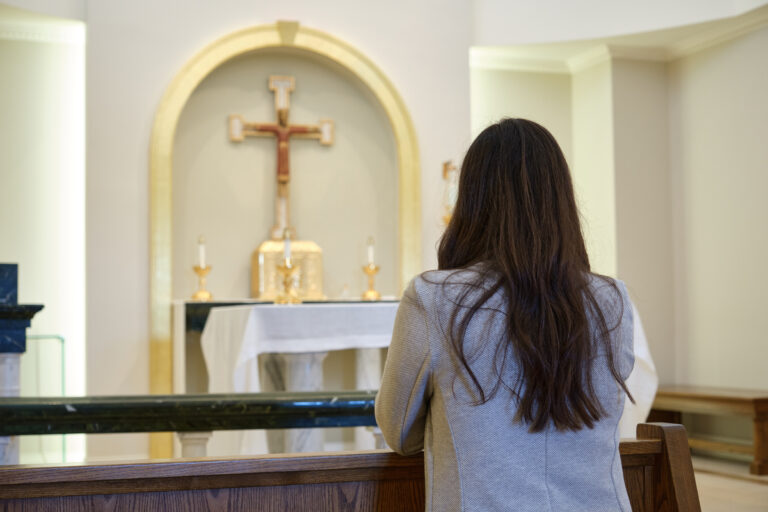

I’ve been checking out a lot of online Masses, and I expect to be dropping in on a lot more during this Third Week in Virtual Time, as it’s been called in our office. It’s been an eye opening experience seeing priests I know, and those I don’t, as they serve their parishioners in a more vulnerable and comforting manner than I would have expected.
Their compassion is heart lifting to see, as some of them work uncomfortably with technology they’re unfamiliar with, yet reaching out with Facebook, YouTube, and other digital platforms. Our priests are not just broadcasting Masses, they’re pastoring, many of them doing some real, personal sharing as they offer support and comfort, before, during, and after Mass, and sometimes in separate videos.
They are stepping up and making televised Mass something that is intriguing and spiritually beneficial. (I’m also getting a new appreciation for preauthorized giving, something I’ve been putting off for years.)
The pandemic and the response to it by Church and state is forcing all of us into some uncomfortable areas and some difficult sacrifice. We’re all being called to do extraordinary things right now. Among them is serious discernment about what God is asking us to do as individuals.
It’s not easy. Most of us have religious, family, employment, and social obligations. Balancing them is a struggle as we discern what God wants of us.
It can mean asking questions whose answers don’t come easily. Am I supposed to visit an empty church, or stay home with my family?
Unfortunately the polarized society we’ve created doesn’t take kindly to people asking sincere questions. People who have views on one side or another of an issue are routinely pillaried by those who have opposite views.
So those who think the churches should still be offering public Masses are attacked by those who say they should be shut down completely.
We need to keep asking questions cautiously and sincerely, trusting the Lord is guiding us.
It’s a reasonable approach that would serve us well with broader questions as well. People who say too many businesses have been shut down are at odds with those who believe too many remain open.
Are governments overreacting with the latest measures they impose? Or is any government action justifiable if it saves a single life?
Cognitive dissonance enters into every COVID-19 question, and a lot of it is because we rely on the conventional media to give us the facts. That happens to be a very reasonable way to approach most things, and many news organizations are stepping up to the current crisis in commendable ways.
And yet, we need to keep asking difficult questions based on our own knowledge and perspectives.
If we’re willing to accept, as most of us do, millions of Canadians being put out of work and extraordinary emergency measures that restrict civil liberties and religious worship, we also need to ask whether we’ll recognize if government crosses a line by using the crisis as a means to an end – as political parties in both Canada and the U.S. have already attempted.
We need to rely on the information delivered by media, while recognizing these are the same media who told us abortion and euthanasia would be used in rare exceptions; the same media who couldn’t care less about the loss of elderly lives six months ago when seniors were signing up for assisted suicide at a rate approaching Belgium; the same media who are not alarmed by euthanasia deaths being reported as “natural causes;” the same media who can’t be bothered trying to uncover accurate abortion statistics or telling stories of women being coerced to have abortions or doctors being pressured to end lives or seniors being nudged to “just end it all.”
Most of us trust that the economic impacts of the current measures are necessary, and yet we suspect the media are not factoring in the tremendous social costs. A 2006 report looked at the increase in suicide attempts in the U.S. after the Sept. 11 terrorist attacks, saying a 49 per cent increase was an example of “psychological toxin” from the attacks. I don’t see media asking how much psychological toxin will result from what’s happening in the world in terms of financial ruin, mental illness, addiction, relationship breakdown, violence, and suicide if the world is forced by governments toward depression and totalitarianism.
Most of us are accepting the measures being introduced across Canada and British Columbia because the tradeoff between lives and freedoms seems reasonable so far. And if there is going to be a net-positive result, maybe it will be an increased appreciation for the lives of the elderly. The annual carnage that is the seasonal flu has been neglected for too long. Perhaps we’ll finally address it as the annual national crisis that it is.
Just maybe we’ll come out of this with some greater appreciation of the value of human life.