



With terms and expressions such as social distancing, flattening the curve, continuity of learning, and COVID-19 in such wide use, it seems incongruous to be writing about technology at this time.
Yet it is to technology that much of the world has turned as another expression becomes prominent: work at home, or work from home.
As this column is written, COVID-19 cases have topped a quarter of a million, governments have moved entire states and countries into lockdown modes, and millions of people have begun working remotely.
This massive shift to remote work has not come without hiccups, and there is some evidence that the internet is showing signs of strain, particularly from bandwidth-intensive video conferencing.
Regulators for the European Union have taken the unusual step of approaching Netflix, one of the single largest consumers of internet resources, and asking them to drop the resolution of their video streams back to standard definition (SD). Yes, you read that correctly. We aren’t talking of a drop from 4K resolution back to high-definition (HD) resolution. No, this request was for a drop down to SD, the old 480-line format that defined North American television for decades.
All to stop the internet from buckling, as it were. And as this column goes to press it looks like not only has Netflix agreed to ratchet down the data demands of its content, so indeed has YouTube, which in North America will set the default resolution to SD, although it can still be reset to HD.
This brings me to Project Starlink, the Elon Musk venture to bring internet delivery across the globe from a constellation of satellites down to pretty much any place on the planet. Starlink may begin service in Canada and the U.S. as early as this year.
You first read about Starlink in this space back in 2019. In May of that year, using one of his SpaceX launch vehicles, Musk placed the first batch of Starlink satellites into a low earth orbit. This batch of 60 satellites caused quite a stir as they were all visible initially in a perfect line. I saw them myself, or at least a cluster of nine of them. Eventually they dispersed and were placed in higher orbits and were no longer generally visible.
Since that first launch, Musk and his team have been producing several of the satellites a day at a plant in Renton, Wash., and launching batches of 60 at a time. Following the most recent launch, in mid-March, Starlink had 300 of these quarter-tonne satellites in orbit.
The project is designed to bring high-speed, low-latency service (i.e., having quick response) across the globe. You might well think this would be uncontroversial, but it isn’t. Almost immediately after the first Starlink satellite “train” was spotted, astronomers raised the alarm that their work from earthbound telescopes would be affected.
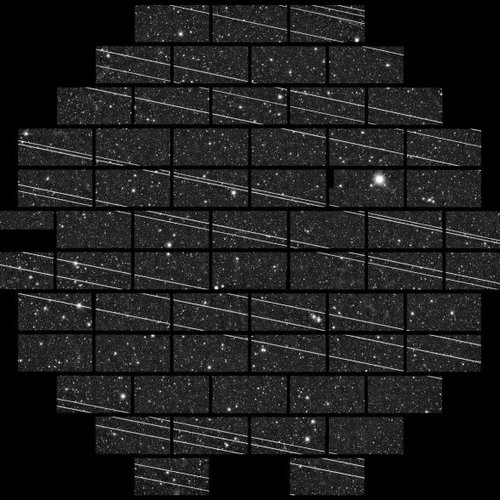
Nineteen Starlink satellites seen by the Cerro Tololo Inter-American Observatory in Chile against a starry background in November 2019. (INSF National Optical-Infrared Astronomy Research Laboratory/CTIO/AURA/DELVE)
It is not as if a few hundred satellites, added to the few thousand presently in orbit, would doom telescope work from earth. Musk’s Starlink project, though, has initial permits for 6,000 or so, and firm plans for up to 40,000 satellites. To achieve a full rollout, Starlink intends to launch those batches of 60 every couple of days.
Nor is Musk the only one with such plans. Other rivals include OneWeb and Project Kuiper, although these companies are much farther back in the race to complete such an ambitious constellation of satellites.
Musk has said that he is planning for Starlink to generate $30 billion a year in profit from bringing high-speed internet service to underserved locations, as well as to commercial aircraft, ultimately funding his ambitious venture to colonize Mars. And, thinking grand scale, Musk envisages a Starlink constellation orbiting Mars, delivering internet connectivity across the red planet.
Musk believes the astronomy controversy over Starlink satellites ruining night sky photography is overblown. He says Starlink is working on reducing the reflectivity of his satellites, but merely painting objects black raises engineering issues about energy transfer and radiance in space. With his usual bravado, Musk has stated that Starlink will have zero impact on astronomy. Astronomers aren’t buying it, at least not for now. Besides, they say, even dark satellites might mimic planets crossing far-away stars. The occultation or crossing method is a key way of searching for and locating exoplanets.
The International Astronomical Union and American Astronomical Society are on record as wanting a moratorium on Starlink launches until concerns can be addressed. Radio astronomy is likely to be even more affected because of the radio frequencies Starlink will be beaming both up and down.
If you want to contribute to monitoring the Starlink satellites and their appearance in your night sky, check out the Satellite Streak Watcher project. The idea is to use smartphones to capture the appearance of the Starlink satellites in the evening sky, across the globe, thereby forming a database of before-and-after imagery.
Astronomers worry they will have to divert effort and resources to mitigate the effects of the Starlink constellation on their work. Which leads us to a rhetorical question: is a dark natural sky part of human heritage? Astronomers argue that without their work we wouldn’t have an understanding of the physics and celestial mechanics that makes satellites possible.
Giorgio Savini, director of the University College London Observatory, has said, “Unfortunately, popular culture sees astronomy as a hobby rather than a science and they forget an enormous portion of physics that we know now is thanks to astronomy. Which, at the end of the day, is the biggest lab we have at our disposal.”
An astronomer in Chile had this reaction via Twitter: “Wow!! I am in shock!! The huge amount of Starlink satellites crossed our skies tonight at @cerrotololo. Our DECam exposure was heavily affected by 19 of them! The train of Starlink satellites lasted for over 5 minutes!! Rather depressing… This is not cool!”
I well recall seeing, as a young boy guided by my father, the first ever satellite widely visible from space, the giant mylar Echo 1 balloon, launched in 1960. Ever since, I’ve been captivated by space technologies. Perhaps Starlink and its nascent competitors have an important role to play in servicing communications demands in a world so changed by COVID-19.
Recently I stood under a pitch-black sky in Tofino for an experiment with a satellite I couldn’t see but could reach via radio signal. I was outside for around 45 minutes and did not see a single visible satellite. I saw several shooting stars. The experience was magical. Would it have been the same if I’d also seen several dozen of Elon Musk’s Starlink satellites?
Follow me on Facebook (facebook.com/PeterVogelCA), on Twitter (@PeterVogel), or on Instagram (@plvogel)
pvogel@outlook.com







