


When 2020 rolled around, jokes abounded of it being the year for 20/20 “clear-eyed vision.”
We were told that this year, more than any other, we would – or really ought to – sort out our priorities and move on from the past.
Alas we are already halfway through, yet headlines each day remind us of how far we are from overcoming an invisible bug from last year’s cusp.
Since then, cities around the world have been re-playing some variation on the theme of Wuhan. Social measures previously thought extreme are now the norm. Laypeople from grocery workers to office staff have learned to use “epidemiology,” “attack rates,” and “incidence” in their daily conversations, terms I never thought I’d hear beyond the medical and public health circles where I trained.
Yet for a time the hospitals became eerily quiet. Emergency department and medical wards, usually bustling with restless movement and controlled chaos, felt abandoned. A noxious air of anxious anticipation filled their hallways. British Columbia reported among the first cases of the virus in Canada: we should have been overwhelmed by now, last week, or last month. Instead, the days have been a slow trickle and drip of cases. Where are the sick ones, anyway?
***
It was a Saturday night in a downtown Vancouver hospital. I was looking after a woman* in her early sixties with colon cancer whose blood pressure had markedly dropped despite fluids and antibiotics. Knowing that she would struggle on the medical floor, I asked for help and sent her to the intensive care unit for further support.
Shortly after, my mom called from Edmonton and urgently asked me to video call Lola (grandma) Meling in Cebu, Philippines. For several days she had been incontinent and stopped eating. More bothersome was that she wasn’t breathing too well. My aunts and uncle, who were looking after her, weren’t sure what to do.
I contacted Lola. Gone were the typical lines she repeated in recent years as her dementia would allow … about her disbelief about my growing up. (“Di gyud ko ka to-o nga ka dako na ba nimong tao, Dong pangga!” – “I can’t believe you’ve grown to be the person you are now”).
She simply stared into the screen, as if seeing much of nothing. She would be 88 the next day.
“Could this be COVID?” everyone in the family was wondering.
“Possible, but I’d first think of the usual suspects given the age” – a bacterial infection, a sick heart, abnormal electrolytes in the blood – these and many others could easily afflict the elderly. I suggested they send her to the hospital to see if there was anything reversible.
Mom hesitated for a second, and not only because hospitals during pandemic time aren’t ideal for birthdays. She was traumatized by Lolo’s (grandpa’s) stroke 20 years ago, which involved long, anxious hoping that doctors would herald news of even the slightest recovery. Too, getting sick in a country with no universal health-care coverage meant each day in the hospital could thoroughly drain years of savings. Now the spectre of Lola’s sudden decline suggested that we endure it all over again. “Of course we’d never leave her alone,” she added.
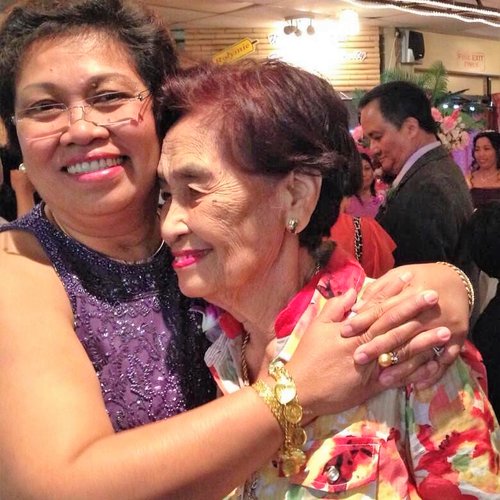
Lola was ultimately admitted and was diagnosed with a viral infection, which likely triggered a mild heart problem and confusion. She was sent home after several days, though she never fully recovered. She was given fluids, but hardly ate. The doctors recommended inserting a feeding tube through her nose, and possibly even doing surgery to insert a tube into her stomach if she still wouldn’t eat at home.
Immediately I recalled hearing a story of mom and Lola frantically going around Cebu looking for help as I cried in hunger. I was about two months old and was sent home after an operation for my cleft lip and palate. The feeding tube inserted through my nose was dislodged, and feeding me would be tricky.
My pediatrician had given them a crash course on managing such contingencies. “Buy a stethoscope and listen for air bubbles in the stomach as you blow air into the feeding tube – that’s when you know you’re in the right spot. But remember that fluids might get into the child’s lungs and cause him to choke.”
Mom and Lola, having no health-care background but using their own motherly instincts and common sense, would have none of it. They brought me to another doctor, who suggested buying a dropper instead.
Three decades later, a familiar scenario was unfolding with reversed roles. Lola was getting worse as time passed. She was no longer speaking and was now hardly moving. Mom was alarmed, her thoughts racing: Was it a mistake to send her back home from the hospital? Why aren’t we feeding her? Shouldn’t we do everything possible to keep her alive?
At that point, and having seen Lola by video call again, it was clear to me that she was actively dying. It was time to speak about ars moriendi – the art of dying. A staple approach of Catholic thought in plague days of old, but now hardly mentioned, it involved recognizing, accepting, and preparing for death.
My family, especially mom, was stricken by the guilt of “not doing enough.” So I explained that Lola was going through the natural process of death, which meant the gradual loss of all the basic human functions, including the ability to feed. Going to the hospital or inserting a feeding tube now would likely make no difference to her quality or length of life. In fact, doing so may cause more discomfort, pain, uncertainty, and even a hastening of her death. In this pandemic, it would also mean further isolation, as families can’t visit their loved ones in the hospital.
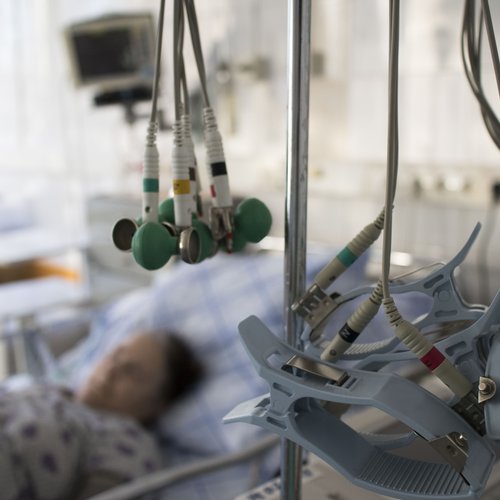
“I glanced at the patient. I counted nine bags hanging by the bedside, invariably connected to the line attached to the side of her neck, infusing medications deep into her heart. Alarms with varying pitches and tones were her close companions, continually reminding her of her own decline.” (Adobe)
Instead, it was now our duty to accept her dying serenely. I reassured my family that despite everything, grandma is doing well and her farewell is peaceful. No health-care system, however sophisticated, could ever “do enough” to confront her death in the same way that her family – her own flesh and blood – would as her last source of health and warmth, her last buttress of strength, and her final reminder of humanity. “She will be gone soon, so be with her, even if it’s just through a screen. You’re already giving her what she needs. Finally, let’s remember that death is not the final word and should remind us of how frail we all will be, how temporary earthly life is, and how we should make the best use of our own lives while we can.”
I was back in the hospital and asked the ICU nurse about the sick patient from last week. “How is she?”
“She’s got the ‘three nurses sign.’ With everything going on, it takes that many just to keep her stable. She was RASS +5 yesterday, now -2 on large doses of hydromorph, loraz and quetiapine. Pressures barely holding with MAP 63 despite milrinone, levo, vaso—all running at max. Amio loaded for her VT. Intubated last night for worsening hypoxia and a chest x-ray showing florid edema. Continued on mero, vanco and micafungin for the colonic infection. Feeds held. Surgery to see for her possible obstruction. Dialysis to start later for her anuric AKI. Full code, obviously.”
The nurse sighed. “In a word, not well.”
There was an incantational ring to her crisp, matter-of-fact summary – like a ritual for the dying, except the words were held together by the internal logic of modern science. Life’s complexity at once revealed and concealed by technical code.
“Family and loved ones?” I asked.
“Still couldn’t get hold of them.”
I glanced at the patient. I counted nine bags hanging by the bedside, invariably connected to the line attached to the side of her neck, infusing medications deep into her heart. Alarms with varying pitches and tones were her close companions, continually reminding her of her own decline. The room was awfully cold. I was tempted to touch her hand but knew that for public health reasons I shouldn’t. I stayed with her at a distance, even for just a few more seconds.
My mother contacted me. “Your Lola stopped breathing this morning after we sang her favourite song, Waves of the Danube. Also, her swab came back positive for COVID. The public authorities are planning to cordon off your aunt and uncle’s place so no one can leave in the next two weeks, but thankfully she had her last rites … they also wouldn’t allow any funeral, so we chose to cremate. We hope to bury her together when the restrictions are lifted.”
“We’re at peace,” Mom continued, “and thanks for guiding us through her death.”
May God grant you peace and life everlasting, Lola Meling, and please help us with the rest of 2020.
Rafael Sumalinog is a Catholic physician-resident in internal medicine practising in Vancouver.
*Details are based on multiple patients and have been heavily modified to protect confidentiality. Lola Meling’s story is shared with permission.







