


St. Athanasius once said, “God became man so that man could become God.” Many of the early Church Fathers echoed his sentiments in subscribing to the belief that man, with God’s grace, can indeed become godlike. This tenet is a thoroughly Christian one, and it is called “the divinization of man” or “theosis.”
The theology sounds borderline scandalous to some of us. Many of us prefer to stay “manageable” in our charitable works (leave the big stuff to the Mother Teresas). Our playing small delivers us into “safely ineffective” territory in our efforts to become saints. If soaring virtue was never possible anyway, we aren’t really missing anything, right? It’s not worth the legwork.
In his book East of Eden, John Steinbeck circles in on a game-changing truth: we are as bad or as good as we make up our minds to be. There is immense power in our free will and in our commitment to nurture all that is good in us and to starve that which does not give life.
In Genesis, when God speaks to Cain after he has slaughtered his brother Abel (in the land of Nod, east of Eden), he tells Cain this isn’t the end of the road for him: he can turn things around. He says, “Timshel (which we learn is Hebrew for ‘thou mayest’) conquer sin.”
As Steinbeck writes, “But the Hebrew word, the word timshel – ‘Thou mayest’ – that gives a choice. It might be the most important word in the world. That says the way is open. That throws it right back on a man. For if ‘Thou mayest’ – it is also true that ‘Thou mayest not.’”
But simply tethering our free will to a well-formed conscience does not turn us into gods. Rather, the level to which we unleash the power of the Incarnation in our lives is the level to which we will have a share in God’s divinity.
What separates Christianity in a huge way from all of the other world religions is the Incarnation. It is unthinkable in Islam, for example, that the Creator of all would subject himself to the confines of the human condition.
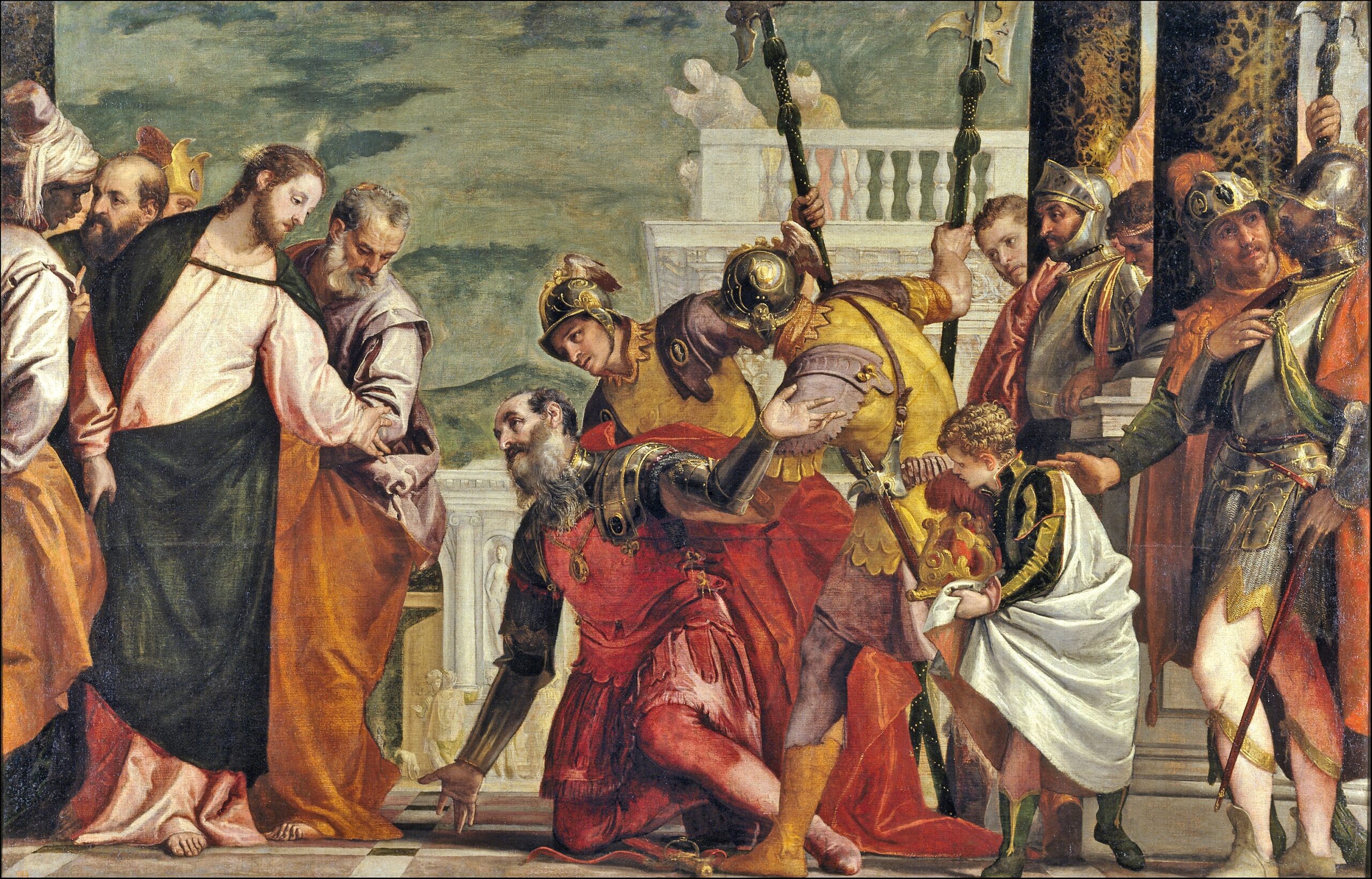
There is one moment in Scripture where Jesus is stopped in his tracks by the virtue of another. Only one place. The person in question is not even an Israelite. It is the Gentile centurion whose slave lay at home dying.
We quote the said Roman centurion before we receive God’s flesh for our “divinization”; indeed, his words are freshly hatched from our lips as we consume God’s life (and thus our own). “Lord, I am not worthy that you should enter under my roof. But only say the word and my soul shall be healed.”
The centurion further explains to Jesus that he intimately understands how authority works, given that obedience and rank are his bread and butter. He knows he is dealing with authority that far outranks his own and makes sure to exercise total submission.
We read that Jesus is “amazed” at the centurion’s faith. Some translations say he “marvelled” at it. Either way, what Jesus says next is the biggest finger-wag for us Christians who regularly subdue our divinity: “Truly, I say to you, not even in Israel have I found such faith. I tell you, many will come from east and west and sit at table with Abraham, Isaac, and Jacob in the kingdom of heaven, while the heirs of the kingdom will be thrown into the outer darkness, where there will be weeping and gnashing of teeth.”
The heirs of the kingdom … that’s us! We all have the ability to do what the centurion did: to give Jesus complete and total authority over our lives. Timshel – thou mayest! We are free to choose each day, each moment.
In his exchange with the centurion, Jesus glimpses his Father’s business. In that moment, God the Father reveals the marvel of humans’ becoming godlike in their docility and faith.
St. John writes in his first epistle: “Dear friends, now we are children of God, and what we will be has not yet been made known. But we know that when Christ appears, we shall be like him, for we shall see him as he is. All who have this hope in him purify themselves, just as he is pure” (1 Jn 3:2-3).
The kingdom gets more glorious with every heir who professes their faith in the Incarnation with their lives and their whole voice before each Communion: “Lord, I am not worthy that you should enter under my roof, but only say the word and my soul shall be healed.”
Let us be people whose faith causes the Lord of Life to be amazed.







