


Easter Sunday, Year A
First Reading: Acts 10:34a, 36-43
Second Reading: Col 3:1-4
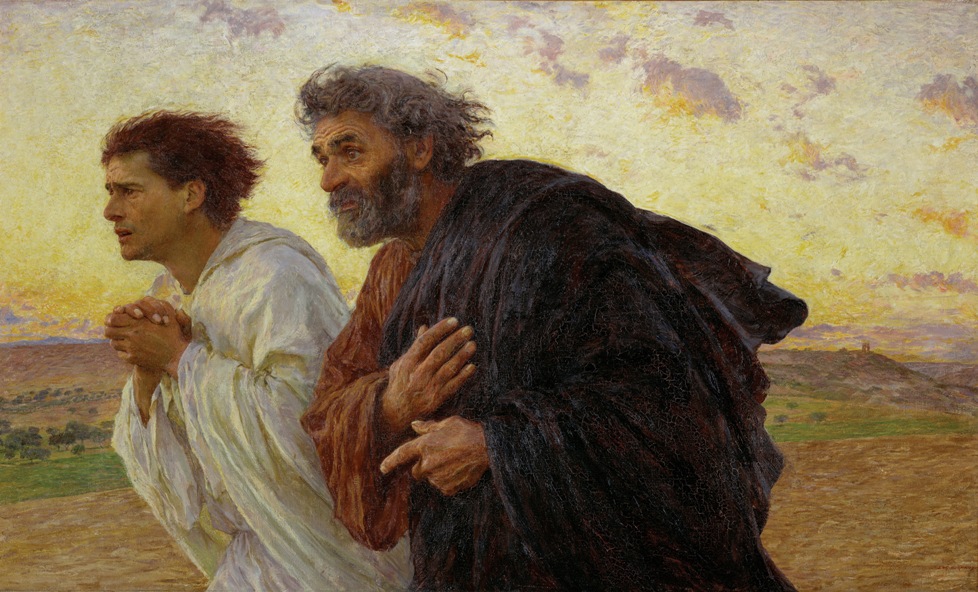
Gospel reading: Jn 20:1-18
The Gospel readings for the Easter Vigil and Easter Sunday relate the facts of Jesus’ resurrection from the dead. “He is not here, for he has been raised, as he said.”
The Resurrection lies at the very centre of our belief. Easter Sunday is called the mother of all feasts, but in fact we celebrate Christ’s resurrection every Sunday.
Sunday “symbolizes the new creation ushered in by Christ’s Resurrection,” says the Catechism of the Catholic Church. “For Christians it has become the first of all days, the first of all feasts, the Lord’s day.” In Sunday’s Night Prayer, the Church says, “Lord, we have celebrated today the mystery of the rising of Christ to new life.” We never fast on Sundays, even during Lent.
Writing a few decades after Christ, St. Justin said that Christians gather “on the day of the sun” because it is the day on which “Jesus Christ our Saviour rose from the dead.” St. Ignatius of Antioch explained that “those who lived according to the old order of things have come to a new hope, keeping no longer the sabbath, but the Lord’s Day.”
In the Gospel reading, Peter identifies himself as a witness. “We are witnesses to all that he did both in Judea and in Jerusalem,” he said. “They put him to death by hanging him on a tree; but God raised him on the third day and allowed him to appear, not to all the people, but to us who were chosen as witnesses, and who ate and drank with him after he rose from the dead.”
Why is the Resurrection so important? “If Christ was not raised, your faith is worthless,” St. Paul replies. “You are still in your sins, and those who have fallen asleep in Christ are the deadest of the dead. If our hopes in Christ are limited to this life only, we are the most pitiable of men. But as it is, Christ is now raised from the dead, the first fruits of those who have fallen asleep.”
None of us wants to die. In an emergency, we all react instinctively so as to save our lives. Even an atheist friend of mine, who believed that death would be the end of everything for him, was troubled, he said, by the thought of the world’s going on without him.
God did not design us to die. “Even though man’s nature is mortal” (subject to death), “God had destined him not to die,” says the Catechism. Death was “contrary” to God’s plan; it “entered the world as a consequence of sin.” Bodily death is “the last enemy of man left to be conquered.” Indeed, we think of death as “an enemy”; we say that so-and-so has “lost his battle with cancer.”
At the same time, as medical science helps us to live longer, we become more conscious of the quality of our lives. We do not want to go on living the kind of life Gandalf describes in Tolkien’s Lord of the Rings: not dying, but not growing or obtaining more life; merely continuing “until at last every moment is a weariness.” We do not want to go on living without the mental and physical faculties of young people.
What we are looking for, in fact, is exactly what Christ offers us. “I came that they might have life,” he said, “and have it to the full.”
Christ’s resurrection has given a whole new meaning to death. We have already “died with Christ” sacramentally, in baptism, in order to live a new kind of life, says the Catechism. A Christian death completes our incorporation into Christ’s Mystical Body, which will live forever with his life, God’s life: abundant, unending life.
Accordingly, just before his death, St. Ignatius said, “I am on the point of giving birth … when I shall have arrived there, then I shall be a man.”







