



It began with a believable email. It ended with $900 sent to a scammer who had a tear-jerking story, and another $800 fortunately held onto when the victim began to have second thoughts.
Behind those facts is someone who feels mortified and ashamed to have fallen prey to such a scheme.
I was contacted by a B.C. Catholic reader a few days after she lost the $900. She described her feelings of shame, but also wanted to warn others.
“Hi Peter, I just got scammed out of $900, which I believed was for a close friend in an emergency,” she said. “It sounded like my friend would write. His email was hacked. Please remind everyone never to send money to anyone unless they have talked to them in person. What an expensive lesson to learn. Please do not use my name. I feel so embarrassed about my stupidity. We just want to help our friends in need, and it makes us careless.”
I assured her of confidentiality and noted how these scams, sadly, depend on good people willing to help others in need. I asked her to preserve every message in the email chain from start to finish. Then I urged her to report the crime to police.
I’ll use pseudonyms as I relate how the incident began with “Alice” receiving an email from longtime family friend “Ken,” who said he needed help buying a gift card for a sick cousin.
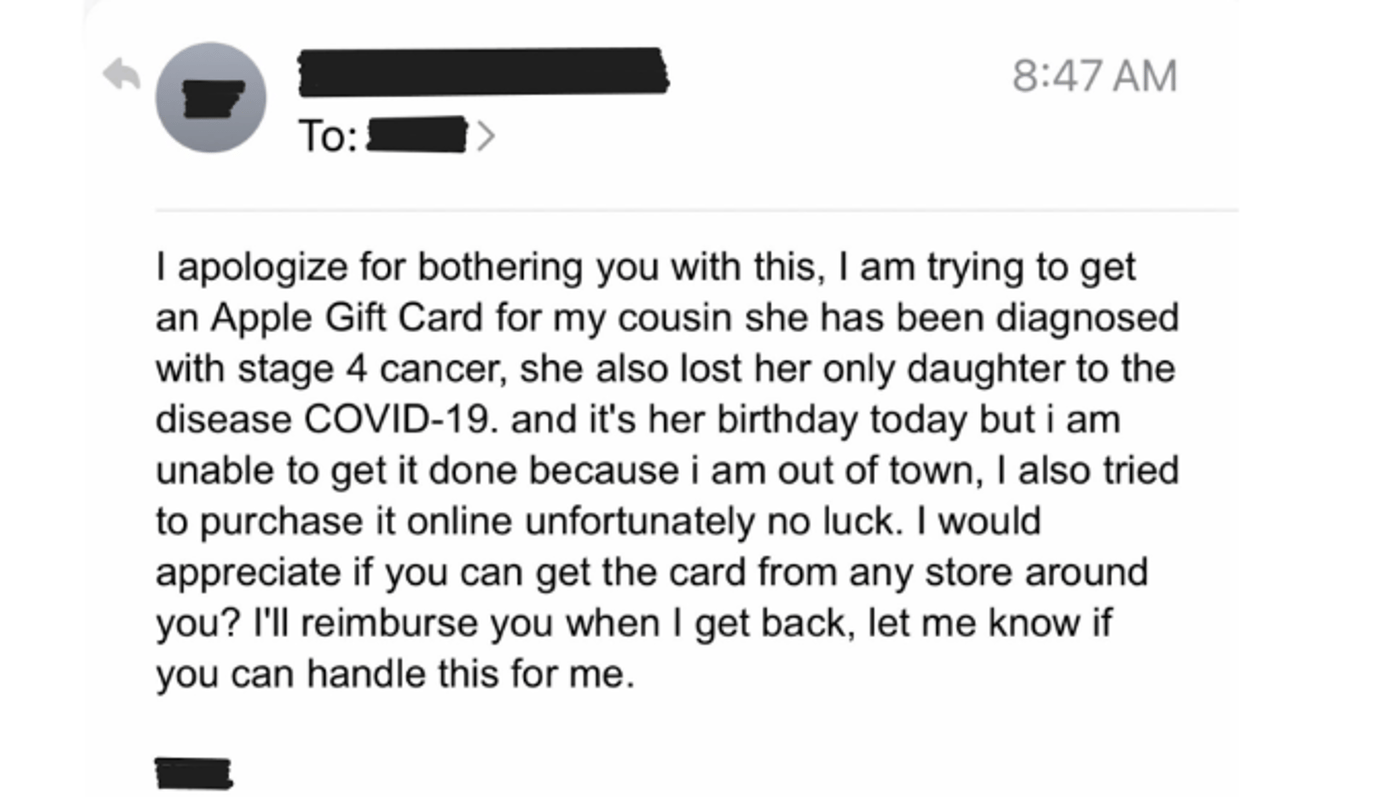
In hindsight, we can find flaws in it: run-on sentences, capitalization errors, and awkward phrasing. But it also contained all the elements that draw victims in: one or more emotional stories, impersonation, physical distance, and a writing style that seems just credible enough.
It’s not clear how Alice received the email, which appeared to come from Ken’s Shaw/Rogers address, but Ken admits to “clicking on something” that led to a spoofed version of Shaw’s webmail site. Later, he told Alice that his entire inbox had been wiped. The scam email was also sent to others in Ken’s address list.
Whether the scammer had remote access to Ken’s computer, which seems unlikely, or simply full access to his webmail account, which seems more likely, we can’t tell. In any case, she believed it was genuine. As Alice put it, “Ken never wastes time. That’s why it made sense to me that he didn’t have time himself to get the gift card.”
When Alice replied, “Of course. Which card? Where should I drop it off? I’m in church right now,” the die was cast. Part 1 of the scam was in motion.
The scammer quickly specified an Apple gift card worth $400 and asked her to scratch off the backing to reveal the PIN, then email the card number and PIN. Alice even offered to drop off the card and visit the sick “cousin.” The reply said the cousin was in Montreal. Distance, or separation, is a key part of such scams.
Shortly after, Alice bought the card and sent the details by photo. Exactly how the scammer redeemed it is unknown, but it opened the door for escalation. The “cousin” was happy to receive the card and was trying to use it but it wasn’t enough to cover the purchase she was trying to make. Another card, this time for $500, was needed, which would be reimbursed by e-transfer along with the previous $400.
Successful, the scammer was now confident and went for broke: the cousin now needed $800 more, $1,700 in total, to buy a phone and accessories.
Alice grew suspicious. She emailed Ken, asking him to call her, but the scammer had a ready excuse: a problem with the SIM card that allowed only email.
Alice stalled, saying she would send the remaining amount the next day. The scammer tried emotional appeals, but she held firm. Perhaps fearing loss of access to Ken’s account, he sent a new address for the “cousin,” asking Alice to send the gift card details there. She didn’t, and that address was inactive within five days.
I’ve written many columns about scams, and there’s never a shortage of variations. This one resembles the “grandparent scam.” Even as I write, a local news story scrolls by about a senior losing $2,700 trying to help a supposedly jailed grandchild.
I asked cybersecurity expert Dominic Vogel (my son) to comment. He said any such request should always be verified by a second method. An email like the one that fooled Alice should never be acted on until there’s a confirming phone call, and that call must be initiated by the recipient, not the sender.
Alice did report the incident to police. She said officers were respectful, polite, and efficient. Recovery is rare, though not impossible. She later confirmed that at least one other friend of Ken’s also sent money in response to the same scam.
As for those Apple gift cards, scammers typically resell them within minutes on underground markets for 50 to 80 per cent of their value.
Follow me on Twitter/X (@PeterVogel) or on Bluesky (petervogel.bsky.social).
Your voice matters! Join the conversation by submitting a Letter to the Editor here.







