

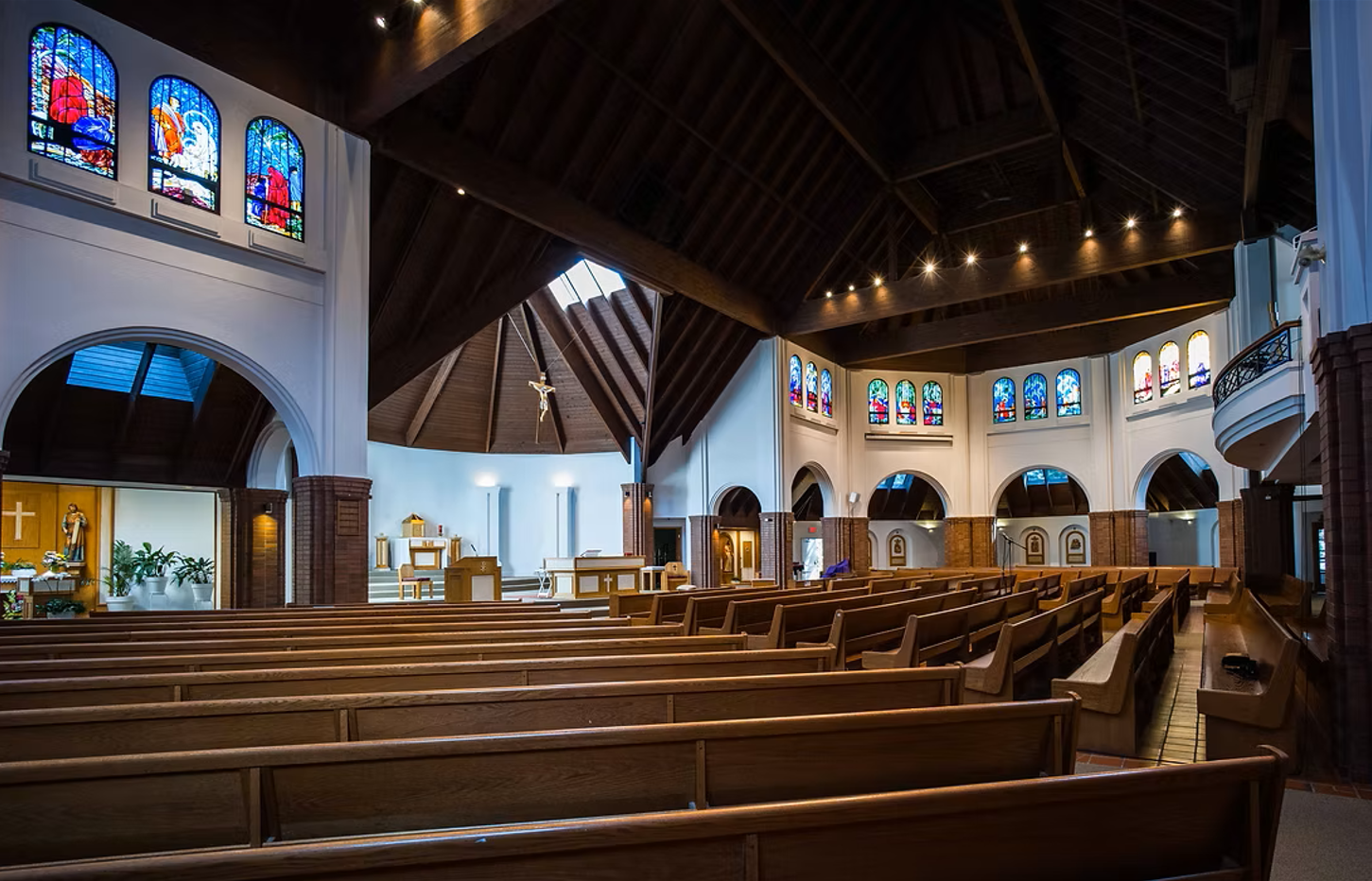

“A picture is worth a thousand words,” Msgr. Gregory Smith said at Alessandra Bitelli’s funeral Mass. But 26 pictures surrounding an entire church? That’s worth a story all its own.
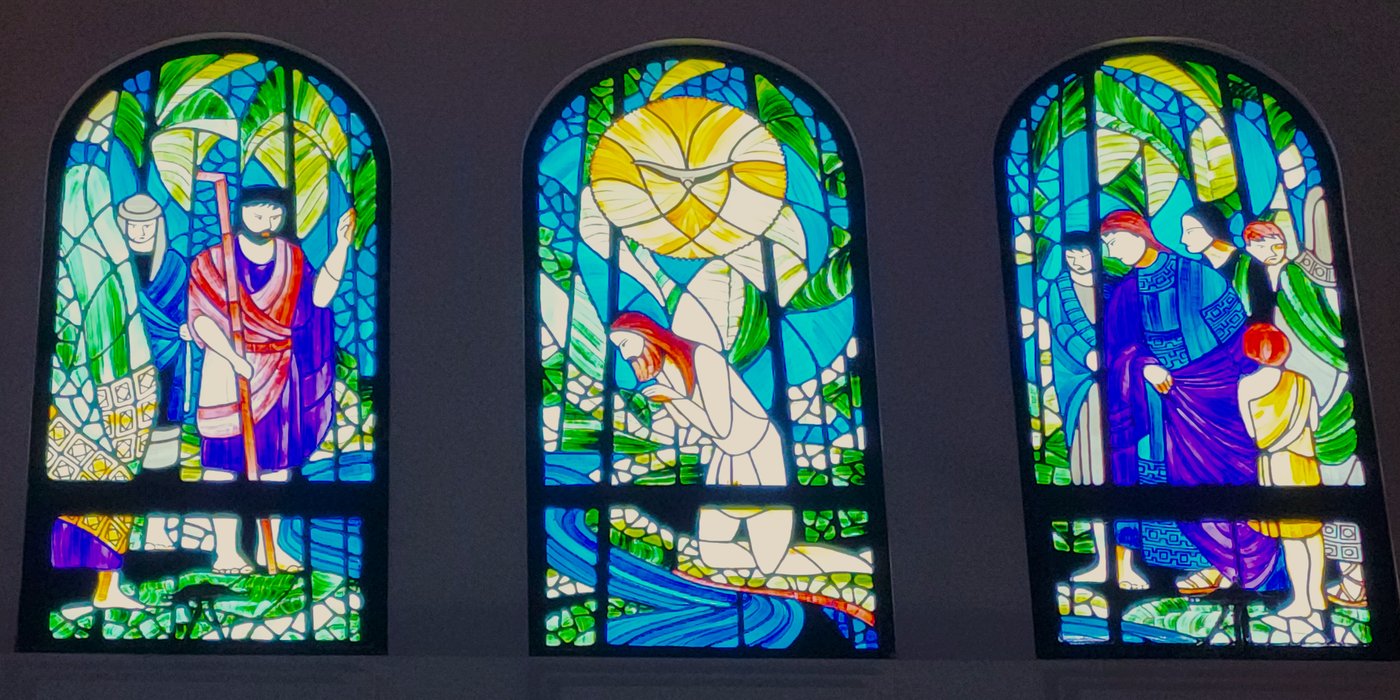
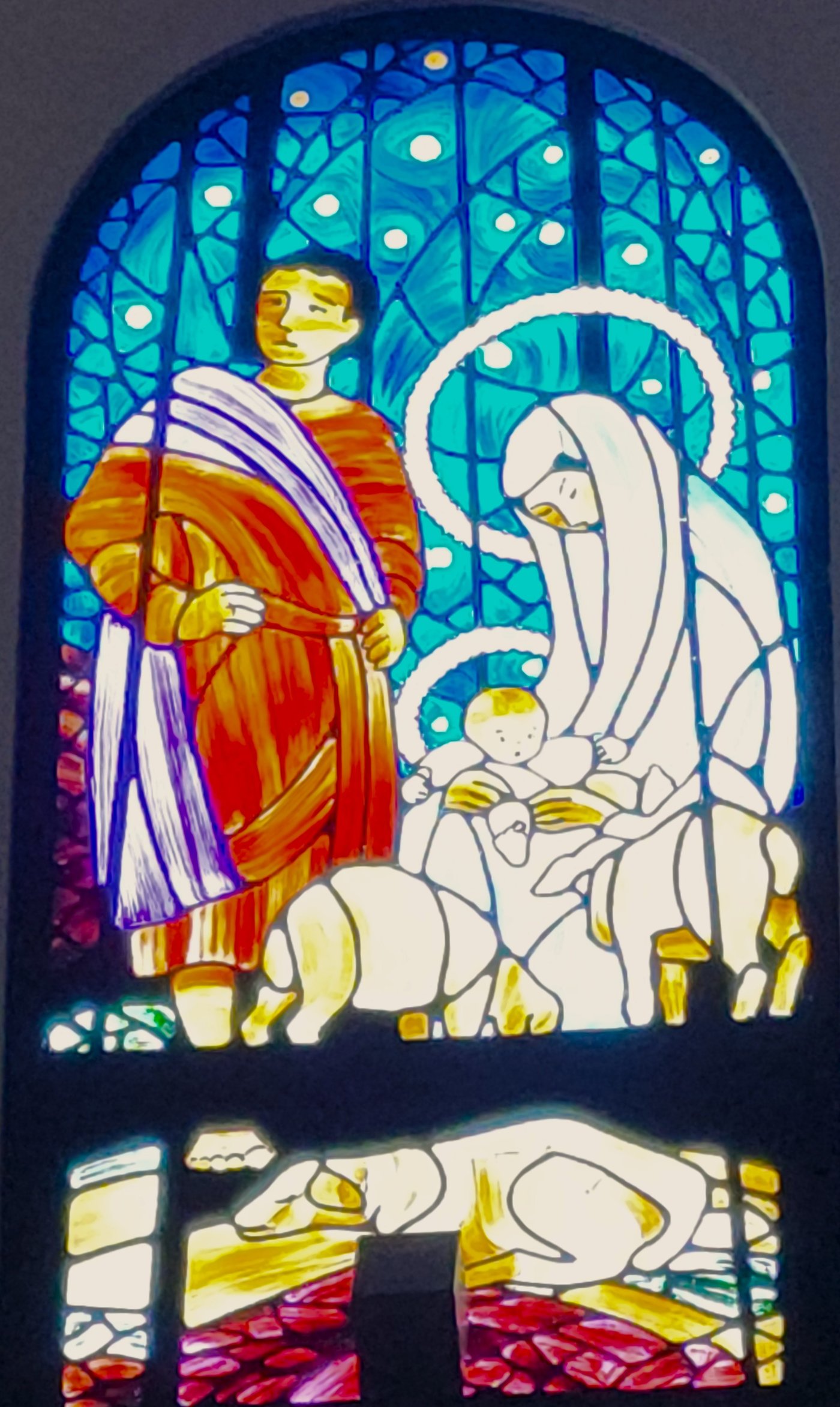
Bitelli, a recognized Vancouver artist who died last year at 96, created the painted glass windows encircling the sanctuary at Christ the Redeemer Church in West Vancouver. In his homily, Msgr. Smith paid tribute to the images, describing them as not just decoration, but as catechism, telling the story of salvation much like ecclesial art did in the Middle Ages before most people could read.
Bitelli’s windows trace the life of Christ from birth to crucifixion. Some depict Jesus with children, apparently in response to a request for images that might be more accessible to youngsters. That was typical of Bitelli. Despite her accomplishments as an international award-winning painter, friends remembered her as a “servant artist” who was willing to use her gifts to support charities such as North Shore Pro-Life, for which she painted Christmas cards.
After Bitelli’s funeral Mass on May 6 at Christ the Redeemer, several people urged The B.C. Catholic to write a story about her, her art, and the windows. Reporter Nicholas Elbers and I set out to find out what we could.
What began as a simple feature turned into a slow, year-long search for the woman behind the windows.
We learned that Vancouver Archbishop J. Michael Miller had admired her work, but he had recently retired and moved to Texas, and we learned little else.
Searches through the B.C. Catholic’s archives turned up almost nothing about the two years Bitelli devoted to the Christ the Redeemer windows.
We found scattered references to exhibitions and awards. Bitelli had exhibited at the Federation of Canadian Artists gallery on Granville Island, and longtime West Vancouver gallery owner Mary Southerst had carried her work for years at her Buckland Southerst Gallery. Southerst was drawn to the artist’s use of composition and texture and said Bitelli was “always experimenting,” and that “though she is an older lady she is a very contemporary painter.”
In a 2003 article in Galleries West magazine, Shannon Heth wrote that Bitelli “explores modern concepts in her paintings while maintaining delicate balance between the contemporary and the traditional.”
But details about the windows themselves, and even finding one of her works locally, remained elusive.
Meantime, the news world interfered. As we were pursuing an uncertain Bitelli feature, a perfect storm of historic news events pushed everything to the margins for several months.
Bitelli died four days after Pope Francis and one day before the Lapu-Lapu tragedy. Her funeral took place just as the conclave was beginning in Rome. Over the next few days and weeks, Pope Leo XIV was elected, Archbishop Miller said farewell, and Archbishop Richard Smith was installed. The weeks that followed brought memorial Masses, public mourning, papal transition coverage, and Archbishop Smith’s receipt of the pallium from the new Pope.
Stories like Bitelli’s can be like detective work. They take time — pursued between deadlines, meetings, and the constant demands of more immediate reporting. There were still family members to reach out to, former colleagues who might remember her, and comments on her online obituary that hinted at unexplored threads. Yet it was coming up on a year after her death and the story still had not quite revealed itself.
Recently I tried to pick up some of those threads again. I visited the Federation Gallery on Granville Island, where they confirmed Bitelli had exhibited there but could offer nothing else.
A visit to Christ the Redeemer turned up little from its archives, although the parish had an undated television interview in which the artist recounted how she was invited to undertake the project by Father Peter Mallon and Oberto Oberti Architecture.
“It was something very exciting and very challenging because of the magnitude of the job,” Bitelli said.
It was the only time I heard her speak about the windows in her own words, and yet the broader story remained stubbornly incomplete. The project was remarkable. Her life was fascinating. But the personal connection I was looking for still remained elusive.
After a year of trying to come up with a story, and having missed the anniversary of her death, it felt like it was time to let it go. Despite several remaining angles to pursue, there are only so many hours that can be spent pursuing a story before it starts to feel like chasing Rosebud in Citizen Kane.
Then, during one final search through old emails and documents, something unexpected turned up.
It was a painting of the infant Jesus surrounded by children — an image Bitelli had painted as a Christmas card for North Shore Pro-Life. The artwork had appeared in The B.C. Catholic on Oct. 25, 1992.
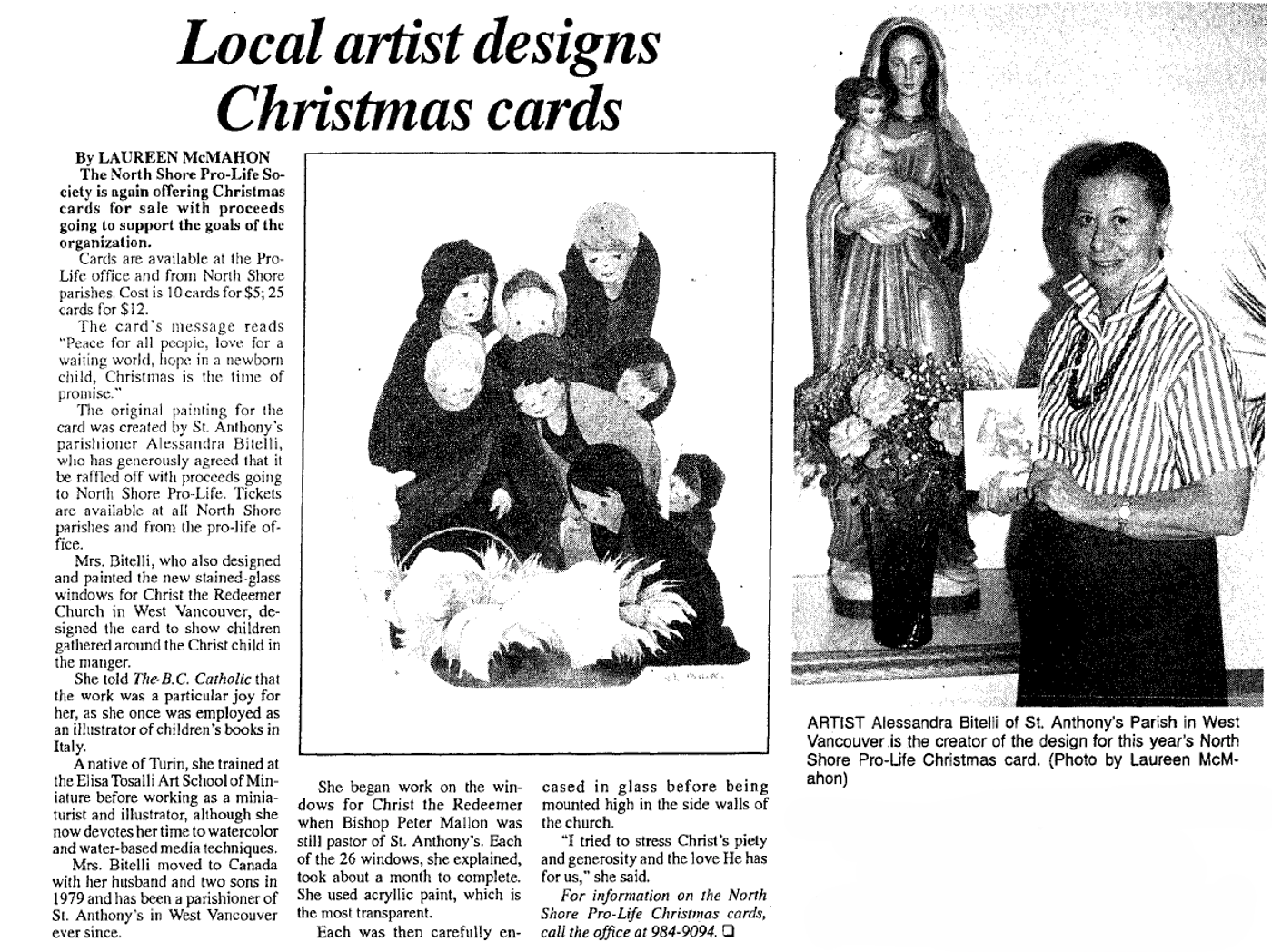
The image looked very familiar.
I glanced up at the wall of my office.
There it was.
Framed in glass and hanging in plain sight all along was the same image — a numbered print received from North Shore Pro-Life with its 2002 Journalist for Life Award for coverage of life issues.
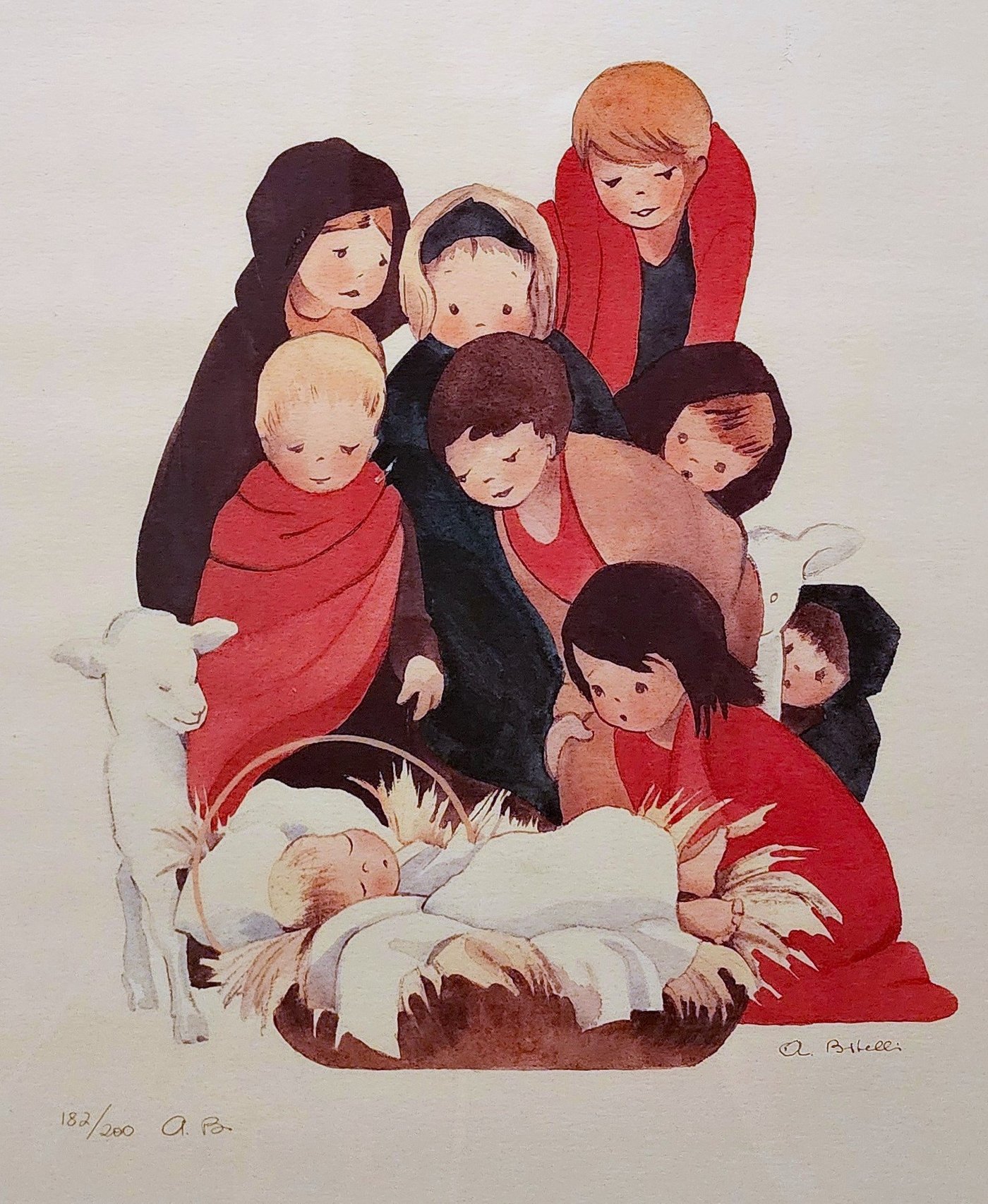
For a year I had searched for something tangible to connect me to Alessandra Bitelli and her work. All the while, one of her paintings had been quietly hanging in my office, waiting for me to notice it.
I’m thinking Alessandra Bitelli finally decided a year was long enough to spend chasing the story.
Thanks, Alessandra.
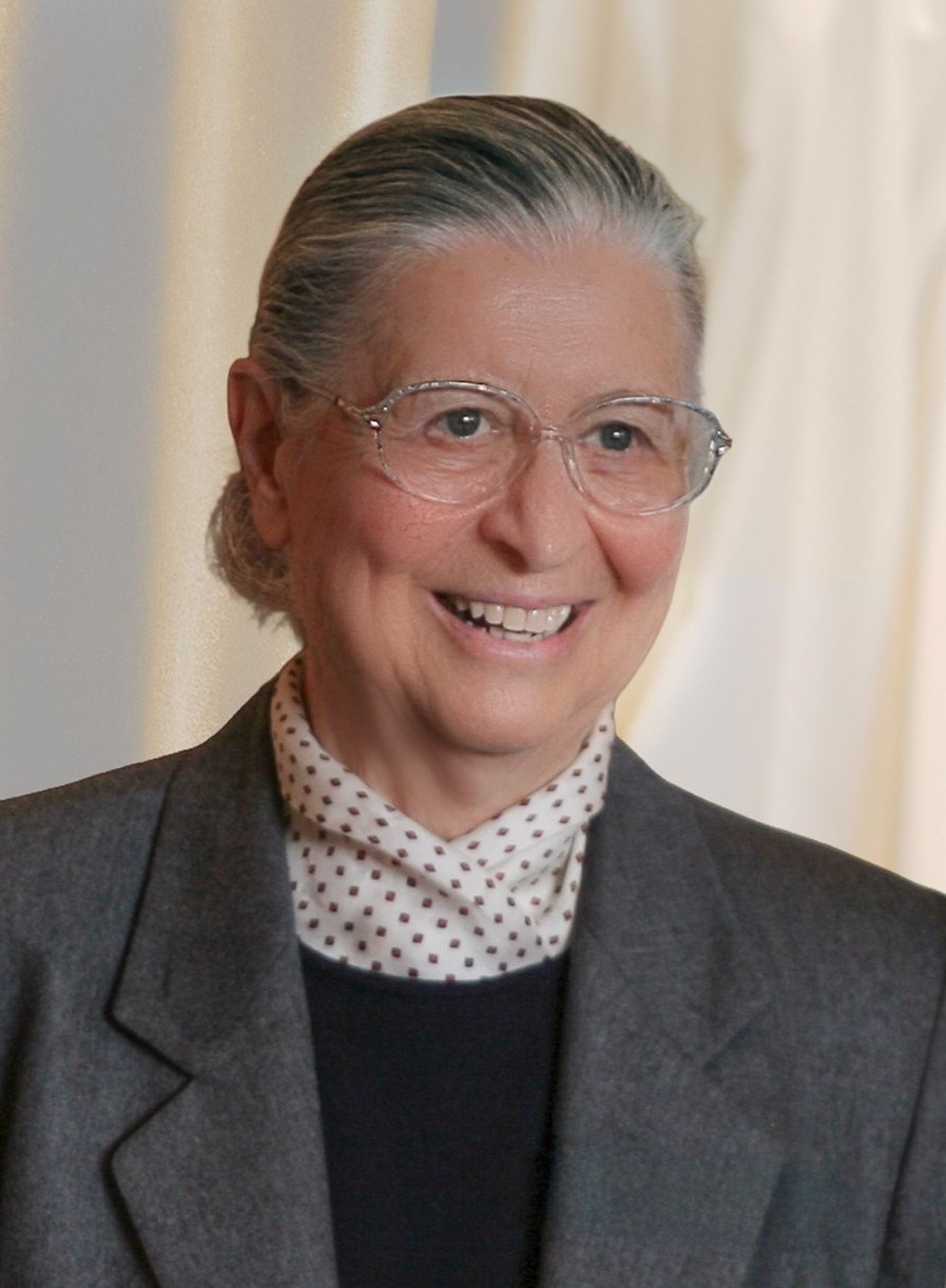
The artist behind the windows
Alessandra Bitelli’s life could have been lifted from a movie script.
Born in Turin, Italy, she followed her father into the art world, becoming an illustrator of children’s books and studying the art of miniatures at the Elisa Tosalli Art School of Miniature.
During the Second World War, while still a student, she contracted tuberculosis. She fell in love with the doctor caring for her, Renato, whom she married at 21.
The couple eventually immigrated to Canada and settled in West Vancouver, where Bitelli continued working in water-based media, pen and ink, and acrylics.
Over the years, she received numerous awards and exhibited throughout Canada, Italy, and the United States. She conducted workshops and remained active with the Federation of Canadian Artists.
Artist Jennifer Heine later recalled her generosity:
“We were very lucky to have Alessandra involved with the Federation of Canadian Artists for many years. I remember her from my father’s peer group and valued her continued support.”
In an undated television interview found in the Christ the Redeemer archives, Bitelli described the windows as a project rooted in the very name of Christ the Redeemer Church.
The panels, she said, were episodes from the life of Christ, chosen with particular attention to his teaching and his mercy. They move from the Nativity and the baptism of Jesus in the Jordan through miracles such as the multiplication of the bread and the fish, and finally to the Last Supper, the Crucifixion, and the Resurrection, symbolized by rays of light behind the cross.
Then she offered a characteristically humble reflection.
“As I think almost all artists, I’m never completely happy with anything I’ve done. Therefore, I would like to be able to go over and correct some things, but there are, of course, things that I really like and am happy with.”
Did she ever make those corrections? More likely those things she really liked and was happy with persuaded her to set her paint brush down.
Your voice matters! Join the conversation by submitting a Letter to the Editor here.







