

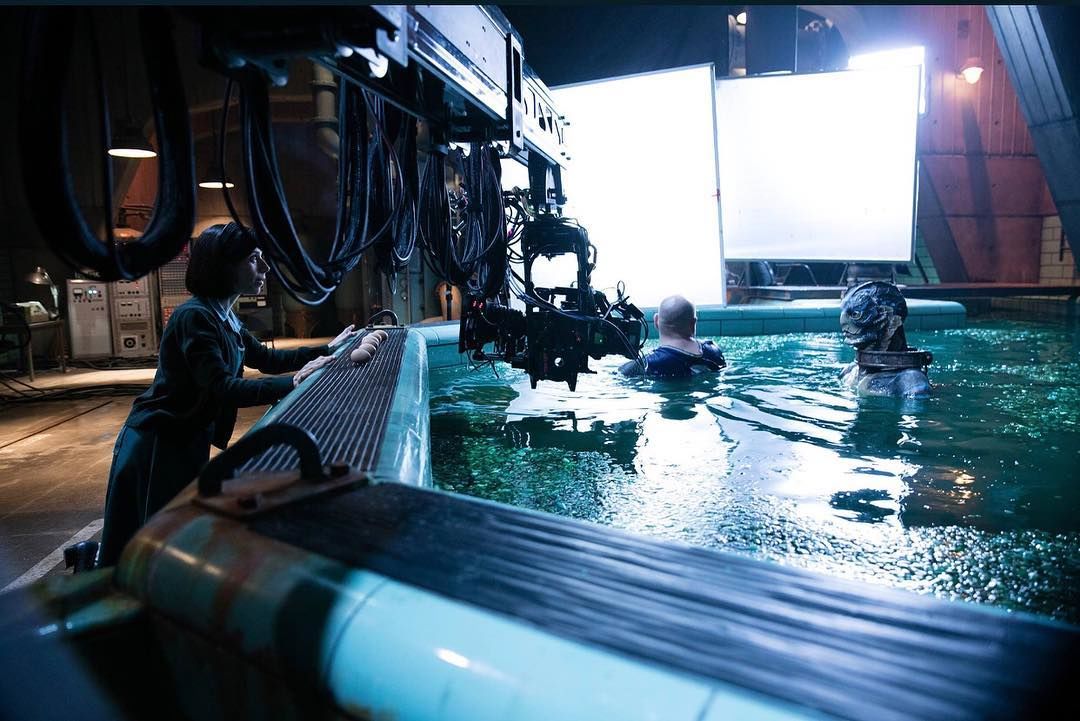

“De gustibus non disputandum est.” Such was the adage of the Romans, stating that matters of taste cannot be disputed. So it is that I accept the fact that the Academy of Motion Pictures Arts and Sciences voted Guillermo del Toro’s The Shape of Water as the Best Picture of 2017.
However, I would hasten to add that it is certainly not to my taste.
The Shape of Water is a film in which del Toro retells the story of Beauty and the Beast in such a way as to provide a kind of homage to movies of the past, particularly those of the Thirties, Forties, and Fifties, to create a kind of fantasy world in which it is possible for a woman to fall in love with a monster, and to tell the story of lonely beings, each attempting to communicate with others. The problem for me is that he is unable to bring all these elements together in such a way as to make of them a convincing and palatable whole.
Living up to his reputation as a visionary of the fantastic, del Toro begins his film with a hauntingly beautiful underwater scene and then switches to the protagonist, Eliza, superbly played by Sally Hawkins, shown masturbating in a bathtub – presumably meaning to show that her sexuality will be fulfilled in water.
Eliza is then portrayed sharing a friendship with the man in the neighbouring apartment, Giles (Robert Jenkins), a closeted gay man who seeks refuge in the musical movies of the past and television shows such as Mr. Ed. We then follow Eliza to some sort of scientific research establishment, where she works as a cleaner in company with Zelda, an African American woman who seeks to protect her. There, Eliza encounters an amphibian monster, obviously inspired by The Creature from the Black Lagoon, chained up in a tank. And that’s where things for me fall completely apart.
Instead of being fearful, even terrified of the monster, Eliza immediately and unquestioningly forms an attachment to him – something which completely contradicts what little we know of this shy, sheltered, and lonely woman.
It is true that fairy tales are not known for their complete and logical plot developments, but simply to throw in poorly developed stories without adequate explanation is inexcusable. A story of ruthless scientists willing to experiment on a foreign life form and set against a background of the Cold War may arise from the director’s wish fondly to recall some of the less than memorable films of the past, but it merely establishes a kind of false reality, altogether at odds with fantasy.
In this vein, del Toro throws in an ambition-crazed officer, Strickland, played by Michael Shannon, who seems to be an over-the-top version of General Jack D. Ripper from Dr. Strangelove; Michael Stuhlbarg as Dr. Robert Hoffstetler, a conflicted Russian spy posing as a doctor – not exactly Alec Guinness as Our Man in Havana, but we all get the idea; and Octavia Spencer as Eliza, a condescending (indeed almost stereotypically cinematic racist) portrait of an African American woman who seems to be a debasement of Hattie McDaniel’s already questionable portrait of Mammy in Gone with the Wind. (It may be a reflection of the past, but do we need to resurrect it in the present?)
As well as indulging his passion for old films,
Del Toro moves us into the modern period of cinema with considerable gore and
eroticism, including a totally and inexcusably redundant scene of Strickland
having sex with his wife. Adding to this, he indulges in several lapses in plot
structure, completely ignoring, for example, the difficulty of getting a
monster out of a van and into an apartment, as well as presenting a highly
unlikely co-incidence of plots involving the fate of the monster. Yes, fairy
stories often leave out key plot developments, but even the worst films of the
Fifties tried to tell stories that did not ignore logic.
Straddling as he does the cinematic past and present, the world of fantasy and the world of modern cinematic realism, and a story of love and fulfilment, del Toro has most importantly failed to do what was essential: create an all-embracing embracing vision – one which is magical enough to make everything that he includes possible, and poetic enough to make it credibly and captivatingly fantastic.
Clearly, for some he has succeeded, which explains the Oscar. For me, the film was far too scattered and frustrating. For some, it may well be engrossing. For me, though the film is relatively short, the ending couldn’t come soon enough. I still cling to the view that Lady Bird was the best movie of 2017, and instead of seeing The Shape of Water, I’d rather see Disney’s Beauty and the Beast. It really is a matter of taste.







