


Initial reactions to Pope Francis’ July 25 apology to residential school survivors were deceptively positive, if not grateful.
“I’ve waited 50 years for this apology and finally today, I heard it,” said one residential school survivor following the event in Maskwacis, Alta.
Another said, “a lot of people will go home now and start to feel more content and … happier, hopefully.”
Chief Vernon Saddleback of Samson Cree Nation, said, “I have a lot of survivors and thrivers in my community who are happy to hear the Pope has come to apologize. Words cannot describe how important today is for the healing journey for a lot of First Nations people.” He called it “a day for everyone in the world to sit back and listen.”
Chief Phil Fontaine, former national chief of the Assembly of First Nations, said it was “an achievement on the part of the Indigenous community to convince Pope Francis to come to a First Nation community and humble himself before survivors in the way he did today. It was special. And I know that it meant a lot to a lot of people. And every time he said the word sorry, people would start applauding.”
Chief Wilton Littlechild of the Ermineskin Cree Nation told the Pope his words “clearly came from the depths of your heart, and were for those who heard them a source of deep comfort and great encouragement.”
Littlechild is a survivor of the former Ermineskin Indian Residential School, a former commissioner of the Truth and Reconciliation Commission, a lawyer, and a former parliamentarian. He had been calling for a papal apology and joined the official delegation of Indigenous representatives to the Vatican in March.
Littlechild placed his own headdress on the Pope, which an elder described as honouring him for his work and welcoming him into the tribe. In response, the Pope kissed Littlechild’s hands, just as he has done for Holocaust survivors and on this trip residential school survivors.
Ermineskin Cree Nation Chief Randy Ermineskin, whose community hosted the papal apology, said the day will always be marked as a significant event, sending a message across the land.
Within 24 hours, there had been time to produce a new narrative in which the initial favourable responses were replaced with criticism and denunciation.
Indigenous and non-Indigenous voices were quoted saying the papal apology didn’t go far enough. It was a failure because it referred to children suffering physical, verbal, psychological and spiritual abuse, without mentioning sexual abuse or genocide. Francis failed to apologize for the collective actions of the Church. He didn’t make the Church accountable and announce concrete action and reparations. He had taken too long. He needed to repudiate the doctrine of discovery. One First Nations chief said the Pope should have gone to Kamloops “where all the mass graves and burial sites were found.”
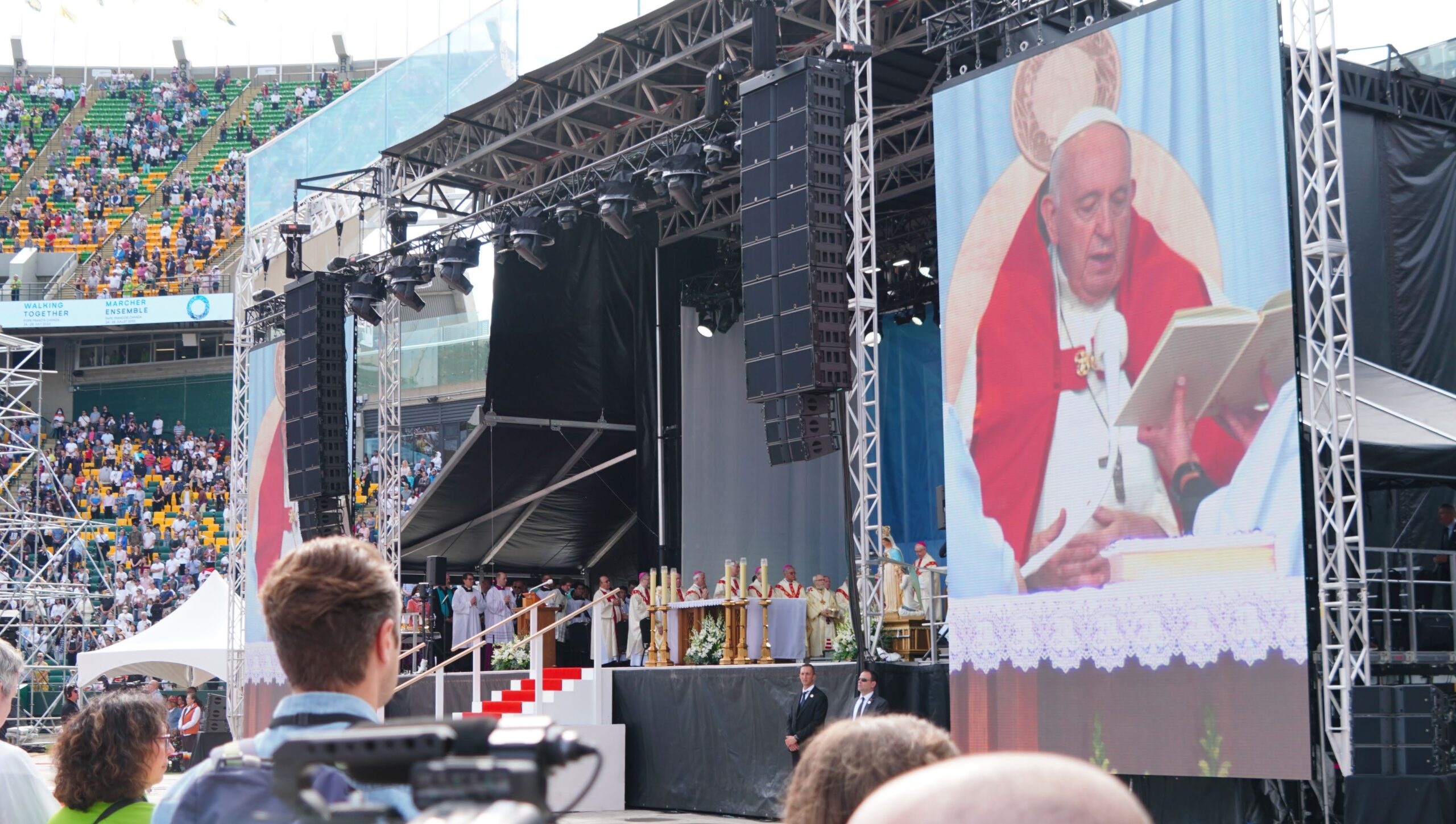
By the time the Commonwealth Stadium Mass ended the next day, that event was being called a missed opportunity for the Pope to incorporate Indigenous languages and worship in the Mass. Even worse, he used his homily in Edmonton to speak of the importance of grandparents and elders, “in stunning ignorance of the fact that many of those grandparents barely lived through residential school,” said one writer.
Fontaine, himself a survivor of sexual abuse at the schools, responded to the growing criticisms by noting the Pope’s apology “reflects the reality that the Catholic Church in Canada is not one institution. It is made up of about 73 different legal institutions, all of which were defendants in the lawsuits.”
He noted that the next day, in a speech to government officials, the Pope acknowledged “local Catholic institutions had a part” in the residential school system, going beyond his original apology. That was significant, said Fontaine, and as close as it was possible to apologizing for the entire Church in Canada.
“If we’re true to our word in terms of healing and reconciliation, we’re going to have to be able to forgive. He’s come here before us a humble person begging for forgiveness, and of course you have to take that seriously,” he told CBC. “Because we also want to move on. We want to find peace and solace in our lives. And if we can’t bring ourselves to forgive, then this matter, this burden that we’ve had to shoulder for years and years, that’ll carry on endlessly.”
Needless to say, the federal government also joined the growing chorus of declaring the Pope’s actions insufficient, with Prime Minister Justin Trudeau saying more needed to be done and Crown-Indigenous Relations Minister Marc Miller faulting the “gaps” in Francis’ apology.
The Church’s role in the residential school system is as complex as it is long, and oversimplified ways of looking at it can be used to justify any response, from false reports about mass graves to declaring the Holy See responsible for every aspect of residential school history. It’s important to look at history not strictly through a lens of total and abject denunciation, but in all its complexity. The ongoing Into the Deep: Truth and Reconciliation series we’re publishing on the work of reconciliation with Indigenous peoples presents just such a comprehensive picture.
It’s unfortunate that at the end of the Pope’s visit to Canada many will only see apologies in need of correction as they reduce the papal pilgrimage to deliverables and checkboxes.
They won’t see a Mass at Commonwealth Stadium that featured First Nations culture as well as various languages presenting the universality and historicity of the Church. Where the Pope used his homily like a priest uses a Christmas or wedding homily to provide a message that is impactful for those who aren’t the core audience and evangelizes to a wider congregation.
Pope Francis did not disappoint, referencing the feast of Ste. Anne, the reason he was in Canada at this time. He incorporated his recent catechesis about grandparents and elders in a world that is marginalizing them, and even killing them.
Although he was criticized for talking about family to survivors who may have been deprived of family because of residential schools, Francis was bearing Christian consolation in the midst of pain, hardship, and brokenness. The Church teaches about the important role of the family, even for those who have no family. It speaks of the necessity of parents, even to those who may have had no father or mother.
Francis’ message was important because the message of grandparents is important. As he said in his July 24 message for World Day for Grandparents and Elderly, which he established two years ago, “The elderly are not outcasts to be shunned but living signs of the goodness of God who bestows life in abundance. Blessed is the house where an older person lives! Blessed is the family that honours the elderly!”
His homily in Edmonton spoke not only of grandparents, but of elders and all those who came before us. “Preserving the history that gave us life also means constantly returning to that school where we first learned how to love. It means asking ourselves, when faced with daily choices, what the wisest of the elders we have known would do in our place, what advice our grandparents and great-grandparents would have given us.”
It’s a message that is as applicable to residential school survivors as it is to all Canadians: The importance of being children of a history that needs to be preserved. We are authors of a history yet to be written.
Far from being insensitive, Francis was delivering a message of hope, inviting people to be “artisans of a new history, weavers of hope, builders of the future, peacemakers.”
He asked, “What is it that I must now do?,” a question that each of us should ourselves daily.
“Brothers and sisters, it is easy to criticize, but the Lord does not want us to be mere critics of the system, or to be closed and ‘backwards-looking.”
Based on the spontaneous applause the Pope received at the end of the Mass, delaying Archbishop Richard Smith’s closing remarks for more than a minute, those attending understood and appreciated Francis’ message
At the end of his pilgrimage the Pope would leave all Canadians asking themselves, “Am I giving life? Am I ushering into history a new and renewed love that was not there before?”
It’s message that is as important as one of repentance and reconciliation.







