
It is obvious that a multitude of people, families especially, Christian or not, have their own Christmas customs. Whether they are centred around churchgoing and the singing of carols, gift-giving, decorating, or cooking, many of those customs owe their continuance to Charles Dickens. After all, the great novelist has been dubbed “the man who invented Christmas.”
Certainly, many of the Christmas traditions, ranging from decorating with holly to playing games at Christmas parties, were lent immortality by the vivid descriptions in his works, starting with Pickwick Papers and on through his Christmas stories.
Most notable among these is, of course, A Christmas Carol. Since its publication in 1843, the story of Ebenezer Scrooge has enjoyed enormous popularity. Not only do many (not as many as I would like!) annually read the heartwarming, brilliantly written story of the miser’s conversion from skinflint to benefactor, but it has, of course, been given innumerable adaptations, including many film versions.
Probably most beloved is the 1951 film, starring Alistair Sim as Scrooge; I must also go on record as saying that I enjoy almost as much The Muppet Christmas Carol, released in 1992. Regardless of how many versions are offered, there is always room for one more.
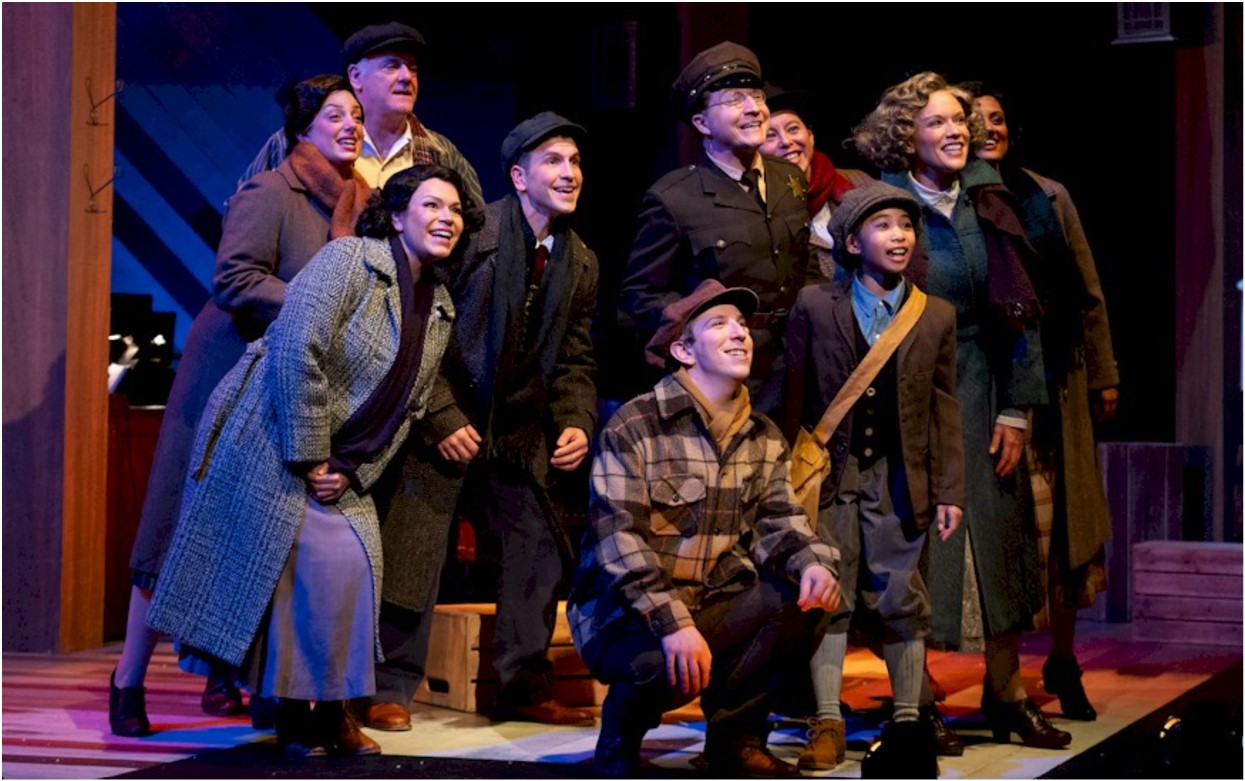
So it is that, after a three-year absence, one joyfully welcomes a return to the Arts Club on Granville Street of Dolly Parton’s Smoky Mountain Christmas Carol, through Dec. 24.
While staying true to the novella’s narrative trajectory, this musical version is, as its title suggests, set in Tennessee. It is no longer in Victorian Britain, with all the negatives of the Industrial Revolution providing a background, but in the Great Depression in 1936. It is liberally laced with references to moonshine, oatmeal with raisins, and rural poverty. At the same time, the songs not only reflect the setting but are also exactly what one would expect from the talented Miss Parton.
The result is a wonderful tribute to the great themes of Christmas: love of others, forgiveness, and benevolence. The Arts Club production certainly does the show full justice. As song after song bursts forth, with titles such as “Appalachian Snow,” “Three Candles,” “Circle of Love,” and “Christmas Party,” the performance is enlivened with plenty of humour, lots of high-stepping dancing clearly inspired by Agnes De Mille and Michael Kidd, and, at the centre of it all, there remains the familiar tale of Scrooge, Bob Cratchit, and Tiny Tim.
The production is beautifully mounted with a masterly fluid set, appropriate costumes, and brilliant lighting. The cast of twelve, headed by David Scott as a superb Scrooge, do total justice to the work, performing a multitude of roles with crowd-pleasing enthusiasm and energy which simply grows richer as the performance unfolds. It tells its familiar story with grace, comedy, and emotional impact.
In short, if one is looking for a new ingredient to give variety to one’s traditional Christmas entertainment, then a visit to the Granville Street Arts Club Theatre is just what the season demands. Above all, in a world that too often ignores the underlying message of the real Christmas story, it is a timely reminder of the real meaning of the season.
Your voice matters! Join the conversation by submitting a Letter to the Editor here.