
For the 2025 Jubilee, the Vatican unveiled a cartoon mascot as the light-filled face of the Catholic Church during the holy year. Named Luce (pronounced LOO-chay), the mascot made a pop culture debut in comics, video games, and social media. Archbishop Rino Fisichella, the Vatican’s chief organizer for the jubilee, said the shining eyes of Luce (light in Italian) are “a symbol of the hope of the heart.”
Just a question: Why do we need a Jubilee mascot?
When I think of a mascot, what comes to mind is someone dressed up in an animal suit—meant to inspire humour and enthusiasm, especially at sporting events. Mascots are fine in such circumstances.
But for a solemn Jubilee? What does an androgynous anime character have to do with the 1,700th anniversary of the First Ecumenical Council and the solemn definition of the full divinity of Christ as God from God, Light from Light, true God from true God? Little Luce will inspire no one under the age of 9, which we may presume is not the target demographic for pilgrims to Rome in 2025.
So why not a patron saint instead of a mascot?
Saints have several beneficial features that Luce does not.
First, they’re real and have the advantage of looking sort of like us. We can identify with them.
Second, they lived holy lives and provide an excellent example to follow.
Third, they’re in heaven, so they can intercede for us as companions on the way.
Fourth, should we complete the pilgrimage of our lives well, we get to meet them in heaven, so we might as well get to know them now.
There are thousands of saints to choose from—roughly ten thousand at last count—but some are specific to pilgrimage: Saint Christopher, who carried the child Jesus on his back; Saint Brendan the Navigator, who sailed across the Atlantic in an animal-skinned boat; Saint Thomas the Apostle, who journeyed all the way to India, like the future Francis Xavier. Then there’s Saint Albert the Great, called “Bishop Boots” for the untold miles he covered in his itinerant walks across the breadth of Europe; Saint Alexius, who arrived back at his own father’s house as an unknown itinerant and stayed in a closet under the stairs for years, his true identity only revealed after his death. And we may as well add England’s Saint Richard, called the Pilgrim.
But my own favourite is St. Benedict Joseph Labre, who spent his entire life going from shrine to shrine across Europe in prayer, penitence, and solitude, ending up in Rome, living as a hermit in the Coliseum (before it was a tourist attraction), and dying on the streets of the Eternal City on April 16, 1783. Children ran spontaneously out of their homes crying, “The saint is dead! The saint is dead!”
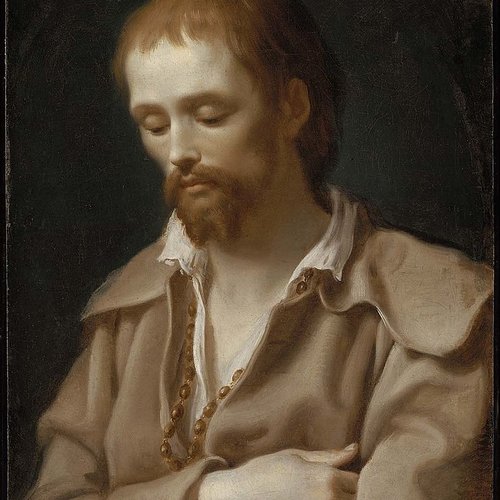
Benedict’s ascetic, serene Christ-like face and his prayerful demeanour stand in stark contrast to the cartoonish Luce. Benedict’s love and devotion to the saints, their relics, adoration of the Blessed Sacrament, the innumerable churches of the Eternal City, and the seat of Christendom are all inspiring, to say nothing of his countless miracles.
He’s always been a patron and inspiration to this author. I just re-read his wonderful biography by Agnes de la Gorce. I say “inspired” because much of his life I could not (would not?) imitate. I’m far more a stay-at-home hobbit and far less an ascetic than he. That said, like Frodo, I do get the desire to pilgrimage and to wander incognito to holy places far off.
I’m not sure I’ll make it back to Rome—with rents through the roof, I may have to sleep in some alleyway like Labre. But whether you go or not, try a pilgrimage somewhere. Even if it is not a ‘holy’ place, make it holy by a prayer, some holy water, planting a medal, or making a cross with some sticks. The earth is the Lord’s, and the fullness thereof (Ps 24:1). Our beleaguered Church could use all the prayers she can get as we barrel ahead into this Jubilee year.
Your voice matters! Join the conversation by submitting a Letter to the Editor here.