

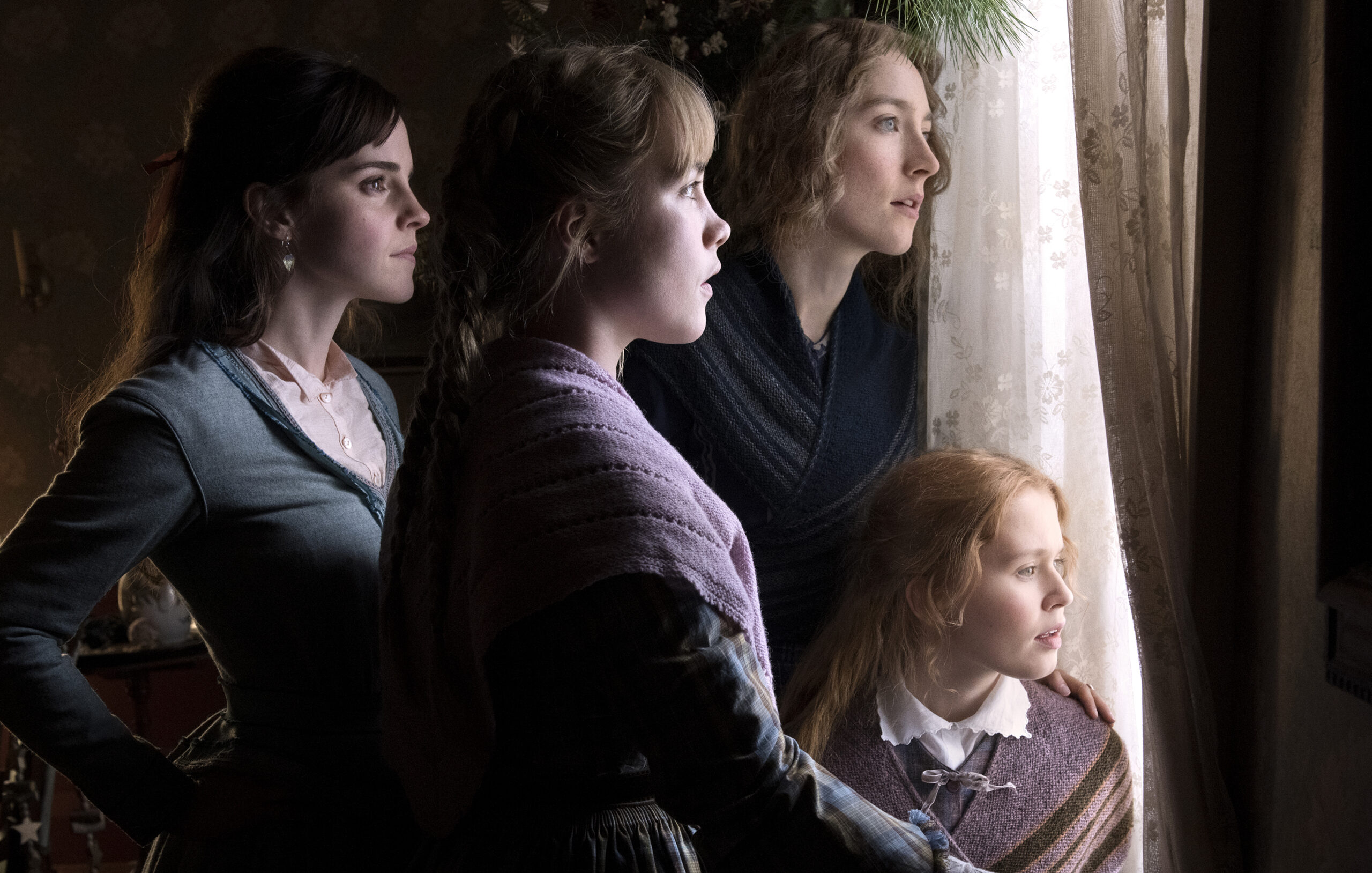

There is perhaps a danger in too high a level of expectation. Fully aware of the great critical acclaim and popular approval accorded the latest film version of Little Women, I approached it with the greatest of hopes – perhaps too high, for I found the film to be a muddle and a disappointment.
Of the book itself, I had only the dimmest idea since it was well over 70 years ago that I read it; I did, however, remember that I had found parts of it, particularly those dealing with Beth, the youngest of the March sisters, far too reminiscent of the over-sentimentalized parts of Dickens – particularly Little Nell in The Old Curiosity Shop, the only one of Dickens’ novels that I totally dislike. However, I also recognized there is far more to the novel than that, so I attended the film prepared to be both entertained and impressed.
Now there is nothing wrong with an artist using a novel, even one as famous and beloved as Little Women, as a platform for her own ideas. This is clearly what Greta Gerwig, who both wrote and directed this latest of a multitude of film and television versions of the novel, has done.
Perhaps taking her cue from author Louisa May Alcott, who was a feminist and something of a social rebel, Gerwig has chosen to make her film a feminist statement. Focusing on the principal interests of each of the protagonists of the novel – acting (Meg), writing (Jo), art (Amy), and music (Beth) – Gerwig has used the film to decry that properly discredited notion that women’s only purpose is to get married and nurture the family.
There is absolutely nothing wrong, ether philosophically or artistically, with using a 19th-century book to express 21st-century notions; indeed, modern readers can be forgiven as they follow the fortunes of the March sisters for feeling some impatience with their willingness to suppress their own talents in conformity with the accepted social norms of the time. However, this needs to be done in a way which is artistically satisfying. This is the problem with the film.
As I watched the film, I must confess that for the first hour I was simply bewildered. The narrative leaps back and forth between Jo, the ambitious author, clearly based on Alcott herself, selling the manuscript of her novel, Little Women, and the events in the March girls’ lives, indeed the lives of Alcott’s family, on which the novel is based.
However, it is such a muddle of story-telling that I had no idea what was the “future” and what was the “past.” Moreover, my perplexity was not aided by the fact that the actresses portraying the girls, who in the novel grow from early adolescence to young adulthood, are clearly, with only one exception, well into their twenties. As a result, there was little sense of the passage of time – or explanation of their growth to a kind of maturity. They were all too clearly unable to be 14 or 15 years old.
At the same time, for much of the film, they were depicted as engaging in what Alcott termed “frolics” which repetitively had them screaming, yelling, giggling, and squabbling before wrapping themselves in conciliatory group hugs. For me, it simply became annoying.
The same problem revolves around the girls’ relationship with the boy next door, “Laurie,” who provides a great deal of the love interest of both the book and the film. Timothee Chalamet may be handsome and talented, but there is no way that he can be mistaken for a 15-year-old, pouty adolescent. He’s clearly a young man from start to finish, which makes nonsense of much of the narrative.
It is true that the second half of the film follows a more linear approach, but it all seems so hurried. Gerwig has chosen to include a selection of incidents to tell her story, but these at times are almost as bewildering as the first part of the film.
It may be that people attending the film have a better knowledge of the book, so that they are able to follow the film’s erratic course easily. Indeed, having come away from the film wondering about so much of it, I re-read the book.
I can see why Gerwig had difficulty in compressing its nearly 600 pages into a two-hour narrative, but I regret that she omitted some of its better moments – for instance, the charming way in which the March girls first meet their young neighbour, or the more convincing way in which Alcott recounts Jo’s development as an author. Above all, I was disappointed that she did not adopt a more linear narrative.
However, Gerwig is a gifted director and she does elicit some strong performances from her actors. The cast valiantly try to portray their characters, though clearly struggling with the age factor. Laura Dern as Mrs. March conveys the warmth of the character without having to resort to the original’s preachiness. More impressively, Gerwig has made a film which is a visual delight. Much of the action seems to be taking place in some kind of isolated rural area, though supposedly very close to the thriving town of Concord, Mass. The result is a charming and lovely setting for the story.
And though the March children are supposed to be poor, they do seem to be able to sport an impressive variety of dresses, so that scene after scene is a dazzling display of colour and texture.
In the end, however, I left the theatre disappointed that Gerwig, whose Lady Bird remains one of my favourite films of recent years, was not able to manage proceedings better.
I realize my negative reaction places me very much in a tiny minority of those who have seen the film, but I advise anyone who has not read the book recently to familiarize themselves with it before doing so.







