


“I grow old but always learn many things,” said Solon, the ancient Greek poet and statesman who reformed the laws of Athens.
In this famous saying, he gives encouragement to anyone experiencing the difficulties of aging. No matter how old you are, you can still tap into the incomparable thrill that goes with learning a little bit of something new each day.
Subjects like physics and math are worth knowing for their own sake. The experience of solving a problem and understanding its solution brings us great joy.
Even revisiting simple but powerful ideas like the Pythagorean theorem, which we may have learned only by rote memorization in our school days, can be worth it.
One gift of old age is the ability to suddenly understand something for the very first time. We can savour and feel grateful for such an experience, especially if it had been denied to us earlier in life by unjust circumstance.
I know many people who, when either close to retirement or already past their working years, firmly decided to revisit subjects they previously found baffling or inaccessible.
I can relate to the sentiment. Many ideas that are difficult to fully comprehend take time and patience. Unfortunately, for too many people their youthful experience of schooling felt stressful because of time pressure and competing demands on attention.
Recently science journalist John Horgan decided to seize the unexpected opportunity presented to him by the pandemic. Although the mathematics associated with modern physics had always been a barrier to him, he resolved to try to learn enough math to understand quantum mechanics in better detail.
I fully endorse any effort to grow in comprehension of physics and math. But to make the most progress, one needs to find the right teacher, otherwise you could land right back in the unpleasant experience of grade school incomprehension.
That’s why I have recommended the series of textbooks Physics for Realists, by Dr. Anthony Rizzi of the Institute for Advanced Physics. Rizzi has a rare gift for constantly relating mathematical abstraction back to concrete sense experience. He offers vividly memorable examples, which is what learners need in order to reach a complete understanding of the essences of things.
Solon and other ancient Greek wise men had the same poetic gift. Plato portrayed his great teacher, Socrates, actively engaging his listeners. Plato wrote many dialogues depicting Socrates’ classic teaching style, “the Socratic method.”
Socrates liked to toss around seemingly crazy ideas, but he always had a goal in mind. If we can be open-minded enough to consider what may strike us as odd or objectionable, we can open ourselves up to those exciting moments of sudden insight and comprehension.
The trick is we also have to be humble enough to admit just how much we don’t know. But once we do the hard work of finding our way to true humility, we have placed ourselves right where we need to be in order to make the breakthrough to wisdom.
In the Platonic dialogue called Meno, Socrates is shown teaching mathematics to an uneducated slave boy who never had the benefit of a good teacher. Most translations of this passage fail to communicate how Socrates succeeds in teaching abstract geometrical ideas: it’s because he is able to relate abstract essences back to the concrete sense experience of the learner.
The translation of Meno in John Deely’s Four Ages of Understanding is a rare exception. The reader can follow along when Socrates asks questions and the slave boy answers because Deely has a series of helpful diagrams. Most translations don’t.
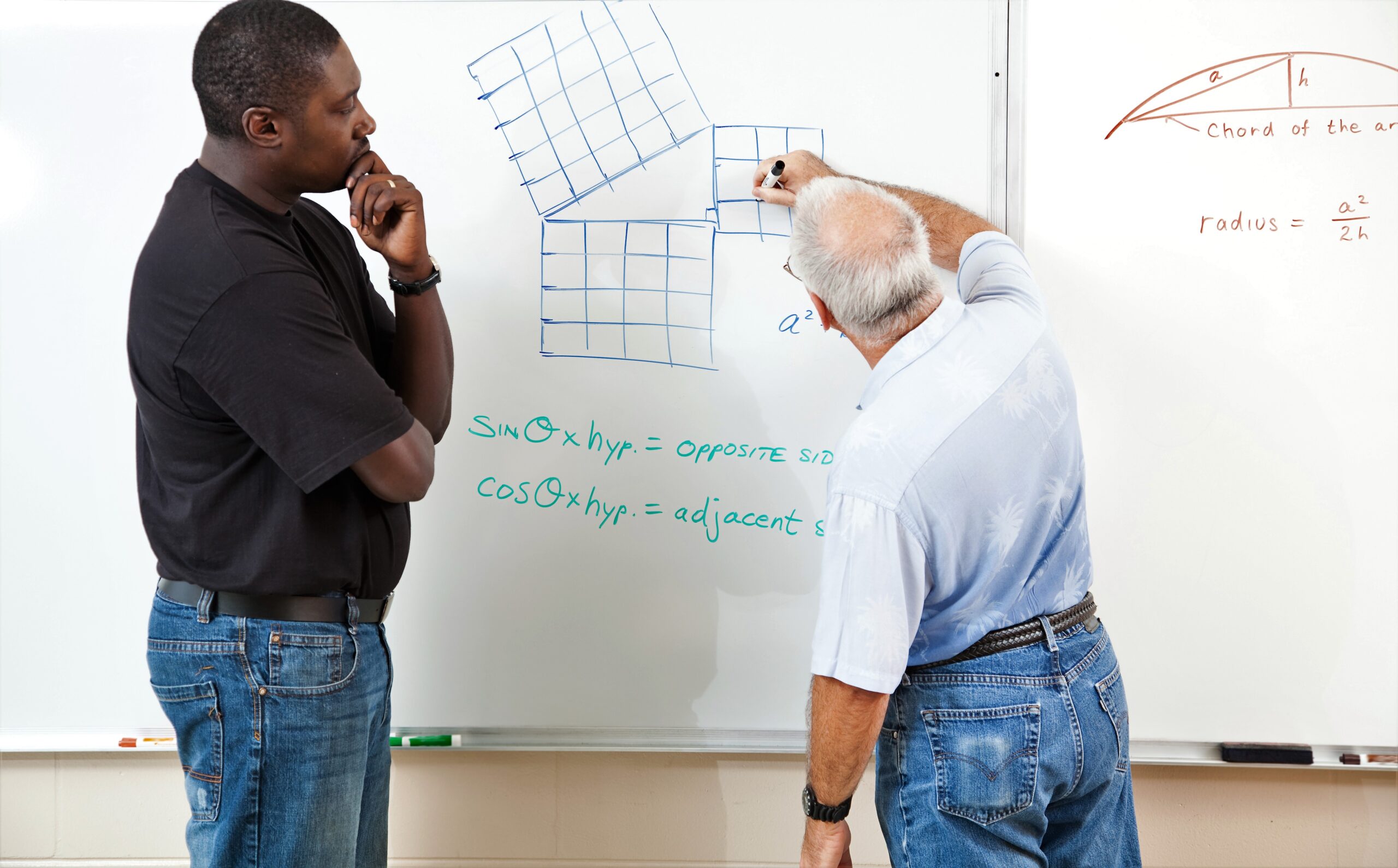
Perhaps you never understood the Pythagorean theorem because it was dumped on you as an abstract formula, with gobbledygook words like “hypotenuse” somehow mysteriously connected with certain triangles.
If so, try learning from Socrates. He gives the concrete physical understanding that allows you, not just to understand what the Pythagorean theorem means, but to see what you need to eventually prove it to yourself all on your own.
Here’s a hint to get you started. Ask yourself, how can I look at a picture of any square and then draw another square that is exactly double its size?
Can you draw a picture that adds one square to itself so that, right before your eyes, it becomes the double-sized square you are searching for?
The best teachers, like Socrates, show you the way to figure out how to do it for yourself.
Dr. C.S. Morrissey is a certified member of the Institute for Advanced Physics.







