

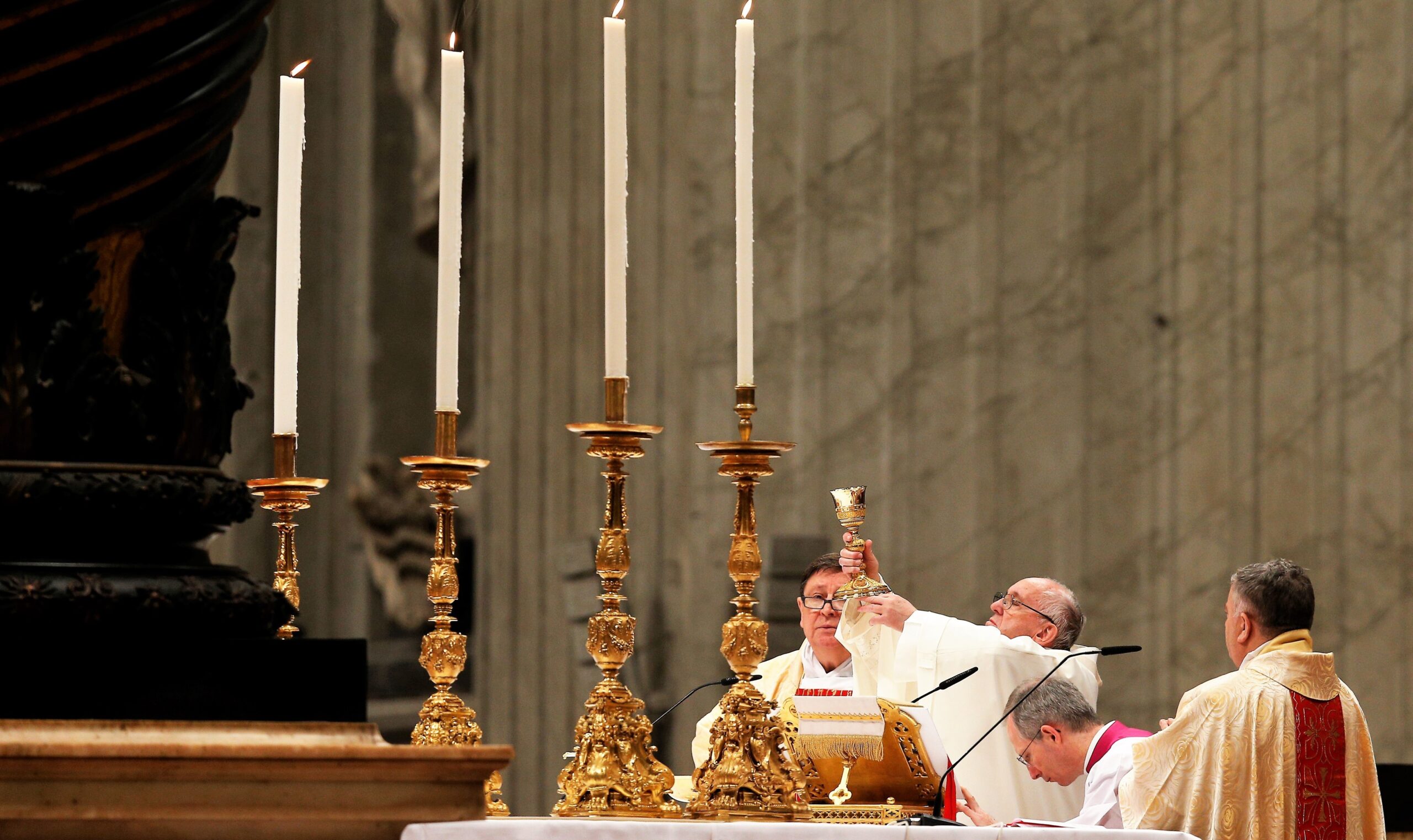

Absence makes the heart grow fonder, says the old adage. So not being able to receive Holy Communion in these pandemic days, as many parishioners now lament, might just occasion an even greater love and longing for the Holy Eucharist.
But as people thirst and long to be in our Church community once again, it is worth asking whether we understand what actually happens during the live sacred action of the Mass from which we are now physically remote?
First, consider some background. Although being unable to receive Communion in Mass is a new phenomenon for most Catholics who live in Canada’s southern urban areas, it is familiar situation in northern Canada. There the priest may visit by plane or truck, serving numerous communities over a period of a month or more. In each of the parishes, he consecrates enough hosts to last until he returns. Parishioners have a Scripture service, homily, Communion, and adoration led by a lay person who has been commissioned by the diocesan bishop.
In such locales, parishioners can become very used to receiving Communion outside of Mass. When the travelling priest returns again and celebrates Mass after several months of being away, he can be looked upon simply as a bread blesser, a consecrator of bread.
But Mass is not just where we receive Holy Communion. There are at least three aspects to what the priest as well as the faithful do, summed up by the acronym ORA (Latin for pray). With the priest, the faithful can offer Jesus, receive Jesus, and adore Jesus.
It’s true we come to Mass to be a worshipping community – to praise, thank, and honour God for who he is and for his gifts to us. We come to hear the word of God proclaimed and preached, to sing together, and to receive Communion.
An essential component of the Mass, though, can often be overlooked: the sacrificial offering of the body and blood of Jesus at the consecration. Parishioners who are not physically present at weekly Mass are particularly vulnerable to being inattentive to this sacrificial dimension.
The bread and wine the priest blesses is first of all to be offered to God the Father as the body and blood of Jesus, the Son of God. Only after that offering has been made do people come forward to receive and adore the Blessed Sacrament.
Parishioners who are privileged to be at Mass might remark on their joy at being able to receive at Mass (through the homily, Holy Communion, good music, and singing) or adore the host before receiving Communion. But when was the last time we heard someone say how pleased they were to unite with the priest to offer the sacrifice of Jesus’ body and blood to the Father in heaven?
The priest’s prayer concluding the preparation of the gifts (the Offertory) reminds us that the Mass is a time to offer sacrifice: “Pray, brothers and sisters, that my sacrifice and yours may be acceptable to God the almighty Father.”
The people’s response affirms the Mass as a sacrifice: “May the Lord accept the sacrifice at your hands for the praise and glory of his name, for our good and the good of all his holy Church.”
Eucharistic Prayer 1 clearly enunciates this offering: “we, your servants and your holy people, offer to your glorious majesty from the gifts that you have given us, this pure victim, this holy victim, this spotless victim, the Holy Bread of eternal life and the Chalice of everlasting salvation.” Each of the other three eucharistic prayers also emphasizes offering.
The sacrifice being offered is Jesus’ body and blood, as well as our own personal sacrifices that we unite with Jesus’ sacrifice. For example, people may sacrifice our time to purchase groceries for the elderly, volunteer at a soup kitchen, or spend extra time with their children rather than the computer or TV.
Perhaps this sacrificial offering is overlooked because we come to Mass hoping to be built up and strengthened in spirit both by the priest’s homily and receiving Communion. There’s nothing wrong with that, but by placing attention on ourselves we might forget that “it is more blessed to give than to receive” (Acts 20:35).
What’s more, we should not fear that in giving, we ourselves will somehow be left short, for Jesus told us, “give, and it will be given to you” (Lk 6:38). We give the Father the gift of God the Son in the sacrificial offering of the Mass; in return the Father gives us his son in Holy Communion.
The deeply felt lament people feel at not being able to receive Communion may be a beautiful sign of their love of the real presence of Jesus in the consecrated bread and wine.
Those who for various reasons have not been able to receive Communion can still adore Jesus and offer him to his father. And now, as we view livestreamed Masses, all of us can still participate in the priest’s acts of offering Jesus and adoring him. Thankfully, some parishes have arranged for adoration by placing the monstrance with the Blessed Sacrament to be viewed through a window of the church or elsewise.
It may be a blessing in disguise that we can no longer take for granted our access to Holy Communion. For how awesome a sign it is of the lengths to which God has gone to be among us for the sake of our salvation!
As St. Paul says in his Letter to the Philippians, “Christ Jesus, who, though he was in the form of God, did not regard equality with God as something to be exploited, but emptied himself, taking the form of a slave, being born in human likeness.”
And further: “For we do not have a high priest who is unable to sympathize with our weaknesses, but we have one who in every respect has been tested as we are, yet without sin” (Heb 4:15).
This article was submitted by a priest of the Archdiocese of Vancouver who asked that his name not be published.







