

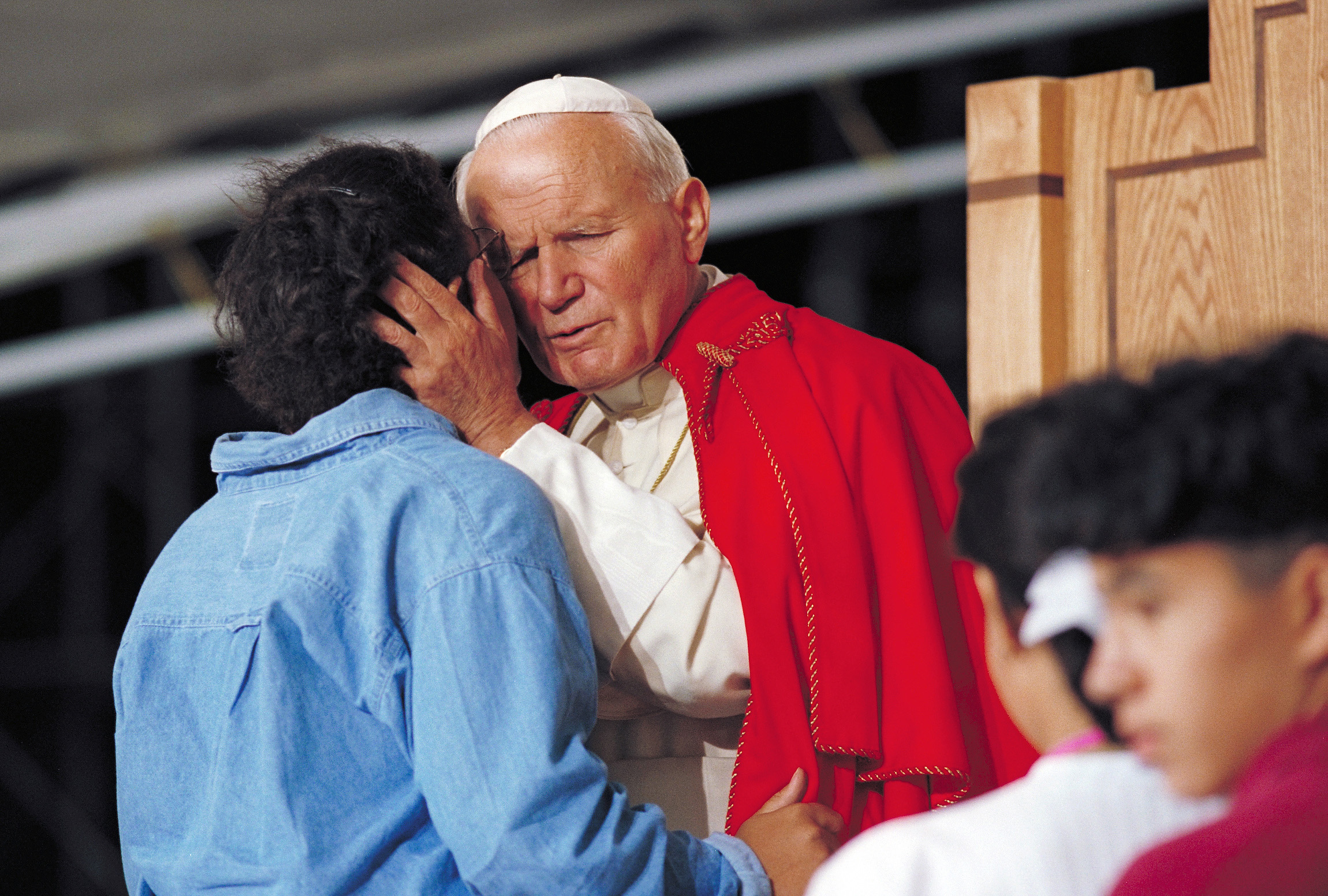

Does St. John Paul II’s Theology of the Body have anything to tell us during this time?
I think it does. In this time of solitude for many, reflecting on Pope John Paul II’s Theology of the Body can give meaning and direction to our experiences of isolation and longing for connection.
Let’s start with the core truth of Theology of the Body: human beings are created in the image and likeness of a Trinitarian God who is a communion of persons.
In God there is both relationship and individuality: dependence and independence. Our human needs for individuality and connection are rooted in the truth of our identity in God.
What does this have to do with our COVID-19 solitude and longing for connection? Let’s explore St. John Paul II’s description of original solitude and our being created for relationship.
He describes Adam’s state of being before meeting Eve as original solitude. This time of solitude was a necessary time for Adam to find himself and learn who he was in the eyes of God.
Perhaps God allowed Adam to live without Eve for some time, so he could experience the longing, the emptiness, the desire for relationship with another.
Here Adam represents all humanity, not just men. In my experience the current time of isolation has been a time to be alone with God, to take a look at my life, my priorities, my relationships, slow down a bit, and ask myself some big questions.
We are all posed with these fundamental questions: Who am I? What is my identity? What am I created for? This time of solitude can be an opportunity for clarity about what is working and what isn’t working well in my life. It can be an opportunity to practice mindfulness, prayer and interior reflection.
The good news is that Adam didn’t stay alone for very long. God brought Eve to him and he rejoiced in finding an equal to enter into relationship with. In Genesis 2:18 we read, “it is not good for the man to be alone. I will make a helper fit for him.”
St. John Paul II says: “Man cannot fully find himself except through the sincere gift of self,” (Gaudium et Spes, #24). It is in loving relationships that we find fulfillment, that we become fully ourselves, that we discover what we were made for. Why? Because we were created in the image and likeness of a God who is a communion of Persons.
The question is: would Adam have rejoiced as much with the gift of Eve if he hadn’t experienced that original solitude, if he hadn’t felt the longing in his heart for another?
I’ve heard of multiple friends and acquaintances of mine who, after months of being single, committed to excellent romantic relationships during this pandemic. I’m not sure if it was all coincidence. I personally think that the solitude of the pandemic has been a wakeup call for many to discern what really matters in life and what the true desires of the heart are.
Science is showing more and more that we are made for connection, that we are hardwired for meaningful relationships, from the crib to the grave. All of us have experienced this in one way or another, and we are experiencing it acutely during this pandemic in which face-to-face connection is being reduced significantly.
I remember from my studies in psychology that Bowlby’s attachment theory says healthy relationships are one of the greatest predictors of good health and emotional well-being. Connection with others regulates our physical and emotional well-being, and when connection is lacking, we suffer.
So if you are struggling during this time of isolation, know that you’re not alone in this. You are normal. You are human. Created in the image and likeness of a God who is love, we are hardwired for relationship.
At the same time, let us take advantage of this time of solitude. The best thing we can offer in a relationship is self-awareness and a deep personal relationship with God through prayer.
Let us take this opportunity to dig a little deeper in our relationship with ourselves and with God. Let us enter into the heart without judement and see what desires the Lord has placed there.
During this time that we can’t take trips to faraway places, let’s take the trip inward, where some of the greatest adventures and mysteries lie (St. Augustine of Hippo, Confessions).
Anna Loch is a parishioner of St. Joseph’s in Vancouver and outreach manager at Gardens of Gethsemani. She holds a master’s in theology and counselling psychology.







