


Fifth Sunday of Easter, Year A
First Reading: Acts 6:1-7
Second Reading: 1 Pt 2:4-9
Gospel Reading: Jn 14:1-12
“It is not right that we should neglect the word of God in order to wait on tables,” the apostles said in this Sunday’s First Reading. “Therefore, friends, select from among yourselves seven men of good standing, full of the Spirit and of wisdom, whom we may appoint to this task, while we, for our part, will devote ourselves to prayer and to serving the word.”
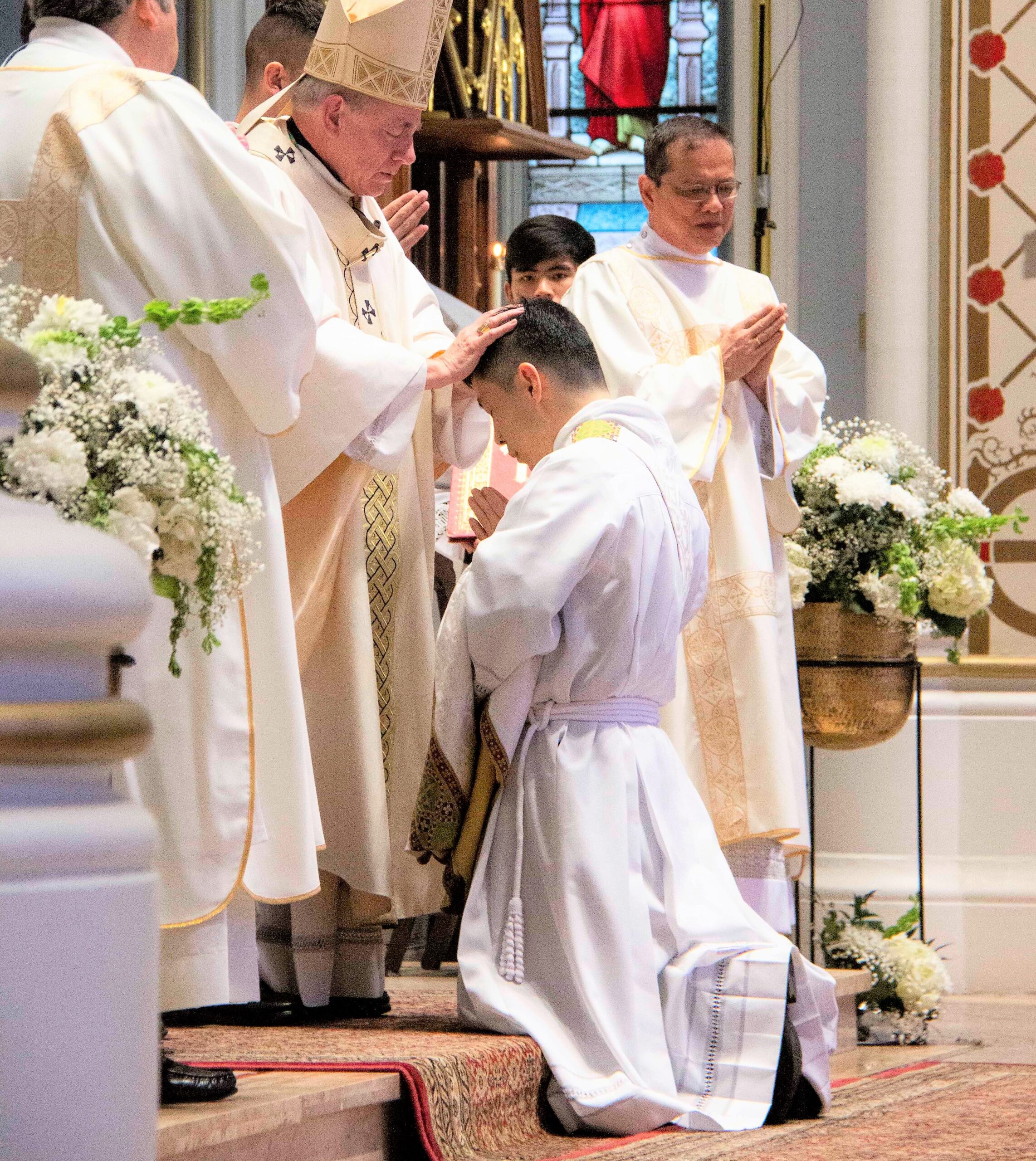
While the apostles said that feeding the hungry was not their job, they nevertheless made sure that the job would be done. Moreover, they themselves commissioned the workers: the whole community chose them and then “had these men stand before the apostles, who prayed and laid their hands on them.”
Thus they began the permanent diaconate, the third level of ordained ministry in the Church, after bishops (called episkopoi in the Acts of the Apostles) and priests (called prebyteroi).
At some periods in history, the Church has emphasized spirituality, rather than feeding the hungry. At others, she has emphasized “waiting on tables.” We oscillate from one to the other, like the drunkard who falls off his horse first on one side and then on the other.
Today, perhaps, in the west, we tend to think that the only true Christians are those who help the poor. In fact, some people call themselves Christians not because they are baptized or because they believe in Christ, but because Christianity preaches love for the poor.
C.S. Lewis’ fictional devil Screwtape says that Satan (if he cannot make us reject Christianity completely) wants us to believe what Christ taught “not because it is true, but for some other reason.” He wants us to treat Christianity as a means – a means to anything, even social justice.”
Those who value Christianity for what it can do for this world need the admonition in this Sunday’s Second Reading: “Like living stones, let yourselves be built into a spiritual house” (my emphasis).
In Sacrosanctum Concilium, Vatican II said, “What the faithful have received by faith and sacrament in the celebration of the Eucharist should have its effect on their way of life … Everyone who has participated in the Mass should be eager to do good works, to please God, and to live honestly … putting into practice what he has learned.”
As the deacon says in the dismissal at the end of Mass, we must “go in peace, glorifying the Lord” by our everyday lives.
But Sacrosanctum Concilium says more. After having received the Eucharist, we “will seek to fill the world with the Spirit of Christ, and in all things, in the very midst of human affairs, to become a witness of Christ. For no Christian community can be built up unless it has as its basis and pivot the celebration of the Holy Eucharist. It is from this, therefore, that any attempt to form a community must begin.”
As the deacon says in an alternative dismissal, we must “go and announce the Gospel of the Lord.”
Before we can minister to others, we must be in Christ in the sense that Christ meant in this Sunday’s Gospel Reading: “Believe me that I am in the Father and the Father is in me; but if you do not, then believe me because of the works themselves. Very truly, I tell you, the one who believes in me will also do the works that I do and, in fact, will do greater works than these, because I am going to the Father.”
Christians, then, must not neglect the works that Christ performed in this world, the works of today’s permanent deacons: “waiting on tables.” However, Christ tells us to believe in him first.
The first great commandment is to love God; the second is to love our neighbour. Accordingly, Pope Benedict XVI devoted Part I of his encyclical Deus Caritas Est to love of God; Part II, to love of neighbour.







