

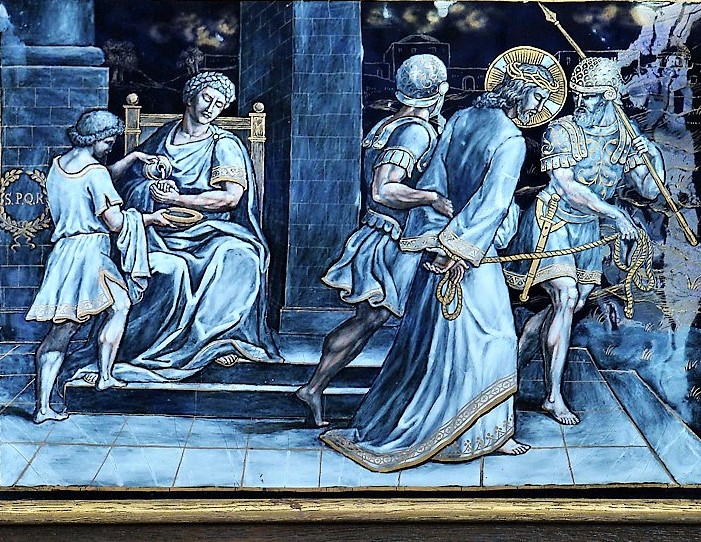

Passion Sunday, Year A
First Reading: Is 50:4-7
Second Reading: Phil 2:6-11
Gospel Reading: Mt 26:14 – 27:66
Next Sunday is called Palm Sunday, because the crowds welcomed Jesus into Jerusalem with palm branches, but also Passion Sunday, because, only five days later, the people shouted, “Let him be crucified!”
How could they have been so fickle and treacherous?
As a matter of history, it was the Jewish authorities who handed Jesus over to the Romans to be insulted, flogged, and crucified. However, “the personal sin of the participants (Judas, the Sanhedrin, Pilate) is known to God alone,” says the Catechism of the Catholic Church.
“We cannot lay responsibility for the trial on the Jews in Jerusalem as a whole,” it says, “despite the outcry of a manipulated crowd.” In fact, Jesus himself, as he forgave them from the cross, acknowledged their ignorance.
“Still less can we extend responsibility to other Jews,” the Catechism says. The crowd’s cry – “His blood be on us and on our children! – is simply “a formula for ratifying a judicial sentence.”
As the Church declared at Vatican II, “neither all Jews indiscriminately at that time, nor Jews today, can be charged with the crimes committed during Jesus’ Passion.”
As we listen to this Sunday’s Gospel Readings, then, instead of marvelling at the fickleness and treachery of “the crowds,” “the people,” or “the Jews,” let us acknowledge our own, for, like them, we turn on him whenever we sin.
“The Church does not hesitate to impute to Christians the gravest responsibility for the torments inflicted upon Jesus,” the Catechism says. “We must regard as guilty all those who continue to relapse into their sins.” Thus we “crucify the Son of God anew” in our hearts “and hold him up to contempt.”
If the Jewish leaders had known who Jesus was, “they would not have crucified the Lord of glory,” St. Paul says. “We, however, profess to know him,” the Catechism notes, “so it can be seen” that our crime is greater than the Jews’.
We might try to excuse ourselves by arguing that Jesus’ Passion was part of God’s plan. It is true that this Sunday’s Readings proclaim that it fulfilled the prophecies. Even the Catechism says that Jesus’ death was not the result of chance in an unfortunate coincidence of circumstances, but is part of the mystery of God’s plan.
However, “this Biblical language does not mean that those who handed him over were merely passive players in a scenario written in advance by God,” says the Catechism. When God “establishes His eternal plan of ‘predestination,’ he includes in it each person’s free response to his grace.”
In accomplishing his “plan of salvation,” God “permitted” the evil acts that flowed from the “blindness” of his contemporaries, the Catechism says. God left to the free will of human beings the fate of his own Son, in what Pope Benedict XVI calls a “turning of God against himself.”
God is in no way, directly or indirectly, the cause of evil. However, he permits it, not only because he respects the freedom he has given us, but also because “mysteriously,” he “knows how to derive good from it.”
For example, a man who gives to his neighbour is doing good, while a man who steals from his neighbour is doing evil. However, the neighbour who accepts the theft patiently is doing good. Both men serve God, then: the first as a son, the second as an instrument.
Nevertheless, it makes a difference to us whether we serve God as a son or as an instrument. As Jesus said at the Last Supper, “The Son of Man goes as it is written of him, but woe to that one by whom the Son of Man is betrayed.”
“From the greatest moral evil ever committed – the rejection and murder of God’s only Son, caused by the sins of all of us – God brought about the greatest of all goods: the glorification of Christ and our redemption,” the Catechism says.







