

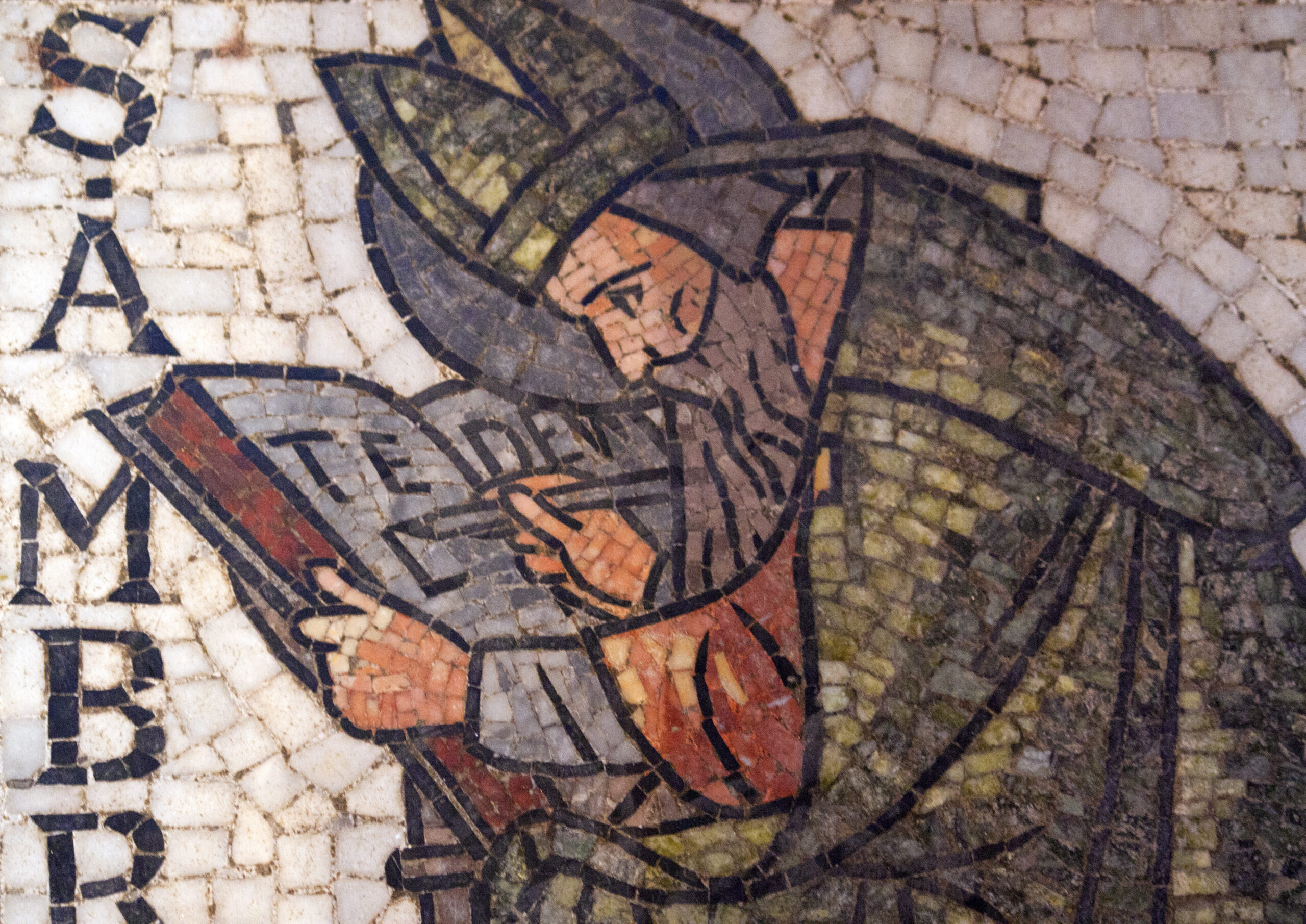

St. Ambrose was born of a noble family in Trier, Germany, in about 339. His father was praetorian prefect of Gaul (modern France), and after his death the family moved to Rome, where Ambrose received his education.
About 365 Ambrose entered civil service as a lawyer, and about 370 he became governor of the Provinces of Emilia and Liguria in northern Italy, with his headquarters in Milan.
Ambrose’s older brother and sister (Satyrus and Marcellina) are honoured as saints by the Church. Satyrus was excessively shy and simple in manner but was a most efficient and successful administrator, looking after the temporalities of the diocese of Milan for Ambrose.
When Satyrus died in 378, Ambrose preached the funeral orations “De Excessu Fratris” (on the death of a brother). At the oration delivered at the gravesite, Ambrose said, “Death, in fact, was not in nature, but it became a part of nature. God did not establish death in the beginning but gave it as a remedy. Let us then consider it, lest it seem the opposite. For, if death is good, why is it written that ‘God made not death? but by the evil of men death came into the world’? Death was not necessary to the divine plan, since for those placed in paradise a continual succession of all good things flowed forth. But after the transgression of Adam and man’s condemnation to long labors and unbearable sorrow, his life became wretched. Consequently, an end had to be established for evils, so that death might restore what life had lost. For, unless grace should breathe upon it, immortality would be rather a burden than an advantage.”
Marcellina inspired Ambrose with a love of virtue. She became a consecrated virgin on Christmas day in 352 and received the veil from the hands of Pope Liberius.
Father Alban Butler, author of The Lives of the Fathers, Martyrs and Other Principal Saints, wrote, “She fasted every day till evening; and sometimes passed whole days without eating. She never touched any fare but what was of the coarsest kinds and drank only water. She never laid herself down to rest till quite overcome with sleep. The greatest part both of the day and night she devoted to prayer, pious reading, and tears of divine love and compunction. St. Ambrose advised her in the decline of her life to moderate her austerities, but always to redouble her fervor in tears and holy prayer, especially in reciting often the psalms, the Lord’s prayer, and likewise the creed, which he calls the seal of a Christian, and the guard of our hearts.”
In 374, Ambrose, as governor, was keeping order at the episcopal election in Milan where Catholics and Arians were at odds. Ambrose gave a speech to the people with much discretion and mildness, exhorting them to proceed in their choice peacefully. Suddenly a child cried out, “Ambrose Bishop.” This the whole assembly took up and unanimously proclaimed Ambrose Bishop of Milan.
Ambrose was still a catechumen when he was chosen as bishop. After due preparation, he was baptized, confirmed, ordained to the diaconate, ordained to the priesthood, and, on Dec. 7, was consecrated bishop.
Father Butler wrote, “He was no sooner placed in the episcopal chair, but considering that he was no longer a man of this world, and resolving to break all ties which could hold him to it, he gave to the church and the poor all the gold and silver of which he was possessed. His lands and estates he gave also to the church, reserving only an income for the use of his sister Marcellina, during her life. The care of his family and temporalities he committed to his brother Satyrus, that, being disengaged from all temporal concerns, he might give himself up wholly to his ministry and prayer.”
安博總督被選做主教
約在公元339年,聖安博出生於德國的特里爾一個貴族家庭,他父親執掌高盧(現在的法國)衛隊。父親死後,整家搬到羅馬定居,而安博亦在當地受教育。約在365年,安博以律師身份加入政府公僕行列;約在370年,他被委為意大利北部的艾美莉亞省及利吉里亞茵省的總督,在米蘭設省府。
安博的兄長和姊姊(薩槽菽及馬策蓮娜)同是教會的聖人。薩槽菽天性甚為害羞和單純,但他替安博管理米蘭教區財產時,則頭頭是道。378年,薩槽菽逝世,安博在喪禮上稱他是「一位傑出的兄弟」;在墳地致哀悼的文辭時,安博指出:「死亡並不屬於本性,但成為本性的一部份。天主在起初並沒有制定死亡,但以死亡作為醫藥。想想看,如果死亡是好事,為何天主沒有創造死亡,死亡是藉人的凶惡而進入了世界。樂園中的美善應該可以世代後繼相傳,死亡並不是天主原定的;但亞當叛逆後,人類承受勞苦與難忍的哀痛,生命變得可憐無助。最後,死亡成了一切災禍的結束,好使死亡把生命所喪失的予以恢復。因此,除非有天主的聖寵,否則,不朽是永遠的負纍,而非裨益。」
馬策蓮娜啟發安博喜愛修德行。352年,她從教宗立柏手中領受象徵獻身童貞的頭紗。「教父、殉道及重要聖人行實」作者、雅伯.本肋神父寫道:「馬策蓮娜每天黃昏前都守嚴齋,有時整天食物不沾;謝絕上乘,寧擇粗糙,只喝清水。除非極其倦睏,否則都不願躺下休息;晝夜大部份時間都用作祈禱、閱讀聖書,流下愛和痛悔的淚水。聖安博曾勸說正衰老食物的她稍為緩和她的苦行,但加倍熱心地流淚和作神聖的祈禱 ── 特別是常誦唸聖詠集、天主經和信經 ── 聖安博稱經文為基督徒的烙印、心靈的守衛。」
當時的米蘭,是天主教與亞略異端激烈對抗之地。374年,聖安博以總督身份維持選舉米蘭主教埸地的秩序,勸說在場選舉的人,要和平地去選主教。突然,有一個小孩喊話:「安博作主教!」全場都強烈響應,一致推舉安博任米蘭主教。
是時的安博,還只是一位慕道者;在眾人簇擁下,加速慕道的進程,接受洗禮、領受堅振,晉升六品和鐸品,繼而在12月7日晉牧坐掌米蘭教區。
雅伯.本肋神父記述:「安博坐上主教座位後,便視自己不屬於俗世,立志要脫離煩囂枷鎖,把擁有的金銀,全送教會和貧民;把自己名下的地產物業,送獻教會,只保留生養姊姊馬策蓮娜的費用。他將家務和俗務交由兄長薩槽菽打理,好譲自己脫離暫世的顧慮,全心作牧靈和祈禱。」







