

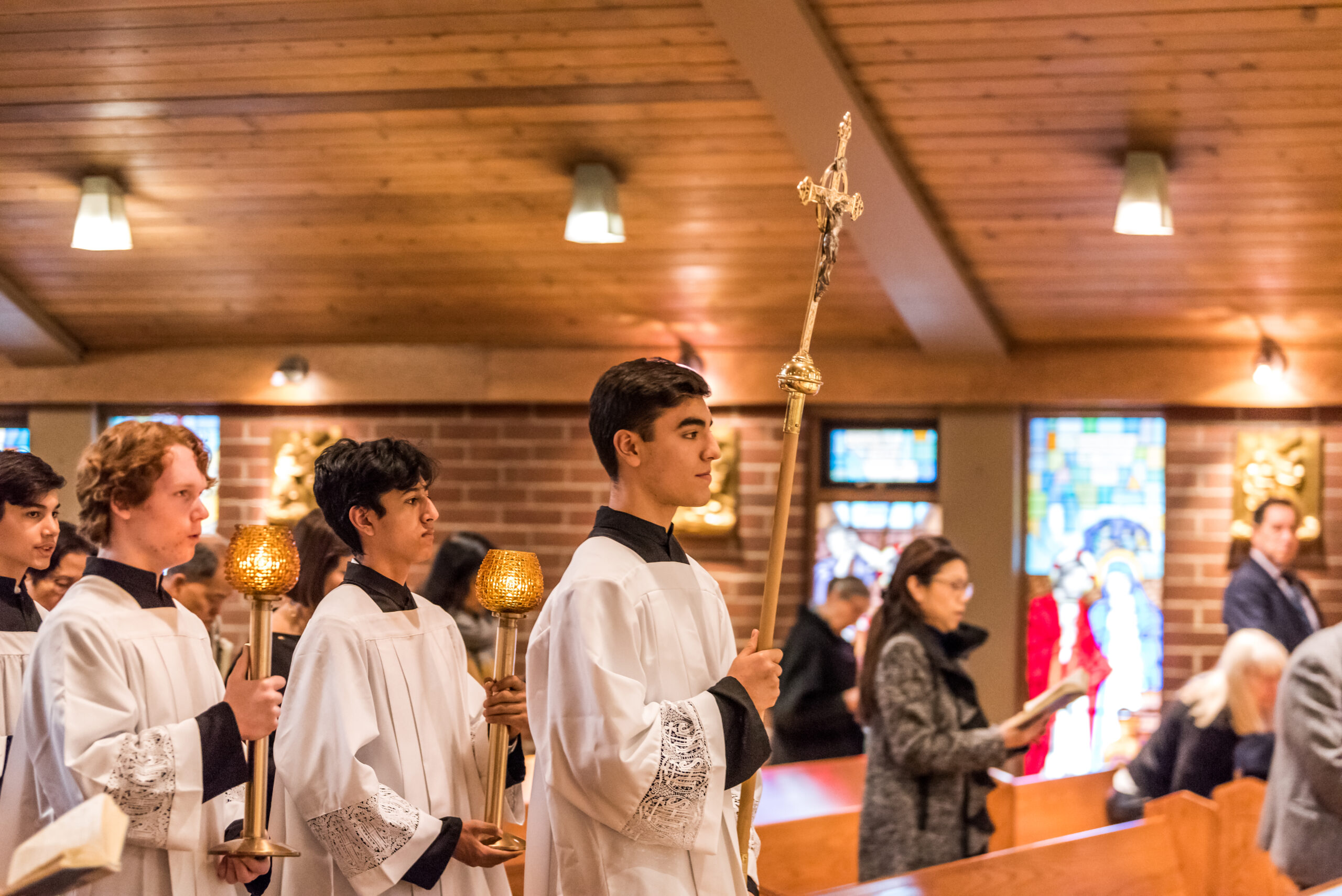

This is an excerpt of Archbishop Miller’s remarks during a visit to St. John the Apostle Parish in February. More information about parish visits available here.
The more visits I complete, the more I am inspired by the vitality and holiness of the lay faithful in the Archdiocese. Your parish, under the wise and kind direction of your pastor, Father Anthony Ho, is certainly no exception. The opportunity to meet, even briefly, a broad range of parishioners who are engaged in the life your parish family has been encouraging.
Among the many particular blessings I have seen at St. John the Apostle, allow me to mention just three of them this morning. First, the introduction of Mass in Cantonese on Saturday afternoon is providing a new home for many faithful in the parish community, and continued efforts must be made to ensure that this added diversity truly builds up the parish as one family.
Secondly, your parish enjoys a rich liturgical and musical tradition of which you should be proud and for which you should be grateful. Such a tradition does not just “happen,” it is the result of years of hard work, and I thank you for ensuring that your worship is for the glory of God and nourishing the spiritual life of the parishioners.
Thirdly, I am gratified to know that the Catechesis of the Good Shepherd is taking root here. No doubt you have seen the space downstairs in the hall, what is called an “atrium,” where the ten boys and girls are formed in the love of Jesus. This way of catechizing young people is truly a great gift to the whole Church.
Many of you have been labouring for many years to carry out the mission you received in Baptism to be co-responsible for the life of your parish and all its activities. It is heartening for me to witness that the lay faithful here at St. John the Apostle understand that are called to pray and work together, under Father Ho’s guidance, in fostering Jesus’ call that we proclaim the Gospel, that we “make disciples” (cf. Mt 28:19) of our family members, colleagues, neighbours and those whom the Lord puts on our path. Because of the harvest to be reaped is so great, God is counting on every parishioner, without exception, to place his or her gifts and talents at the service of the parish family in its mission of evangelization.

Is God like a policeman?
Today’s Gospel, which continues Jesus’ teaching as the New Moses, the Giver of the New Law, in the Sermon on the Mount, gives us a chance to think about the role God’s commandments play in our Christian life. Do we think of God’s “laws” the way we do civil law? Is God like a policeman ready to trap us for our violations? Are God’s laws only like traffic signs – their being red or green is totally arbitrary?Primacy of Christ as Saviour
Law as a Gift of God’s Love
What, then, in light of Christ, do the Ten Commandments demand of us? The Ten Commandments clarify the commandment of love: to love, as Jesus loved us (cf. Jn 13:34): unconditionally, sacrificially, obediently.
In giving us the commandments, the Church gives our life direction. She instructs us, so that we can follow the right path. They result from the tenderness and love of God who has given them to us. Like every mother, she never teaches what is evil, she only wants the good of her children.[4]
The commandments are, then, the rules of love; they indicate the way of love; and “they explain how really to love and how to find the right route.”[5]
Such commands are not arbitrary traffic rules, which are one way today and can change tomorrow, but commandments which guide us to make the right choices, the choices that are truly good for us since their fulfilment leads us to happiness.


[1] Francis, Video Message (8 June 2013).
[2] Francis, Angelus (12 February 2017).
[3] Francis, Homily (16 June 2013).
[4] Cf. Francis, General Audience (8 September 2013), 1.
[5] Benedict XVI, Address to the Youth of Rome and Lazio (25 March 2010).







