
1st Sunday of Lent, Year A
First Reading: Gn 2:7-9, 16-18, 25; 3:1-7
Second Reading: Rom 5:12-19
Gospel Reading: Mt 4:1-11
This Sunday’s Readings describe Adam and Eve’s rebellion against God and its consequences for the human race. To understand them, we must realize that the Bible is not a biology, anthropology, or history book as we understand those subjects today.
The Bible describes “the origin of the universe and its makeup, not in order to provide us with a scientific treatise” but to teach that the world was created by God “for the service of man and the glory of God,” said St. John Paul II. In order to do this, “it expresses itself in the terms of the cosmology in use at the time of the writer.”
“Any other teaching about the origin and makeup of the universe is alien to the intentions of the Bible,” he added.
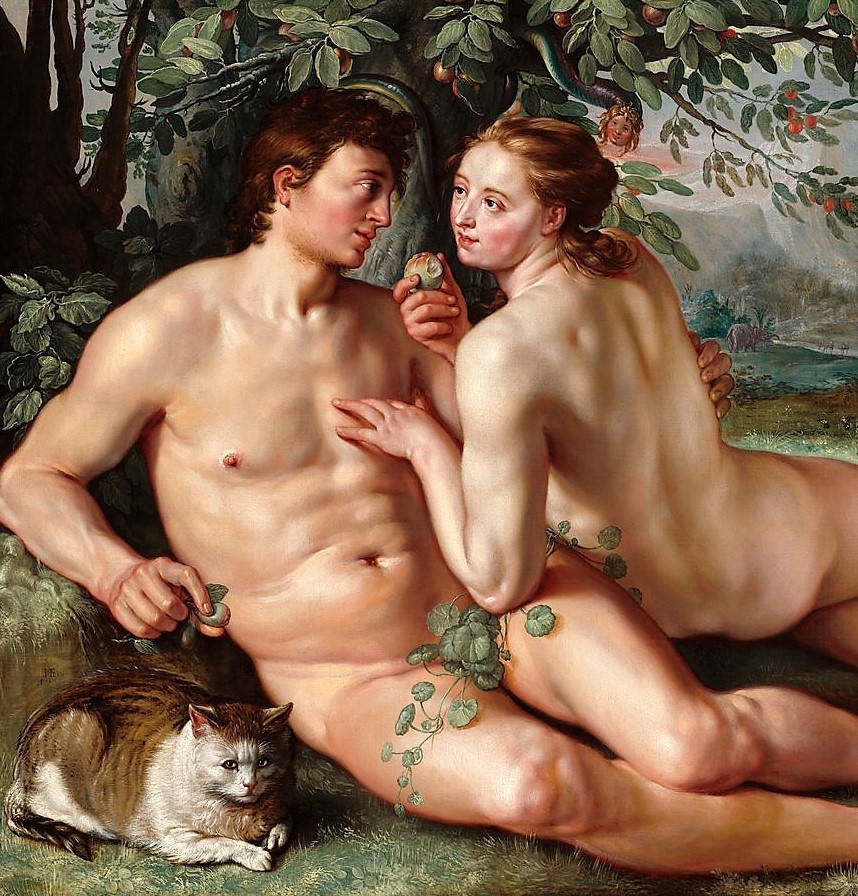
The Bible account of Adam and Eve’s sin uses “figurative language,” says the Catechism of the Catholic Church, but it nevertheless affirms “a deed that took place at the beginning of the history of man.”
Humans are created beings, with “insurmountable limits” that we must “freely recognize and respect with trust,” says the Catechism. God’s command not to eat from the “tree of the knowledge of good and evil” symbolizes these limits.
Wanting to know good and evil for themselves, Adam and Eve ceased trusting their Creator and disobeyed God’s command. “This is what man’s first sin consisted of,” the Catechism stresses. Man “wanted to be like God, but without God, before God, and not in accordance with God.”
Adam and Eve’s sin was thus a sin of pride. It was not a sexual sin, as some people think. For one thing, Adam and Eve were married. For another, sex is not in itself sinful or shameful.
Before their disobedience, Adam and Eve had perfect control of their sexuality. They were not subject to sexual impulses difficult to control, as we are. Accordingly, Adam and Eve “were both naked, and were not ashamed.”
However, their disobedience shattered “the control of the soul’s spiritual faculties over the body,” the Catechism says, so Adam and Eve found it necessary to cover themselves. Their disobedience introduced “lust and domination” into the union of men and women. It also led to the consequence God had explicitly foretold: death.
From now on, Adam and Eve’s human nature was fallen, and that is what they transmitted to their descendants. “Just as sin came into the world through one man, and death came through sin, so death spread to all, because all have sinned,” St. Paul says.
However, God did not abandon humanity to the power of death, but helped everyone to seek him and find him, as we hear in the Fourth Eucharistic Prayer. Again and again he offered his chosen people a covenant, and, through the prophets, taught them to look forward to salvation.
Eventually, God the Son became man in the person of Jesus Christ so that his own divine life might spread through the human race just as the fallen life had spread. “Just as the trespass of one led to condemnation for all, so the act of righteousness of one leads to justification and life for all,” St. Paul says.
In his incarnation, God the Son became fully man in all respects. Like Adam and Eve, he even endured Satan’s temptation, as we hear in the Gospel Reading. However, unlike them, he rejected it. Alive with his life, and with his help, we can do the same.
In a certain sense, Adam and Eve’s sin put the whole human race into Satan’s power. However, his activity among humans will not go on forever. “He knows his time is short,” says the Book of Revelation.
“If, because of the trespass of one, death exercised dominion through that one, much more surely will those who receive the abundance of grace and the free gift of righteousness exercise dominion in life through the one, Jesus Christ.”
Father Hawkswell teaches “The Catholic Faith in Plain English” free of charge every week: Sundays, 2–4 p.m. at the John Paul II Pastoral Centre (33rd and Willow, Vancouver); Mondays, 11 a.m.–1 p.m. at St. Anthony’s Parish (2347 Inglewood, West Vancouver) and 7–9 p.m. at the John Paul II Pastoral Centre; and Tuesdays, 7–9 p.m. in St. Clare’s Parish Hall (2888 Delahaye Drive, Coquitlam).