

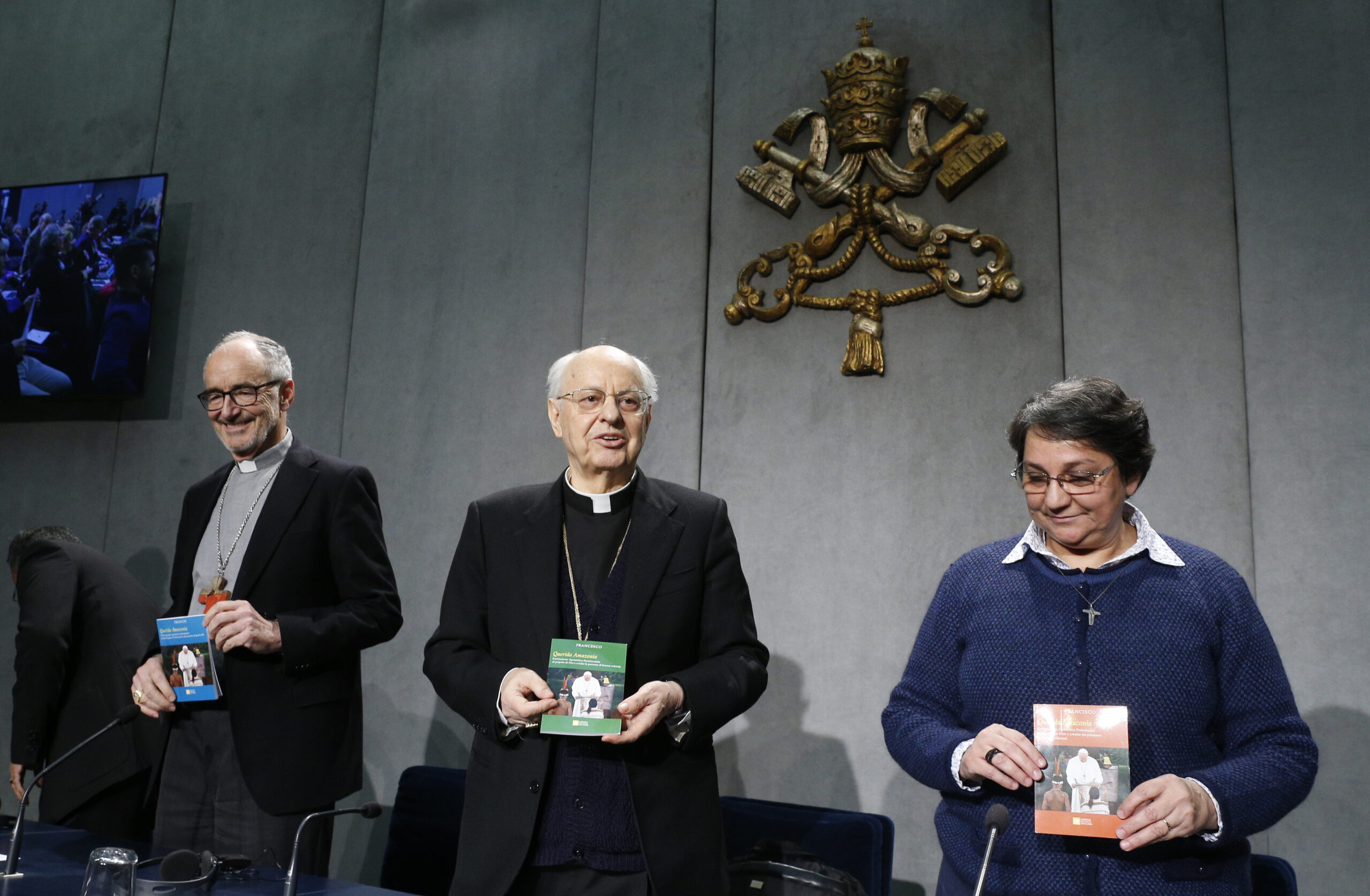

Agenda-driven journalism and the decline of fair media coverage, especially when it comes to religion, has been my focus during Catholic Press Month, and there was no better illustration of the problem than in recent days as media tried to prognosticate and then report on the Pope’s response to last year’s Amazon synod.
The synod itself had generated media interest primarily because it ended with recommendations for married priests and giving women leadership roles to serve in remote regions. So, no surprise, media ratcheted up their speculative coverage of Pope Francis’ pending response. Controversy was even more heavily in the air after Pope emeritus Benedict XVI wrote an essay defending priestly celibacy in a new book.
So when supposedly leaked copies of Francis’ expected response made their way into media, journalists predicted with breathless anticipation that the writing was on the wall for clerical celibacy.
The leaked report, apparently from “several bishops,” said the post-synodal exhortation would open the door to abolishing priestly celibacy in the Latin Church. They said it reproduced word for word a paragraph on priestly celibacy in the synod’s final document. The Pope’s response, they said, would also make damaging the environment a sin, also one of the synod recommendations.
The individual who leaked the report promised it wasn’t “fake news.”
“Pope Francis opens door to abolish priestly celibacy according to leaked Amazon Synod doc,” said one web headline.
Needless to say, the Pope’s response bore no resemblance to the predictions.
In his 16,000-word document, Pope Francis makes absolutely no mention of marriage and priests. Instead he emphasizes the Eucharist and the importance of promoting vocations.
He does remind the faithful of the need for efforts “to configure ministry in such a way that it is at the service of a more frequent celebration of the Eucharist, even in the remotest and most isolated communities.”
But this, he says, “is not simply a question of facilitating a greater presence of ordained ministers who can celebrate the Eucharist. That would be a very narrow aim, were we not also to strive to awaken new life in communities. We need to promote an encounter with God’s word and growth in holiness through various kinds of lay service that call for a process of education – biblical, doctrinal, spiritual and practical – and a variety of programs of ongoing formation.”
Francis uses a great deal of the document to address the environment, not simply in an ecological sense but calling for “justice in debates on the environment, so as to hear both the cry of the earth and the cry of the poor.”
It is an anthropological environmentalism that he calls for, respecting both earth and mankind, not one that “is concerned for the biome but ignores the Amazonian peoples.”
Having gotten their predictions wrong, the media coverage of the document was equally predictable.
“Pope Francis rejects allowing married priests,” read one headline.
“Pope refuses to endorse married priests in the Amazon,” said another.
“Pope Francis rules against ordaining married men in Amazon.”
In fact, the Pope did none of those things. He does urge Catholics to read, study, and discuss the synod’s final report, suggesting he is interested in the discussion continuing.
Headlines stating what he precisely did not state are simply wrong and hopelessly simplistic, providing yet another example of why, when there has never been so much information at our fingertips, the importance of the Catholic press is more apparent than ever.







