

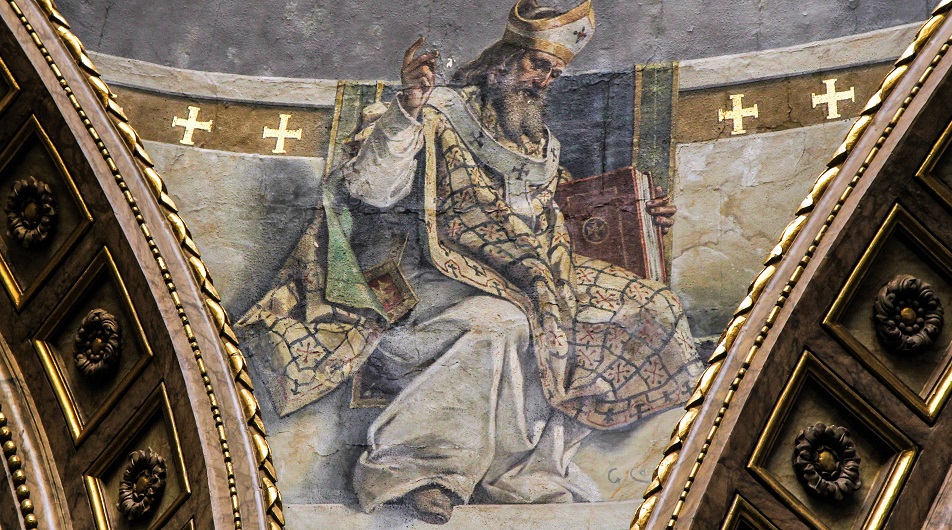

St. John Chrysostom, born about 349 A.D. in Antioch, Syria (today Antakya in Southern Turkey), was given the name Chrysostom, meaning “golden-mouthed,” because of his eloquence.
John thought of becoming a monk, and in 373 he joined a group of hermits living in the mountains near Antioch. He lived with them for four years and then extended his retreat for a further two years, living as a solitary in a mountain cave above Antioch.
Poor health forced him back to Antioch, and Pope Benedict XVI talked about this turning point in the vocation of John: “The Lord, his biographer explains, intervened with the illness at the right moment to enable John to follow his true vocation. In fact, he himself was later to write that were he to choose between the troubles of Church government and the tranquillity of monastic life, he would have preferred pastoral service a thousand times (cf. On the Priesthood, 6, 7): it was precisely to this that Chrysostom felt called.
“It was here that he reached the crucial turning point in the story of his vocation: a full-time pastor of souls! Intimacy with the Word of God, cultivated in his years at the hermitage, had developed in him an irresistible urge to preach the Gospel, to give to others what he himself had received in his years of meditation. The missionary ideal thus launched him into pastoral care, his heart on fire.” (Benedict XVI, General Audience, Sept. 19, 2007)
John was ordained a priest in 386 and was assigned to preach. He became an outstanding orator, and for 12 years he preached regularly to the people of Antioch. His talks usually took place during the liturgy.
In his Lives of the Saints, Father Augustine Kalberer, OSB, wrote, “No other excels him as a moralist; and the most attractive part of his sermons is the section – generally at the end – in which he inveighs against some common vice, such as anger, pride, ostentation, lust, or avarice.”
Pope Benedict XVI pointed out that John is among the most prolific of the Church Fathers: “17 treatises, more than 700 authentic homilies, commentaries on Matthew and on Paul (Letters to the Romans, Corinthians, Ephesians and Hebrews) and 241 letters are extant.”
In 397 John was appointed Bishop of Constantinople, the capital of the Roman Empire of the East.
Author Father Joseph Tylenda pointed out that as bishop, John “immediately instituted much-needed reforms in his diocese, opened hospitals, and saw that the poor were given the help they needed. His honesty and frankness in speaking out against the luxury of the imperial court and its laxity in morals earned him the hatred of the wealthy and influential, and thus he was forced into exile in June 404.”
“During the years of exile, John wrote letters to St. Olympia to encourage her. In one of the letters he wrote, ‘Such is the nature of tribulation: it renders those who bear it meekly and nobly to be superior to their sufferings, high above the devil’s darts, teaching one to despise his plots. Trees nurtured too tenderly become weaker and less apt to bear fruit, while those which partake of changes in the air, receiving battering by the wind and heat from the sun’s rays, stand stronger, full of leaves and laden with fruit – which usually happens with those growing by the sea.’”
John spent three years at a frontier outpost in Armenia, but because he still had influence in Constantinople through letters (some 236 of them, written to about 150 different people), he was exiled further away. In 407, during the rough journey to a more remote spot on the Black Sea, he died of exhaustion on Sept. 14.
In 1568, Pope St. Pius V declared John Chrysostom a doctor of the Church. He is the patron saint of preachers. Along with St. Joseph, John Chrysostom was named co-patron of the Second Vatican Council by Pope John XXIII.
金口若望以熾熱的心傳教
金口聖若望於公元349年出生在敘利亞的安提約基亞(今天土耳其南部的安培基亞)。因為他超卓的口才,所以被冠以「金口」的美銜。
若望曾有意當隱修士。公元373年,他跟隨一群隱修士退隱到安提約基亞附近的山上;四年後,他決定獨自留在一個山洞,延長個人的退省兩年。但是,欠缺的健康,令若望返回安提約基亞。
教宗本篤十六世在2007年9月19日公開接見群眾時,談及若望聖召的轉捩點:「他的傳記作家指出:天主在適當的時刻,以生病讓若望跟隨正確的聖召路向。若望後來寫道:要他在教會管理的麻煩與隱修生活的安寧之間作出選擇,他千倍傾向於牧民的職責 :這正是他感到被召叫的所在。」
「若望處於個人聖召重要的轉折點 :要做全職的牧靈人!過去與天主聖言緊密接觸的隱修生活,使他不能抗拒要傳遞福音訊息心中的渴望,他渴望能與其他人分享多年默想的心得。傳教的理想開展他作牧民工作,他的心是熾熱的。」
公元386年,若望晉鐸。十二年在安提約基亞的聖儀中講道,盡顯若望一時無兩傑出的口才。
思定.卡寶勒神父在他的「聖人行實」一書寫道:「沒有其他教父比若望作更出色的倫理家。他講道最引人入勝的──通常都是在終結 ── 攻擊一些常見的罪惡;諸如忿怒、驕傲、炫耀、迷色,或貪婪。」
教宗本篤十六世讚揚聖若望金口是「多產」的教父:「他寶貴的遺訓,包括十七專著、超過七百篇的講道、對瑪竇和保祿(致羅馬人書、致格林多人書、致厄弗所人書、致希伯來人書)的註譯,與及他二百四十一封書信。」
公元397年,若望晉牧,成了君士坦丁堡的主教,是羅馬帝國東面的首府。
若瑟.泰倫達神父說:「若望金口針對自身教區,作出了必須的改革,開設醫院、要看到窮人得到所需要的幫助。他剛直坦蕩地直斥朝廷的奢侈和道德的淪落,惹來富裕和權勢的惱恨,結果,公元404年6月,若望被放逐。」
放逐歲月中,若望給聖奧莉彼婭寫信,鼓勵她。其中一封信寫著:「憂患的性質就是:讓那些以溫良和高尚地忍受的人,能超越苦痛、超越魔鬼的衝擊、不屑牠的陰謀。就像長在海邊的樹木,要經歷風吹雨打和灸熱的陽光,才變得強壯,比較那些太溫柔地養育的樹木更能耐和更果葉豐盛。」
若望在亞美尼亞邊防前哨過了三年,但由於他通過書信在君士坦丁堡仍有一定的影響力(他給約一百五十人發出了二百三十六封書信),遂被發配到更遙遠的地方。公元407年,若望被放逐到黑海荒地途中,9月14日倦極而亡。
公元1568年,教宗聖庇約五世,尊金口聖若望為教會聖師。他也是講道者的主保。教宗聖若望二十三世,把大聖若瑟與金口聖若望,奉為梵蒂崗第二次大公會議的主保。







