

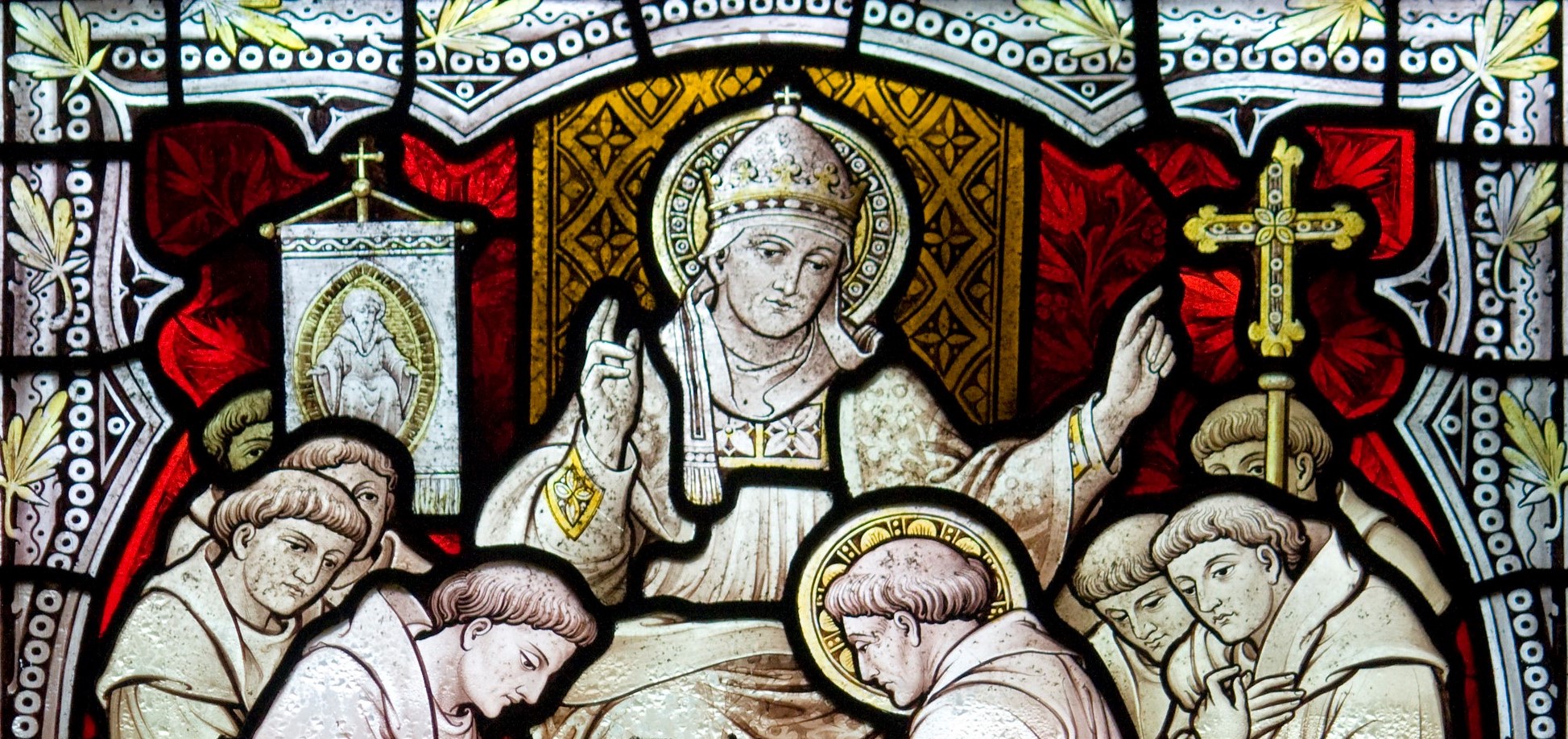

St. Gregory was born of a noble family in Rome around 540. He was educated in law and became prefect of Rome about 572. Two years later he decided to become a monk, and turned his house on Rome’s Coelian Hill into a monastery.
According to Pictorial Lives of the Saints, “While still a monk the Saint was struck with some boys who were exposed for sale in Rome, and heard with sorrow that they were Pagans. ‘And of what race are they?’ he asked. ‘They are Angles.’ ‘Worthy indeed to be Angels of God,’ said he; ‘and of what province?’ ‘Of Deira,’ was the reply. ‘Truly must we rescue them from the wrath of God. And what is the name of their king?’ ‘He is called Ella.’ ‘It is well,’ said Gregory; ‘Alleluia must be sung in their land to God.’ He at once got leave from the Pope, and had set out to convert the English, when the murmurs of the people led the Pope to recall him. Still the Angles were not forgotten, and one of the Saint’s first cares as Pope was to send from his own monastery St. Augustine and other monks to England.”
Gregory was ordained a deacon, and in 579 Pope Pelagius II sent him to Constantinople as his representative to the imperial Byzantine court. After some years Gregory was recalled to Rome by the Pope, who appointed him his secretary. On the death of Pope Pelagius, the clergy and people were unanimous in choosing Gregory as his successor to the See of Peter. Gregory tried to resist, even attempting to flee, but to no avail. Finally he had to yield and was consecrated on Sept. 3, 590. He was the first monk to become Pope.
Pope Gregory was a dedicated pastor and a competent administrator. In his Lives of the Saints, Westminster Abbey’s Father Augustine Kalberer, OSB, wrote, “The 854 extant chancery letters, spanning his fourteen year pontificate, are so many masterpieces of Christian wisdom and jurisprudence, each characteristically Gregorian in the way it situates the business at hand within the broader context of the Gospel and the common good. No other pope has supplied canonists and moralists with so many enduring formulas. He brought to the papacy all that was best in the Roman tradition of law, respect for rights, courtesy, and order.”
Pope Gregory introduced several changes to the celebration of Holy Mass, for example: the Kyrie and Christe eleison were to be sung alternately by clergy and laity, the Alleluia was to be omitted in Lent, and the Lord’s Prayer was to be said after the Canon. Gregory promoted a plainchant that now bears his name.
Many of his homilies have been preserved, but he is best remembered for three works: Pastoral Rule (about 591), detailing the duties of those engaged in the care of souls, which Gregory called “the art of arts;” Book of Morals, a commentary on the Book of Job, which is at the same time a summary of Christian morality; and Dialogues, which contains accounts of the lives and miracles of various Italian saints and an essay on the immortality of the soul.
Gregory died on March 12, 604, but in the General Roman Calendar his memorial is celebrated Sept. 3, the anniversary of his consecration as pope. Pope Boniface VIII declared him a doctor of the Church in 1298. St. Gregory is one of the four great doctors of the Latin Church.
隱修士成了教宗
公元540年,聖國瑞出生於羅馬一個貴族家庭,修讀法律。572年,他成了羅馬教宗禮節中的司儀;兩年後、公元574年,他有意成為隱修士,遂把座落在科連山上的私宅,改成隱修院。
當聖國瑞渡著隱修士的生活時,見到有異教徒的男孩在羅馬境內出售,感到十分難過。打探得悉是從英國德拉郡來的孩子,他的反應是『他們堪成為天主的天使。』他馬上向教宗辭行,要到英國推廣皈化天主的工作;不過,教宗卻把他召回。然而,他內心對此不息 ── 當他登位教宗時其中最關心的事,就是派遣聖奧思定和一些隱修士到英國去。
國瑞被授予六品聖職後,公元579年,教宗貝拉二世派遣他到君士坦丁堡,位列拜占庭宮廷的教宗代表。又在數年後,國瑞被召回羅馬,任教宗的秘書。教宗貝拉二世駕崩,眾人都無異議地推舉國瑞繼任,但他極力推搪,甚至嘗試逃走,均不果。590年9月3日,國瑞是第一位隱修士成為教宗。
教宗國瑞是一位獻身的牧者和稱職的行政者。本篤會的思定.卡伯勒神父寫道:「854年尚存的教廷文書中,國瑞持續十四年的教宗職務,遺下很多充滿基督徒智慧與法律學的傑作。他的『國瑞特色』把事務放在更擴闊的福音領域,以及大眾的裨益。沒有一位如他一樣的教宗,能向教律學者和倫理學家,提供那麼多定律。他為宗座帶來羅馬最好的傳統法律、權益尊重、禮節及規範性。」
教宗國瑞引入了幾個舉行彌撒聖祭的變動:主祭與信眾對唱「基督垂憐」、四旬期取消詠唱「阿肋路亞」、彌撒常典後誦「天主經」。他推動彌撒中的平調詠唱。他很多的講道都被保留;但有三本最為人樂道的著作有591年的「牧民守則」,詳列靈魂牧者的責任(他稱為《藝術中的藝術》);解說「約伯傳」的「道德書」,同時亦綜合了基督徒應有的道德;「對話」一書記錄了不同意大利聖人的生平和聖蹟,附上一篇有關靈魂不朽的文章。
國瑞死於604年3月12日,但一般教會年歷都用9月3日他被祝聖任教宗的一天,作為的他的慶日。1298年,教宗博義八世奉聖國瑞為「教會聖師」,是拉丁教會四大聖師之一。







