

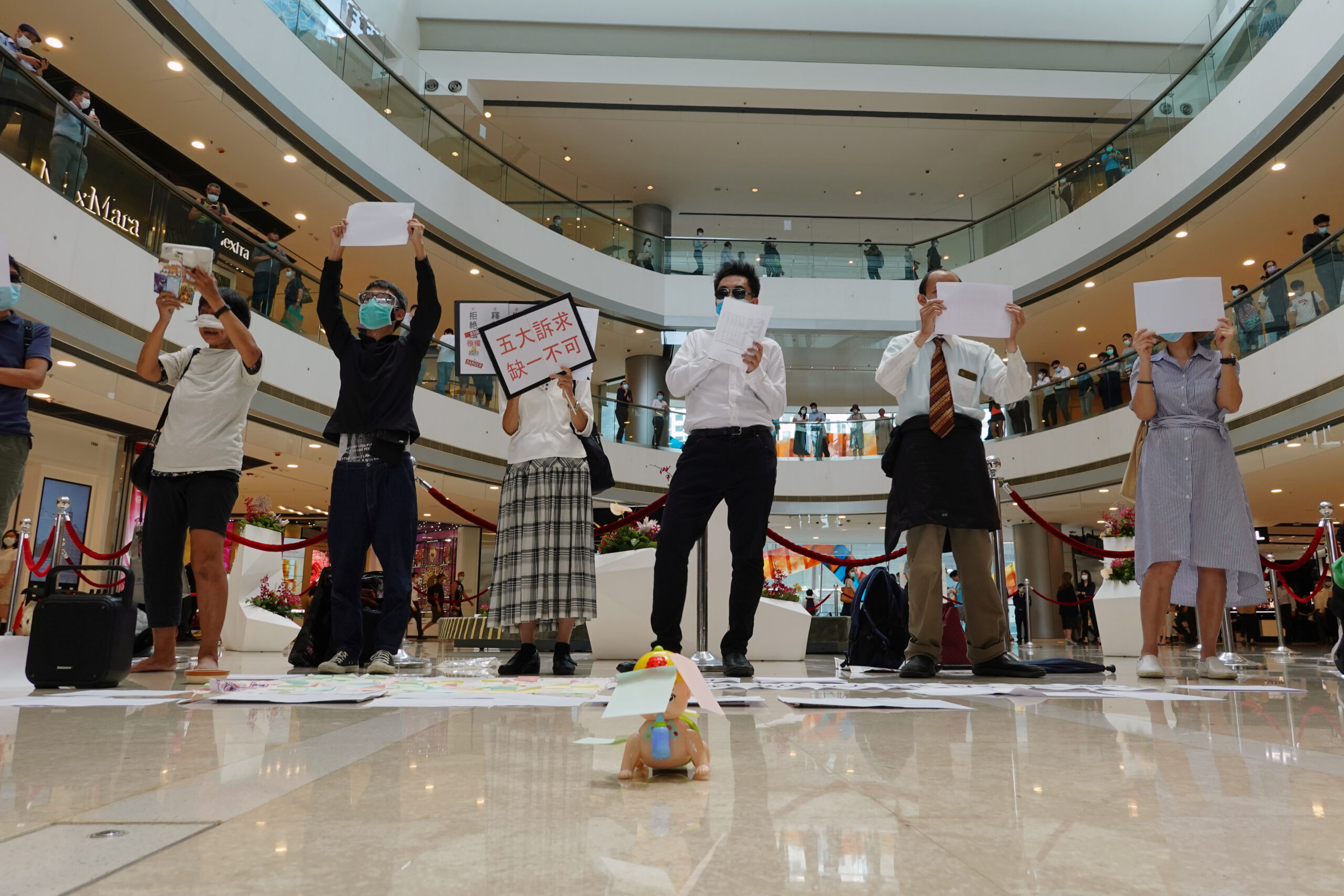

On Sept. 30, the controversial 2018 agreement between the Vatican and China on the appointment of bishops is set to expire. As discussions continue on renewing the agreement, this Holy See and Beijing series examines the situation of the Church in China. In this part, Father Richard Soo, SJ, of Eastern Catholic Church in Richmond looks at the persecution of Christians in China and Hong Kong and offers his thoughts on bringing about change.
Unlike China, Hong Kong has traditionally been a place where Catholics enjoyed religious freedom. The Diocese of Hong Kong was so alive that its large Cathedral did not have enough space to receive all the converts from RCIA at the same time. Converts had to be baptized/received over four separate Masses on two different Sundays!
The last British governor, Sir Chris Patten, was a devout Catholic, an active parishioner, and a determined promoter of democracy and civil rights there.
But all that is now over.
On July 1, Beijing imposed a “National Security Law” on Hong Kongers (without even consultation, much less a vote). Hong Kong Catholics would now be subjected to the same persecution that the Catholic Church in the People’s Republic of China has been suffering.
In the last couple of years, pressure and intimidation has ramped up against Catholics in the PRC. Human rights agencies report increased persecution of the Church and its members.
Churches are being demolished, the Bible being rewritten to conform to communism, and crosses, statues, and other iconography destroyed and replaced by photos and sayings of PRC dictator Xi Jinping.
Clergy who refuse to join the communist Church-controlling agency, “the Catholic Patriotic Association” CPCA, are being persecuted and detained.
Priests say it’s worse now than during the Cultural Revolution when you could “go underground.” Currently the PRC is the most surveilled state in the world, with government cameras videoing people everywhere and everyone’s social media being monitored by Beijing.
Catholics – lay and clergy – are being imprisoned and tortured. There are dark rumours of organ harvesting among political and religious prisoners.
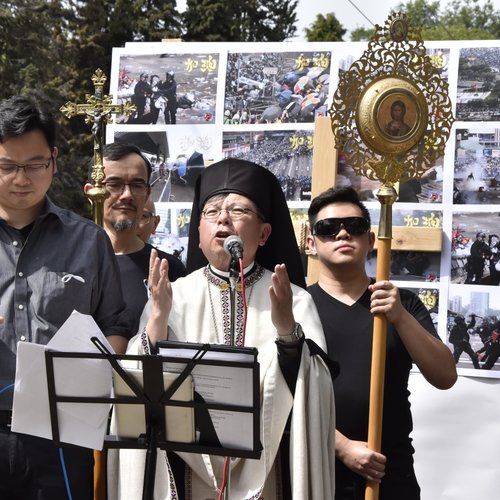
In recent weeks, the religious freedom magazine Bitter Winter reported the following:
On March 8, the government of Handan city put an 83-year-old priest under house arrest in a hotel to coerce him into joining the CPCA. Three days later, the priest was taken to a hospital with stroke symptoms. Afterward, they banned him from celebrating Mass and other services. While he was hospitalized, government agents surveilled his parish and prohibited the faithful from gathering – effectively closing the parish.
In April, in the Diocese of Mindong in Fujian province, the government’s intimidation of Catholic conscientious objectors intensified after a priest was tortured to make him join the Patriotic Association in April. Some priests had to go into hiding to evade torture and persecution.
On July 8, bishops and priests of the Diocese of Yujiang were “prohibited from any pastoral activity.” Accounts say the PRC forced priests to attend several days of attempted brainwashing to pressure them to succumb to the “Patriotic Association.”
These are just a few recent examples of life for Catholics in the PRC, and this is the fate looming over Christians in Hong Kong.
In China, torture is standard practice; there is mass surveillance of everyone; civil or legal rights, where they exist, are meaningless; conviction rates in the courts are an incredible 99.9 per cent; there is no freedom of speech and certainly no religious freedom.
When Britain handed Hong Kong over to Beijing (without consulting the Hong Kong people themselves), the PRC signed an international agreement to give Hong Kong democracy, rule of law, and civil rights until at least 2047. Canada was a witness to the agreement.
Yet on July 1, Beijing unilaterally imposed its National Security Law upon Hong Kongers. Through this law, China in one fell swoop stripped away all Hong Kongers’ human rights, destroyed the rule of law in Hong Kong, and violated its international democratic obligations for Hong Kong. Beijing has imposed its own totalitarian rule on Hong Kong.
Canadians might feel distant from all that is happening, but alas Canada is already involved. Canadian citizens are suffering torture in the PRC – the best known being the two Michaels, Kovrig and Spavor. You may remember the Garratts, a Canadian Protestant missionary couple doing charity work in China for 30 years who were suddenly imprisoned for 775 days.
Canadian Catholics are already under threat, because Beijing says the new security law applies not just people in China or Hong Kong, but anywhere. If Canadians speak out, or pray, or do anything Beijing doesn’t like, even while in Canada, we are deemed to have violated their law. If you speak up for freedom of religion for our fellow Catholics in Hong Kong, it is no longer safe for you to visit Hong Kong now.
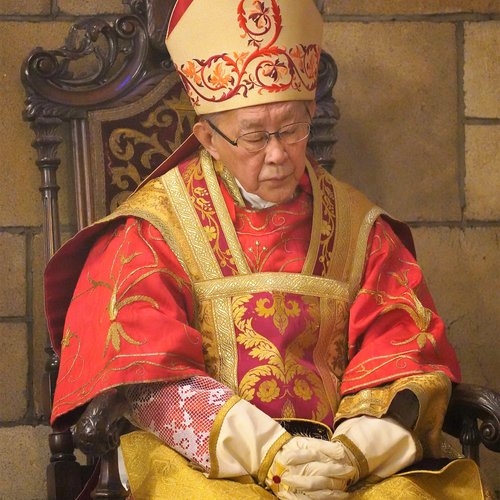
Cardinal Joseph Zen, retired bishop of Hong Kong, says he is waiting to be arrested as a result of the new security law. (CNS photo/Gregory A. Shemitz)
Cardinal Joseph Zen, emeritus bishop of Hong Kong, says he is now waiting to be arrested by Beijing’s agents – because he fearlessly spoke out on behalf of persecuted Catholics in the PRC.
Joshua Wong, a Christian Hong Kong student activist, said his faith is the foundation and driving force for his dedication and work for democracy and human rights in Hong Kong. After July 1 and the security law, he says he now goes to bed in fear he will be dragged off in the middle of the night to China to face torture life in its gulags.
Lest we think this is an empty threat, last night, July 29, Beijing state agents came to the homes of four Hong Kong teenagers and dragged them off – at night – for a single social media post that merely speculated about Hong Kong independence. It was seen by Beijing as endangering “national security.”
Anything could be construed by Beijing as violating the National Security Law (including this article in The B.C. Catholic). Anyone could be accused of “inciting subversion” of the PRC’s “security” on any pretext whatsoever.
This week alone, it was reported that China had hacked Vatican computers as well as those in the Diocese of Hong Kong and other Catholic organizations.
Naturally, Catholics need to care about this issue. It’s part of what it is to be Catholic – to love our neighbour as ourselves. The Second Vatican Council’s Gaudium et Spes tells us, “The joys and the hopes, the griefs and the anxieties of the men of this age, especially those who are poor or in any way afflicted, these are the joys and hopes, the griefs and anxieties of the followers of Christ.”
The situation in Beijing and Hong Kong is not just a socio-political issue. It is very much a Church issue. Cardinal Zen, the emeritus bishop of Hong Kong explains: “When Hong Kong loses its freedom, the Church will not be spared either. And when the Church loses its freedom, it can no longer defend Hong Kong’s freedom with the people. The freedom of the people and religious freedom cannot be separated. In China there is no religious freedom, because there is no freedom for the people; when religion is deprived of freedom, it can no longer help the people to fight for freedom. When Hong Kong loses its freedom, the Church will not be spared either. And when the Church loses its freedom, it can no longer defend Hong Kong’s freedom with the people.
“When the whole society is challenged to choose between right and wrong, can the Church be dispensed from that choice and enjoy privately its own peace? No! It’s not possible!”
When I was in Ukraine giving a retreat to our Byzantine Catholic seminarians, our Patriarch came to celebrate a full-blown Pontifical Liturgy on the seminary’s feast day. During His Beatitude’s sermon, he suddenly turned to me in front of everyone (and on live TV broadcast throughout Ukraine and the world) and said: “Father Richard, please convey to your parishioners in Vancouver that the Chinese are part of our Church. Our Church is a mother Church for them. Their sorrows, their hopes, for their homeland in Hong Kong, is a part of our concern and our prayer. Please convey to them that heart-full embrace of the Mother Church from Kyiv.”
Someone asked me recently, “Is there any hope?” I pointed to the crucifix I was holding and said, “Of course there is hope. This is our hope.”
Is there anything that we can do? There is a great deal we can do, starting with prayer. Let’s pray for freedom for Hong Kong, China, and anywhere else the children of God are suffering at the hands of cruel, modern slave masters. Let’s pray for their freedom to practise their Faith and live the lives our Lord gifted them to live – lives of the dignity of children of God.
You might think nothing short of a miracle would be needed in the face of such overwhelming tyranny and cruel repression. Then let’s pray for a miracle, which is not as far-fetched or unrealistic as it may seem to those outside the faith.
We know that miracles are real. They are scientifically investigated and objectively verified. They are not outlandish occurrences. Indeed, for Catholics, miracles are daily and weekly occurrences – in the Eucharist and in confession, for example.
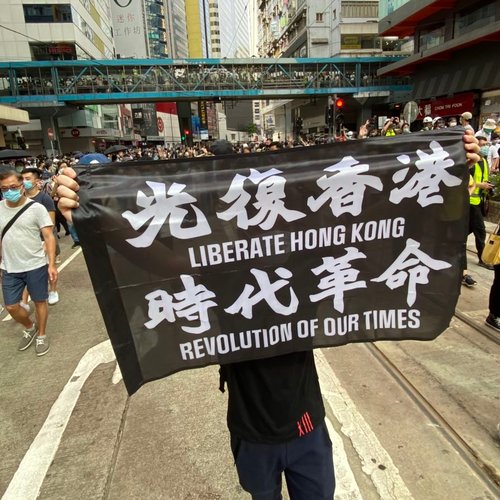
We can cite the miracle of the fall of the USSR and the resuscitation of the Byzantine Catholic Church in Ukraine after its brutal suppression by the Soviets. Many would count the unbelievable and sudden success of the 2013-2014 Maidan protests in Ukraine as a miracle. Our Byzantine Catholic Church and its young students from the Ukrainian Catholic University played a key role in it, with protests that included daily prayer, every hour on the hour. Our Church built a street chapel in the midst of the Protest Plaza. When the regime’s riot police destroyed it, we rebuilt it. (Hong Kong’s Umbrella Democracy Protests in 2014 also built a “St. Francis Street Chapel.” It too was destroyed by riot police. Its crucifix was gifted to my parish.
You don’t have to be an expert in international law or a theologian to discern what is going on in Hong Kong or China, you just have to be a regular Catholic. Cardinal Zen sums it up in one Bible verse from the Book of Amos: “Hate evil, love good; maintain justice in the courts …”
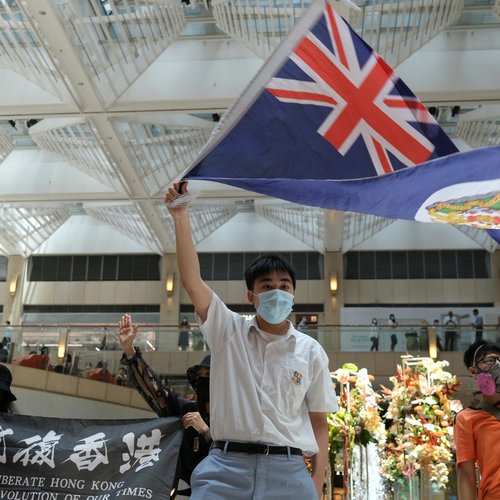
A pro-democracy demonstrator waves the British colonial Hong Kong flag during a protest against new national security legislation. (CNS photo/Tyrone Siu, Reuters)
When you pray for our fellow Catholics persecuted for their faith, for all the people in the crosshairs of a brutal atheistic regime, consider another quote from Amos offered by Cardinal Zen: “Let justice roll on like a river, righteousness like a never-failing stream!”
Miracles are not foreign to our everyday Catholic faith. Let us pray, and may our prayer lead us to action.
Father Richard Soo, SJ, is the protosynkellos (vicar general) of the Eparchy of New Westminster, Ukrainian Greco-Catholic Church in Canada.







