

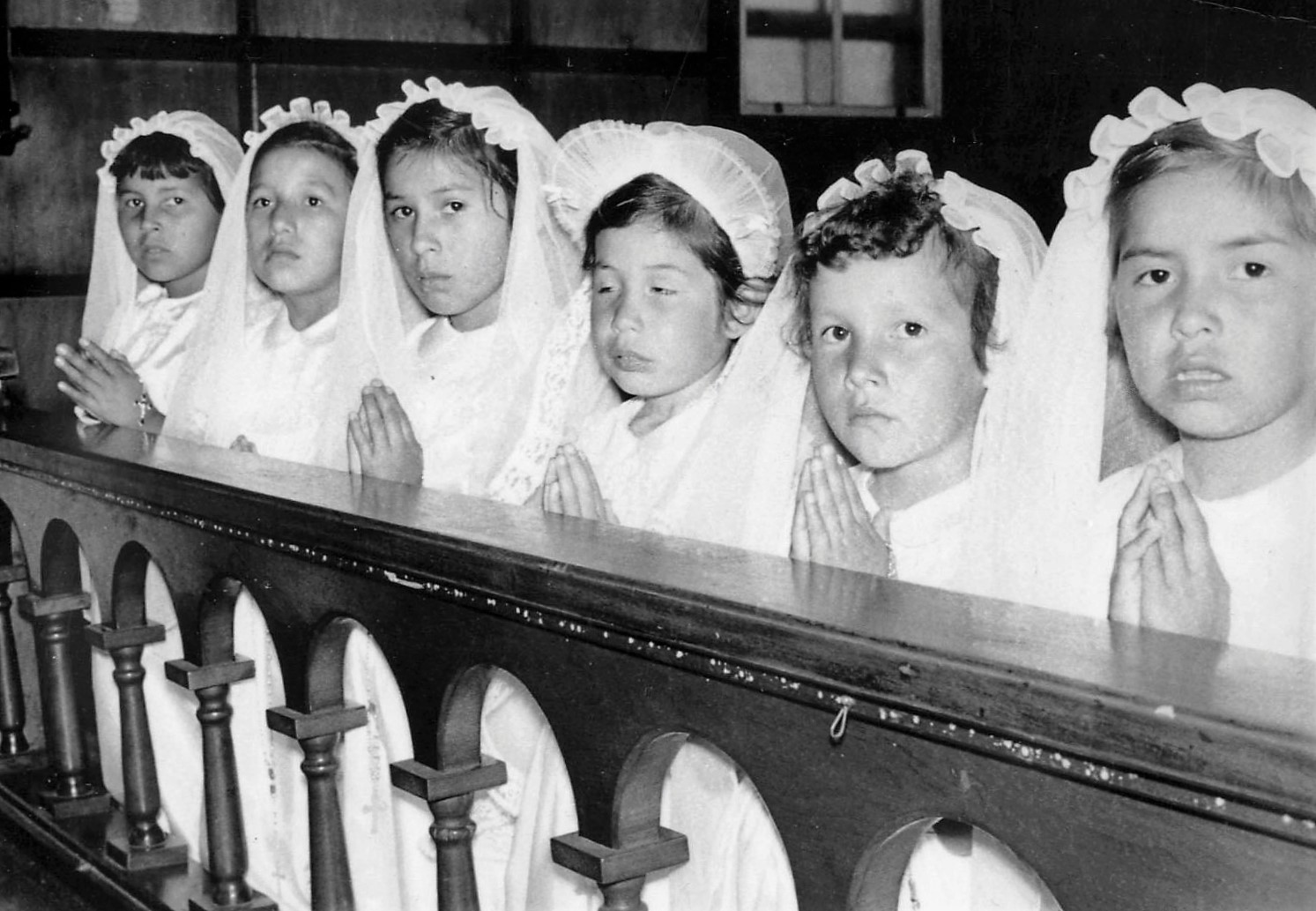

Our Church leaders are being browbeaten by the media to render another litany of apologies. I wince at this posturing not because I am opposed to apologizing, but because I am married.
Healthy married couples seek “truth and reconciliation” with each other by making amends and choosing to weather the coming storms – together. The mainstream media, bent on spoiling Catholic-Indigenous relations, are like a mother-in-law who whispers into her daughter’s ear, “I saw an old picture of your husband with that girl. I wonder if he’s hiding something.” There are some who cannot tolerate a missed occasion to breed gossip.
You will be hard-pressed to find any indigenous group in the history of the world that has received as many apologies and as much outreach and compensation as our First Nations have received from the Catholic Church. The Church’s efforts toward reconciliation have been, if not always exemplary, at least historically unparalleled.
If there is need for further apologies from Catholics, let us be courageously and unapologetically Catholic.
Edwin Bryan
Blind Bay, B.C
Your June 7 interview with Dr. Scott Hamilton provided his testimony of what he discovered and details of burials during a century’s time. He said the “mass grave” description “misses the point with the Residential-School story.” He expanded on his findings and his awareness of all the people who lived and died there. He stated there was no mass grave, but there were numerous burials in the area. Yet the announcement has gone all around the world, with nobody listening to Hamilton and making this distinction.
It would be helpful if there were some way to examine DNA, but we must leave that to the scientists. Some closure would surely help those so distressed in this mystery.
Ultimately, nothing can be assumed until there is more information.
I recall attending Mass many years ago at Mission's Marian Pilgrimage to Our Lady of Lourdes Grotto. The archbishop was clothed in a beautiful leather chasuble the Indigenous people had given him. As we processed uphill to the grotto, a senior Indigenous lady talking to her friends said, “I don't know what everybody is talking about. The nuns gave me an education.” She proceeded to speak of her young life. It felt like all souls had come together at that moment.
The peace that woman displayed that day is something we need to embrace.
Helen Masters
Vancouver
The discovery of unmarked graves at the sites of residential schools has given the public a perfect opportunity to vent their anti-Catholic prejudices, as we see in the recent burning and vandalism of churches.
To categorically refer to the tragic history of residential schools as “genocide” is not only inaccurate, but an insult to a real genocide taking place today. The People’s Republic of China is indeed committing genocide against the Uyghur people in China. Up to 1.5 million Uyghur people are being placed in concentration camps, where rape and torture are everyday occurrences.
The internment of the Uyghurs and other Turkic Muslims represents the largest arbitrary detention of ethnic and religious minorities since World War II. The Chinese government is doing its utmost to wipe out any trace of the language, heritage and culture of its people.
The Senate of Canada shamefully defeated a motion to recognize China’s genocide against the Uyghur people. Some senators, for reasons I would not name here, merely parroted the words of the Chinese ambassador in explaining their stance.
As Catholics, we must stand against injustices, no matter where they are happening. Let us not forget this crime against humanity happening right before our eyes today.
Patrick May
Vancouver
Two letters in the July 5 issue demonstrate the need for education of Canada’s non-indigenous people is desperate. Look up policy documents such as the Canadian Indian Act to understand the attitudes that governed the policymakers in Ottawa. Search the Doctrine of Discovery, upon which much of Church and state policy has been based. It is nothing less than shocking.
A recent article in Canada’s National Observer described the alternative dispute resolution process as a system “set up by bureaucrats, for bureaucrats, and beloved by bureaucrats.” Victims were divided into categories, depending on whether they had suffered sexual abuse or had physical injuries lasting longer than six weeks, or whether they had been confined. Financial compensation was awarded for things like severity, permanent physical damage, location – some provinces were worth more points that others – and the identity of the abuser. According to Phil Fontaine, former national chief of the Assembly of First Nations, the ADR point system weighted being abused by a Protestant as worth 30 per cent more than being abused by a Catholic.
Of note is the 1907 report by Dr. Peter Henderson Bryce, a public health physician for the Ontario provincial and Canadian federal governments, in which he “exposed the genocidal practices of government-sanctioned residential schools …” and which the federal government subsequently ignored.
Instead of hiding behind such falsehoods as expressed by this week’s letters, we colonist descendants must listen to our Native elders and speakers and follow their requests and direction for reconciliation, rather than continuing to remain locked inside our ignorant viewpoints.
Penny Oyama
Burnaby
Deacon Jamie Meskas’ July 5 article “Trust with First Nations has been severely broken” on the reality of his ministry within Aboriginal communities helped me refocus the conversation going on in my head. His statement that “Jesus has placed us with them to love them, not to be successful” was, to use a contemporary cliché, a powerful reminder of our position within the world as Catholics.
I must admit, however, that considered within the framework of other conversations in The B.C. Catholic about the decline of Christianity in the west and our transition into an “apostolic” mode of existence, the quotation is a bit depressing. If we are not going to be successful in an age where our core purpose is apostolic in nature, what is the point? The rash of burned churches and vandalism has done nothing to help me, or us, feel better.
I’ve been trying to sift through all the responses to the recent burned churches. The sadness and the anger can feel overwhelming. But the angry and hateful words directed toward the vandals and arsonists leave me feeling troubled. Deacon Meskas’ reminder that love is our primary obligation to other people is needed. Churches can be rebuilt, but the damage that reciprocal anger and spite do to our relationships with these people who need our love – even when they persecute us – is inexcusable.
Just because anger is understandable does not make it justified. Remember that Jesus healed the slave’s ear when Peter rushed to defend him in the garden. He did not tell Peter his anger or fears were justified, instead he chastised him for drawing his sword.
Christ told us more than once that persecution and rejection were to be our reward for following him faithfully. He told us to love others as he loved them and he showed us how to do this on the Cross.
Nicholas Elbers
Maple Ridge
Colleen Roy’s June 28 column “Be kind, calm, and safe, but choose Christ” really touched us. She put into words exactly how we are feeling these days! Thank you!
Tim and Louise Scatliff
Winnipeg







