


17th Sunday in Ordinary Time, Year B
First Reading: 2 Kg 4:42-44
Second Reading: Eph 4:1-6
Gospel Reading: Jn 6:1-15
This Sunday, we hear how Elisha fed 100 people on twenty loaves of barley and ears of grain and how Jesus fed 5000 people on five barley loaves and two fish, with twelve baskets of food left over. It is the first of five on which we hear Jesus promise to give us his body to eat and his blood to drink. (This year, the Solemnity of our Lady’s Assumption takes precedence over the fourth one.)
Most of Jesus’ contemporaries did not believe that he could transmit God’s life to us by giving us his flesh to eat, and not even his apostles knew how he would do it. Most people do not believe it today. Even we who do can grow careless about it.
It is God who provides even the natural food we need. He fed the Israelites in the desert with manna; he fed Elijah in the wilderness through an angel. It is he who ordained just how our bodies process this food so as to maintain our natural life.
Why, then, should God not supply the food we need to maintain our supernatural life, which we began at our baptism? “Let Me solemnly assure you,” Jesus said: “if you do not eat the flesh of the Son of man and drink his blood, you have no life in you.” Just as he has divine life because he is begotten by God the Father, he said, so we will have divine life because we feed on him.
St. Paul warned us not to take this food carelessly. “A man should examine himself first,” he said; “only then should he eat of the bread and drink of the cup. He who eats and drinks without recognizing the body eats and drinks a judgement on himself.”
To properly “recognize” the body of Christ, we must first believe that bread and wine have been transubstantiated, or transformed in their innermost substance, into his body and blood.
Accordingly, said Pope St. John Paul II in his 2003 encyclical Ecclesia de Eucharistia, we may not give communion to anyone “who is not baptized” or “who rejects the full truth” of “the Eucharistic mystery.” Conversely, Catholics, “while respecting the religious convictions of [their] separated brethren,” must not receive “the communion distributed in their celebrations, so as not to condone an ambiguity about the nature of the Eucharist.”
Therefore, all ministers of Holy Communion, whether priests or deacons (the ordinary ministers) or lay people (the extraordinary ministers), must be alert. It is easy for us to fall into a careless rhythm: “the body of Christ, the body of Christ.”
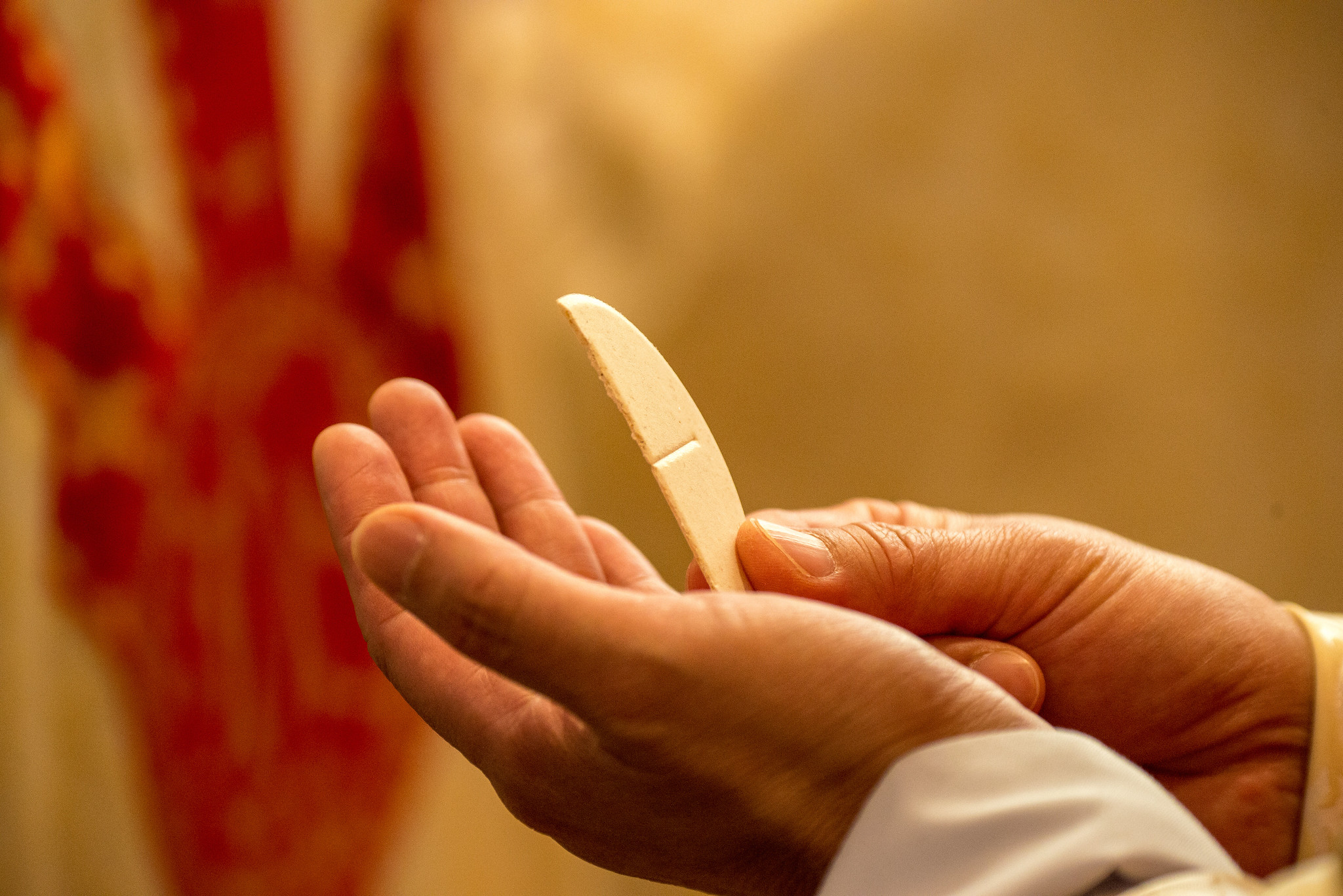
Before we give the host to communicants, we must allow them time to assert their belief in the real presence by responding “Amen.” As far as possible, we must ensure that they consume it and do not carry it out of church or even back to their pews.
In fact, we should all help to guard the body of Christ. We should not behave like policemen, but we should gently stop anyone we see carrying away the host.
For us to receive Christ’s body and blood worthily, we must not only believe, the Pope said, but also “persevere in sanctifying grace and love, remaining within the Church bodily as well as in our heart.”
Accordingly, he said, he reaffirmed the Church’s stern rule that, before receiving communion, we must go to confession if we are “aware of mortal sin.”
Only we and God know whether we are in a state of grace, he admitted, but the Church “cannot fail to feel directly involved” in cases of “outward conduct which is seriously, clearly, and steadfastly contrary to the moral norm.”
It is “Eucharistic communion” that “confirms the Church in her unity as the body of Christ,” the Pope said. Let us, then, obey St. Paul, who exhorts us to live a life worthy of our calling.
Father Hawkswell’s course, “The Catholic Faith in Plain English,” has now ended, but all the materials (video and print) will remain available online free of charge at beholdvancouver.org/catholic-faith-course until the end of August.







