


“Lift high the Cross” are words sung with gratitude and joy as we recall Christ’s victory over death. Because we know of the Resurrection, Christians treasure the symbol of the cross, making it almost difficult to imagine that, until Christ, a cross was a dreaded instrument of torture.
As Bishop Robert Barron reflects in his YouTube recording of the Rosary’s Sorrowful Mysteries, to pre-Christians, a cross “meant a death in utter agony, nakedness and humiliation.” He goes on to state that “for the first several centuries of Christianity, artists were reluctant to depict the death of the Lord because it was just too terrible.” The image of a cross symbolized evil and suffering; therefore, no one wanted to even think about it, let alone depict it in art.
Today, Christians proudly share images of the cross. It is seen in greeting cards, jewellery, and paintings and displayed in churches, cemeteries, and homes. How could this despicable image become one so revered?
As the theologian Dr. Sean Innerst stated in Episode 6 of The Search, “The Cross is a paradox. What it represents … is the worst thing that human beings have ever done and the greatest thing that God has ever done.” In a profound act of love, Christ took on the sins of the world. He suffered every possible human torment – fear, anxiety, betrayal, ridicule, false accusation, beatings, torture, humiliation, and grief – to put our worst to death. Both literally and spiritually, the cross was Christ’s vehicle for redeeming the world, through his resurrection, for our eternal salvation.
Christ humbly entered our world. He was born in a stable, lived amongst commoners, worked as a carpenter, and suffered the death of a criminal, momentously forgiving an actual criminal in his final moments. Christ embraced our worst to crush it, as he conquered death itself.
As Christians we know that without Good Friday there would not be Easter. In the words of Dr. Innerst, in “receiving the worst humankind has ever done, [God] performs the greatest act of love in human history … powerful enough to save the whole human race.” Without suffering, we cannot truly appreciate real joy. The cross – either represented with the crucified Saviour upon it, or bare – is the image which draws our minds and hearts to this reality.
How are we, in Christ’s name, called to transform ugliness to beauty in our day-to-day lives? Forgiveness, patience, tolerance, and service are places to start.
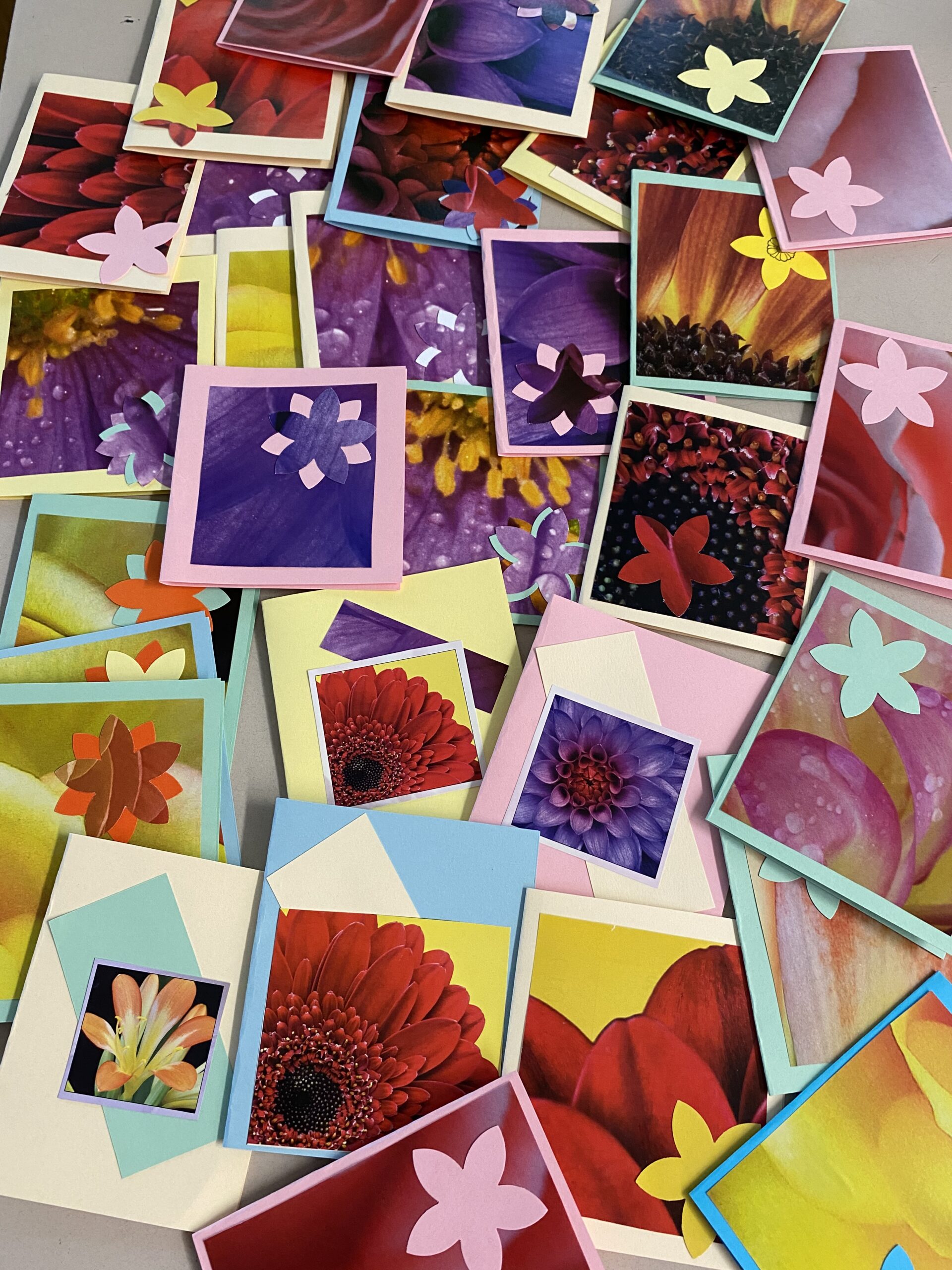
Recently, while making Easter cards, I experienced a moment of transformation. A co-worker had given me a 2020 calendar filled with lovely photographs of flowers. When the lockdown began, this calendar became my lifeline as I recorded myriad Zoom teaching sessions and meetings. Although I was ready to start fresh in 2021, I could not bear to recycle the beautiful pictures, so I carefully stored the calendar with my card-making supplies. For Easter, while making cards for some students to send to a seniors’ residence, I turned to the calendar for inspiration.
As I repurposed the flower images and glued them to cardstock, I found myself face-to-face with my 2020 Zoom schedule on the images’ reverse. Rather than lamenting 2020 and our experience of a second Easter season in isolation, I rejoiced in knowing that I was taking reminders of a difficult time and transforming them to create symbols of Easter hope.
I discussed this symbolism with the children. We talked about how Jesus had transformed the image of the cross from one of horror to one worthy of adoration. We talked about how they, through their loving messages, were taking a memory from a difficult year and turning it into loving gifts for many.
Our joy is real during the Easter season, and we are called to hold onto to the hope of the Resurrection as we look for ways to find positivity in the midst of difficulty in our everyday lives.
The cross is not just a quaint Christian symbol: its role in our redemption and its transformative journey are very complex. God’s greatest thing changed everything. Sin was forgiven. Death turned to life. The ugly image of a cross became beautiful.
Let us “lift high the Cross.” Happy Easter!







