



The opening of any season of Vancouver’s beloved Bard on the Beach is always a matter of delight. This year, however, the pleasure is intensified by the ending of an enforced two-year closure due to the COVID crisis. It is fitting that the reopening should be with the ever-popular A Midsummer Night’s Dream, since this was the play which opened the company’s first season and which it has presented no fewer than seven times over its remarkable 33-year history.
Of course, the Dream is a play which is open to a variety of interpretations. Its mixture of upper-class concerns with marriage to the “right” people; the fantasy of fairyland; and the farcical comedy of a group of rustics attempting to mount a play in honour of a Duke’s marriage allow the director to emphasize a multitude of tones. In the current production, director Scott Bellis has leaned decidedly in favour of the rustics, aiming repeatedly at the farcical with heavy emphasis on the noisily strident and the wildly physical. It is a clear attempt to help the audience forget the enforced quiet isolation and solitariness of the last two years. This approach engulfs the entire production: scene after scene involves noise and frequent physical interaction.
Anyone looking for a poetic interpretation of the play will be disappointed. The production’s approach to fairyland is stridently anti-Arthur Rackham, and the romantic approach to love is buried under the raucous behaviour of virtually all the participants. The result is a broadly farcical evening of theatre – and clearly the opening night audience loved its clamourous comedy.
Setting the play after the First World War lends a worthy piquancy to the relationship of Theseus and Hippolyta and further allows for some charming 1920s costuming. Scenery and costuming are creatively atmospheric. The entry of Oberon, in particular, is wonderfully fantastical in a rather menacing way – quite suited to the scheming character.

Overall, Bellis’ interpretation of the play works well, though to my mind some aspects misfire. Sarah Rose as Puck enthusiastically throws herself into the role but at times is so abrasive that one completely forgets that Puck is ineptly mischievous rather than nasty. Moreover, for a play which traditionally is romantically beautiful, there are perhaps too few moments of the magical. Thus the ultimate reunion of the feuding king and queen of the fairies, Oberon and Titania, comes as a lovely respite from the frenzy.
The actors are an admirable advertisement for inclusivity with a cast of many ethnicities – a welcome reflection of Vancouver itself. Furthermore, the characters reflect the sex-reversal approach that has now become a theatrical norm. This is most obvious in that Bottom, a male character traditionally at the centre of much of the farcical content, is played by a woman, Carly Street, who is known for other over-the-top performances. Her stentorian, broadly physical performance sets the tone of the evening and was enthusiastically embraced by the audience.
All in all, the current production of A Midsummer Night’s Dream by Bard on the Beach (running until Sept. 24) reflects the company’s enthusiasm for tackling Shakespeare in new and unusual ways. Its light-hearted and broadly comical entertainment mark a fitting return to what we all hope will be a new, more social normalcy. It is a pleasure to welcome back Bard on the Beach!
Share your thoughts about this article. Click here to send us a letter to the editor.
A cinematic treat for Canada Day
In a recent column I remarked that sometimes a small yet rewarding film gets little notice and, after a brief appearance in theatres, disappears. Fortunately, such films often remain available on streaming services.
A delightful example of such a film is Peace by Chocolate (available on Apple TV+ and other streaming services). What is remarkable is that the film is a Canadian story, filmed in Canada, and an optimistic account of the Canadian immigrant experience – a heartwarming film perfect for Canada Day celebrations.
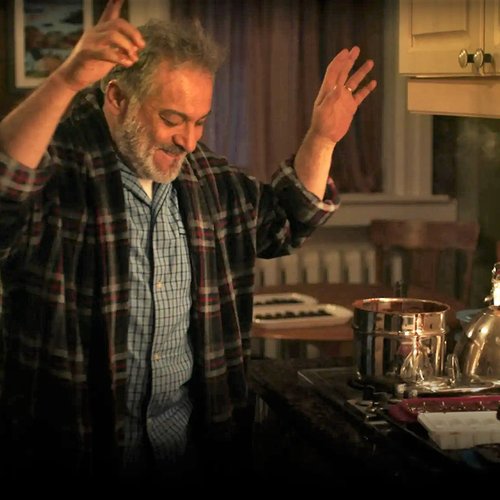
Abdel Hadhad arrived in Canada in 2015, having fled his native Syria and living with his family in a refugee camp in Lebanon.
Accepted as a refugee by Canada, Abdel arrived in Antigonish, N.S. This tiny town in the grip of winter was perhaps not what he expected, but the warm welcome he received certainly was far more than he had anticipated.
Later, joined by his father and with hopes of studying to be a doctor, things took a decidedly unexpected turn. Abdel’s father, before fleeing from Syria, had been an accomplished chocolatier. In his new country, in a make-shift kitchen, he began producing chocolates which proved to be a massive hit in Antigonish and the surrounding territory. Such is the plot of the movie.
Just how close to actual events the film Peace by Chocolate actually is remains questionable, though in its general narrative arc it is certainly accurate. What rings most true, however, is its reflection of the immigrant experience.
The Hadhad family’s arrival and settling in is marked by problems experienced by many newcomers to the country. Yes, they are greeted warmly by members of the community, but others resent the fact that “they are taking away our jobs,” symbolized by the owner of a local chocolate shop whose trade is threatened by the Hadhads.
They face the enormous problem of being faced with a foreign language and rely on Abdel to be the translator (a similar situation to one of the main plot elements in Coda), leading to an intergenerational conflict as the son wishes to pursue his own career goals rather than be part of the family business.
The family has to deal with new social norms. For example, they find themselves unable to apply for a bank loan since in Syria (in apparent accord with standard Muslim practice) no interest can be made on a loan, even by a bank. Over and over such challenges arise for the Hadhad family, resulting in an entertaining and diverting storyline – and one that involves no villains.
Some may take exception to such an approach as unrealistic and foreign to the experience of many immigrants. The fact, however, is that for this particular family the outcomes were positive.
Thanks to the father’s skill, his chocolates became a huge success, eventually leading to a deal with Sobeys and world-wide distribution.
The portrayal of the family and its experiences are conveyed in a bright and lively fashion. The cast acquit themselves superbly, making the events ring true. And the general tone of the narrative can make Canadians feel good about the reception the family generally receives.
While it is certainly a sad fact that this is not always a reflection of the way immigrants and refugees are treated in Canada, there is no gainsaying that the Hadhads not only were successful in their own lives, but have, in a multitude of ways, used that success to give back to their new community with ample support and generosity.
Just in case you should be moved to order Chocolates for Peace, know that they don’t come cheap. At $24 plus shipping for 22 chocolates, one may choose instead to enjoy the product vicariously by spending a pleasant time watching a delightfully entertaining movie, a movie which is proudly Canadian.
Share your thoughts about this article. Click here to send a letter to the editor.







