

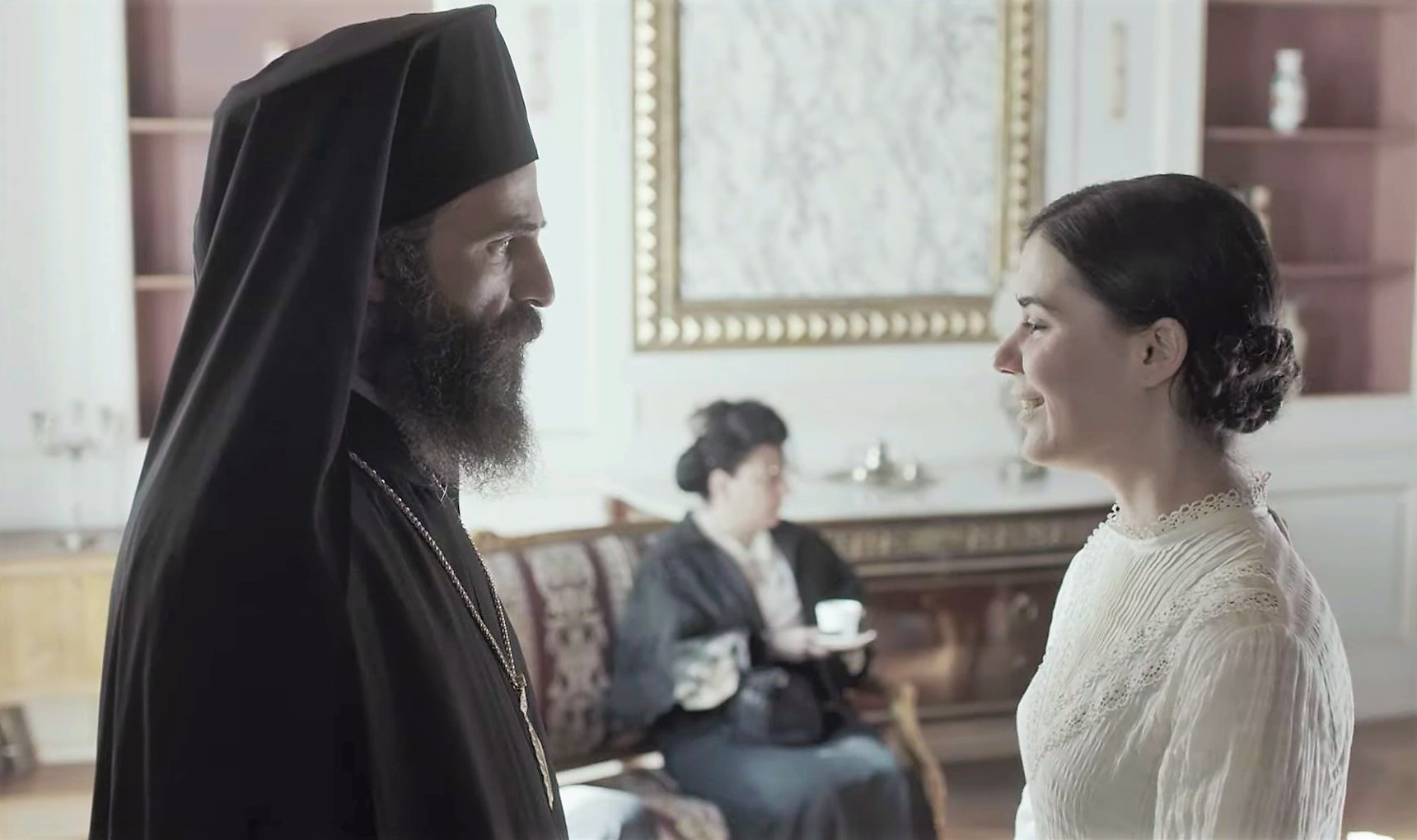

In these days when film publicity is almost entirely devoted to boosting box office receipts for big splashy action movies, it is easy to overlook smaller films – meaningful, unpretentious films that amply repay viewing by the thoughtful viewer. Such a movie is Man of God, available on Discovery Plus.
Definitely avoid confusing it with a similarly titled movie currently available on Netflix, which stars Elijah Wood and is instead about the serial killer Ted Bundy. Also do not be misled that the film is touted as starring Mickey O’Rourke; the actor appears in a very small (though crucial) role in the closing minutes of the film.
The film considered here crept into a few local movie houses with no publicity or fanfare and quickly disappeared, even though it won the Audience Award at the 2021 Moscow Film Festival and broke box office records in Greece. This may be surprising since the film depicts the life of a saint: St. Nekarios of Aegina.
Many of us will not only have been unaware of the film, but also of the saint himself. This is perhaps in large measure because he is a reverenced saint of the Greek Orthodox Church. In fact, a small challenge when viewing the film is that it fails to provide for the uninformed, such as myself, an adequate historical background of the events presented in the film – events which involve the complexities of the history of Greece and Turkey and the structures of the Eastern Orthodox religion.
Thus, it opens in 19th-century Egypt with Father Nekarios, to his dismay, being sidelined, even though he is revered and much loved as a holy man. His exile apparently arises from the resentment that his goodness has aroused in his small-minded fellow clergy. This is the first of many trials and difficulties that Nekarios faces.
He is exiled to Greece. Because he was born in Turkey, though a qualified Greek citizen, he has difficulty obtaining work and supporting himself; his position is made even more difficult because his persecution by his fellow priests pursues him even there. Eventually he is appointed head of a school for boys, where he again arouses animosity, this time among the staff because of his kind and unusual approach to student discipline. Later he helps a group of five women found a convent at an abandoned monastery, but he again is subjected to unjustified attacks.
It is against this series of events that the portrait of the saint is set. The portrait is at once compelling and salutary. The depiction of a truly saintly man, a man who embraced his suffering and exemplified what it is to be Christ-like, avoids the saccharine and never indulges in the obvious gimmicks that destroy so many films attempting to portray holiness. There are no heavenly choirs here, no lights streaming from the sky – just understated and beautiful narration.
The result is memorable in its austere and simple beauty. Indeed, in its restrained intensity it matches Carl Th. Dreyer’s silent 1928 masterpiece, The Passion of Joan of Arc.
Direct and uncluttered scenes in black and white follow the saint’s journey as he patiently accepts the tribulations to which he is subjected. At the centre of it all is a truly magnificent performance by Aris Servetalis. His portrayal of the saint is as restrained and as convincing as the entire production.
Written and directed by Yelena Popovic, the film is a challenging, moving statement of what it is fully to embrace the life of Christianity. And since the film makes clear that the saint’s many books are readily available, it also invites the viewer to further explore insights of his which it can only hint at.
Though Man of God may not be available in theatres, perhaps it is in any case best viewed online in one’s home, where one can quietly reflect on and ponder its wonderful message.







