
Longtime readers of this column know that I have a fascination for all things space-related. It’s been there since childhood when my father took me outside and pointed to the sky and said that any moment we would be seeing the first manmade earth-orbiting object in space to be widely visible to the unaided eye from the ground.
That object was a large passive Mylar balloon, Echo 1, made from an ultrathin plastic material covered in a vanishingly thin layer of vaporized aluminum. I was hooked. For me, at that moment, the space age started, coincident as it turned out, with the space race driven by the Cold War between the United States and the Soviet Union.
A giant balloon reflecting sunlight to observers on the ground captured the attention of people across the world. Objects placed in orbit around the earth were no longer abstract to those unconnected directly to space exploitation.
Fast forward about six decades and we have the International Space Station as one of the last vestiges of cooperation between American and Russian spacefarers because of other geopolitical factors, and even that appears to be under threat today.
Nonetheless, scientific work and cooperation aboard the ISS continues, a hallmark of the cooperation between multiple nations and space agencies.
The ISS is even easier to spot than the 30 m wide Echo 1 space balloon. At a size approaching that of a typical football or soccer field, the ISS reflects vastly more sunlight. Apart from the moon, it may even be the only object visible in light-polluted urban night skies.
One aspect I never tire of, besides looking up at the ISS when it crosses Metro Vancouver, or even bouncing a radio signal of it to other radio amateurs like me, is to admire the still shots taken by the crew aboard the ISS, sometimes during downtime when they may retreat to the special cupola for an unequalled view of our planet.
Such photography, when carried out by American astronauts, becomes part of the public record and all such images are stored in a massive, easily accessible, database.
So it was that I was recently captivated by a stunning view of Metro Vancouver taken by Raja Chari, also known through his Twitter handle @Astro_Raja, from the ISS on April 5 2022. Raja Chari is a member of NASA’s 22nd class of astronauts, who launched to the ISS November 10 2021 and returned May 6 2022.
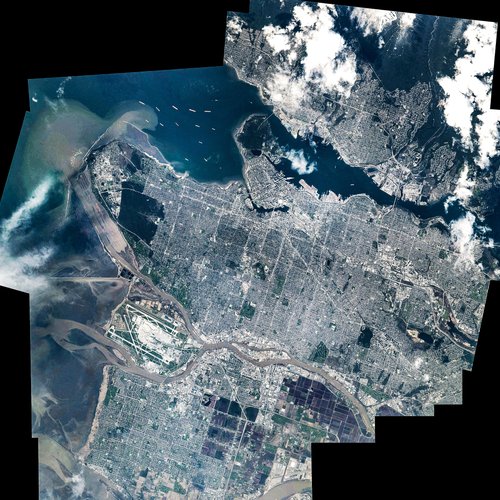
As has happened before, the image, or rather this composite image, was brought to my attention by Huub Eggen (Twitter @phi48), a science commentator based in Deventer, Netherlands. The composite was assembled by Eggen from a set of individual shots taken by Chari, using a handheld camera while in the ISS viewing cupola.
Although the ISS passes over Metro Vancouver pretty much every day, it takes all sorts of things to come together to produce images such as these. Cloudless skies for one, and we know those have been in short supply. The time of day and the consequent angle of the sun for another. Environmental factors such as mist, or perhaps smoke from forest fires are also considerations.
These images aren’t necessarily oriented the way we might be used to when viewing say a map. Sometimes they need to be rotated just to get a grasp on what is being seen. This particular composite comes from a sequence identified as ISS067-E-3628-3721.
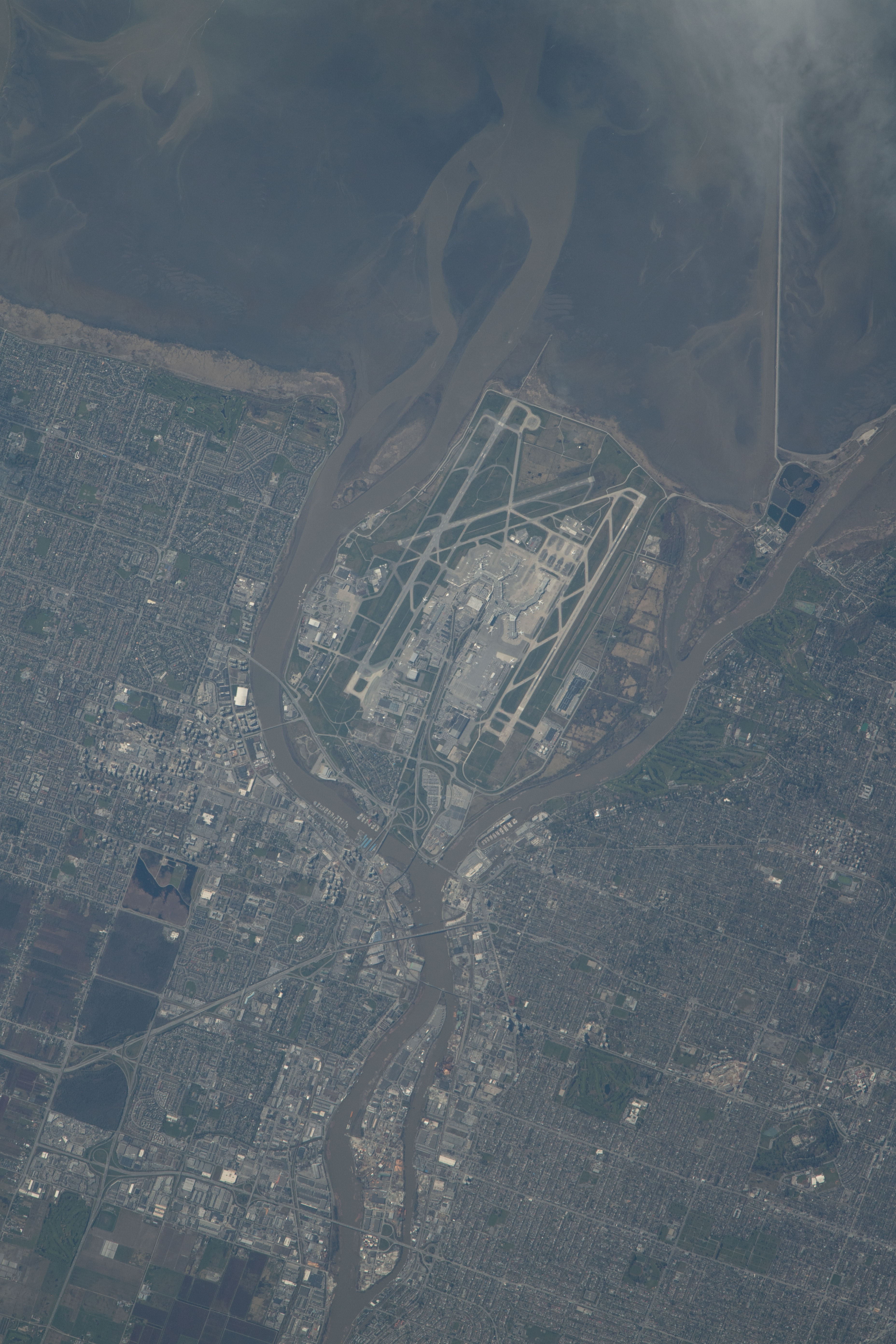
If you want to try your hand at working with the individual raw images from this set, start with this one: https://go.nasa.gov/3NZgrJD.
That shot is centred on Vancouver’s airport. Changing the last four digits brings up other images in this set. For this particular sequence the values run from 3628 to 3721. That’s almost a hundred shots.
With each of the composite images I’ve worked with in recent years I’ve found they can be cleaned up quite a bit by passing them through a tool such as Photoshop and running various dehaze and clarity tools. I use the free Photoshop Express tool for this, however it appears to be available only for Windows 10/11.
To explore images from other parts of the earth just go to https://eol.jsc.nasa.gov/, NASA’s Gateway to Astronaut Photography of Earth site. This site features the previously mentioned massive database of photographs, and is searchable in multiple ways. Warning: searching here can be highly addictive.
You can try making your own composite images, perhaps even for your home town if it isn’t in the Metro Vancouver area image accompanying this column.
Follow me on Facebook (facebook.com/PeterVogelCA), or on Twitter (@PeterVogel)
pvogel@outlook.com