


As a child, I was taught to make the sign of the cross, a gesture which expresses our belief in one God composed of three persons. When I persisted in asking questions about the Trinity, I was told that it was a mystery I would just have to believe.
For a time, that response satisfied me. If adults couldn’t answer my questions and still accepted this teaching, I could as well. As I grew, while I could not fully articulate my beliefs, I accepted what the Nicene Creed teaches: the Father is “Maker of heaven and earth, of all things visible and invisible”; the Son is “begotten not made, consubstantial with the Father”; the Spirit “proceeds from the Father and the Son” and “with the Father and Son is adored and glorified.”
Although the concept of three persons being “consubstantial” or part of a single God is unfathomable, I could appreciate and understand some aspects of this through what I had learned about each person from Scripture and our faith traditions.
When I became a Catholic school teacher and a parent, other people expected me to provide answers to their questions; consequently, I began to struggle with the Trinity in a new way. How could I explain the concept of a “mystery” to someone else when my own attempts to process it were inadequate? Working with children prompted me to look for Trinitarian examples in the world around me.
Nature provides some of the most obvious symbols of the Trinity. Everything from root-plant-fruit similes to St. Patrick’s symbol of the shamrock with three leaves can suggest to us how one being can have three distinct – yet inseparable – aspects. St. Augustine of Hippo even provides intangible Trinitarian metaphors, identifiable in human experience and emotion: memory, understanding, and will; and lover, beloved, and love itself. While these images certainly help to encourage a grasp of the Trinity, I am continually striving to formulate my understanding.
My interest in the Trinity is at new heights right now, not just because of the Feast of the Holy Trinity, but because I am taking a theology course on this very topic. In a recent discussion, several classmates shared that the more we learn, the less we seem to know. Furthermore, I know I am not alone in saying that the more I try to explain my understanding of the Trinity, the more my words fall short. But, truly, how can we expect our human words to ever do justice to the nature of God?
Since theology is known as “faith seeking understanding” (Anselm of Canterbury), I cannot think of a better way to practise theology than to ruminate on and discuss the Trinity. Every time I try, however insufficiently, to explain what has been revealed to us, I rely on faith. That faith, in turn, inspires me to keep seeking answers and clarification. The more confused I get, the more I humbly realize that I am not meant to fully grasp the concept. My faith prompts me to seek answers, and the process of seeking serves to enhance my faith.
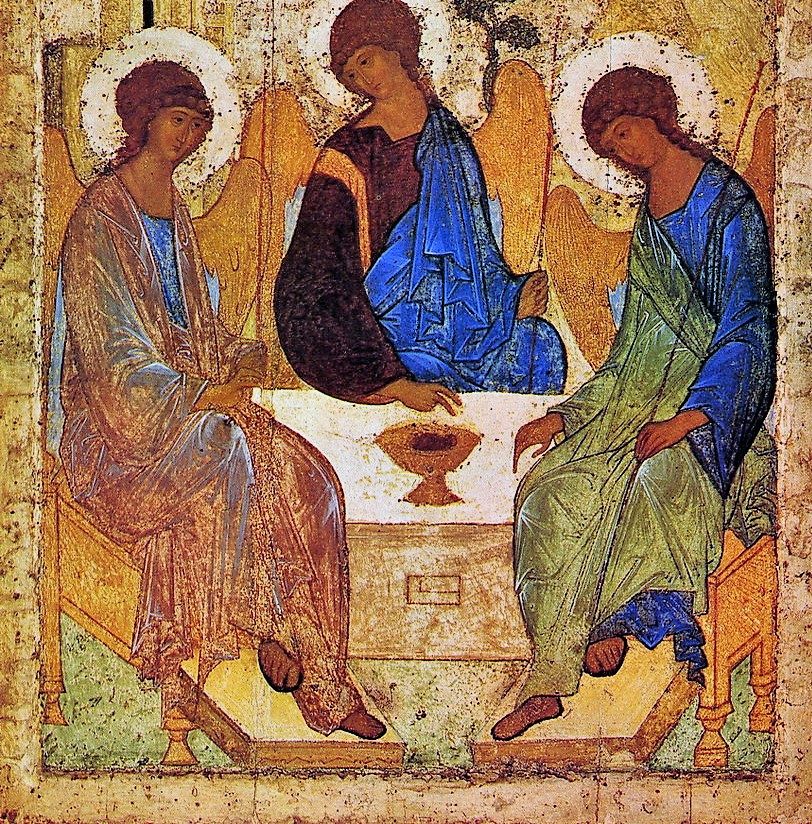
In my course, I was introduced to Andrei Rublev’s icon The Hospitality of Abraham. Based on Genesis 18:1-5, in which three men visit Abraham, the icon depicts figures seated around three sides of a table with the fourth side, in the forefront, vacant as if to invite someone to join them. As explained by Declan Marmion and Rik Van Nieuwenhove, the painting depicts the members of the Trinity who invite us to share in their union. God revealed Godself to Abraham as a representative of Israel, and the icon reminds us that the Trinity continues as a “circle of love” – a mystery of “triune harmony” – into which we are called.
When I was a child, I was told that the Trinity was a mystery that I just had to accept. As an adult, I realize that this mystery invites me into a relationship. Although I will never fully understand the nature of God, the members of the Trinity beckon me to find my place at the table so that I may grow in love with the Father, the Son, and the Holy Spirit.







