

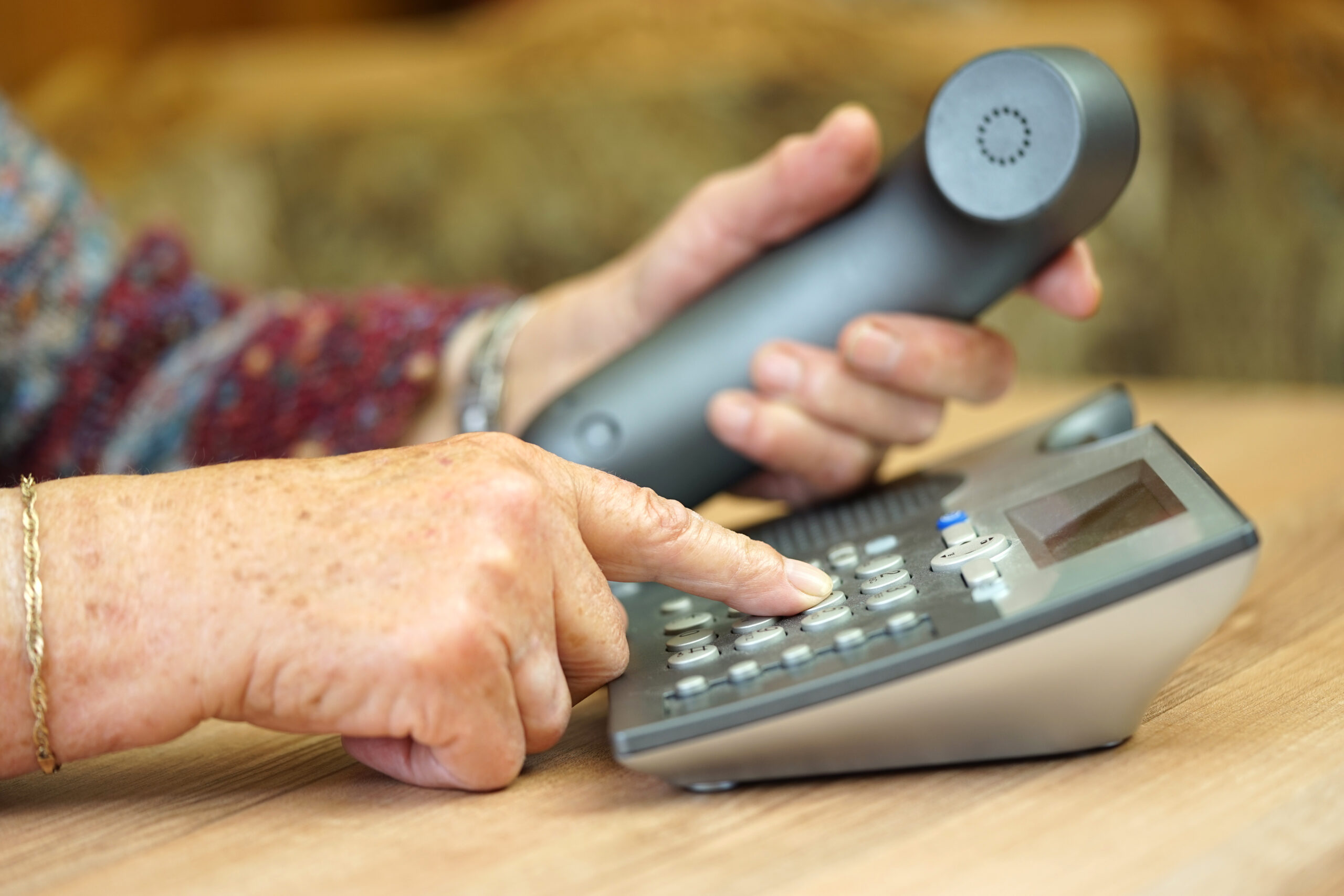

Recently, an older couple, longtime friends of my parents, lost their home phone service without any notification or warning.
There is a backstory, and from the company’s perspective perhaps even a valid rationale for the service cut, but this simply should not have happened, as it potentially put lives at risk.
Here’s how it panned out, and how I came to know about it.
For the past little while I’ve taken to phoning this couple on Wednesday evenings, in particular to chat with the husband, who, for the past two years, has been in declining health and dealing with slowly increasing dementia. We speak in Dutch. He seems to enjoy that, as do I.
This past week, I went about phoning as I had been doing, around eight in the evening. I was met with a recording: “The number you are calling is not in service.” I found this rather odd and thought I’d try again later. No success on multiple attempts. I phoned the service provider to ask for any possible insight. Nothing. I asked clearly if the recording might mean that the service has been disconnected. “No,” I was told, “a disconnected service will state that.”
At this stage I was stymied. My mother had heard nothing about a possible change in service.
The following morning there was finally an explanation. The wife phoned my mother, from a new number, to explain that indeed the phone service had been disconnected. At least three days earlier, she believed. Preceded, as it transpired, by internet service being cut six days earlier.
Here’s why, and the reason should be cause for concern for anyone dealing with a loved one who takes ill, a loved one who had taken care to see that bills were paid and who may suddenly, or even gradually, be incapable of doing so.
About two years ago, that became the situation for my mother’s friends. The husband had always paid the service provider’s paper bills via the computer, online. In the transition to the wife now paying these, at the bank rather than online, a pair of bills was missed. Those unpaid bills never appeared on subsequent statements. There was never any indication of a missing payment, neither in print nor via phone call.
A complicating factor is that coincident with the husband being unable to pay the bills electronically, the phone provider had stopped paper billing, a situation many seniors complained about at the time and that was subsequently reversed by the industry regulator.
Fast forward two years. The telephone service was cut off. No notice, nothing in writing, no phone call, no warning. The wife wasn’t even aware the service was cut until she picked up the phone, only to hear a strange, unfamiliar sound, and found herself unable to make a call. (She does not use a cell phone.)
Not knowing of the underlying reason, she thought little of it and assumed it was either a minor outage or a problem in the apartment building. She was concerned, though, as she sometimes has had to phone the doctor for a sudden prescription for her husband. Such prescriptions were typically delivered within a couple of hours.
It was at about this point, three days into the outage, that I placed my call to the apartment and subsequently attempted to get clarification from the service provider. Fortunately, at this stage, other family members had become aware of the situation and were already working to remedy the situation.
Upon learning that the underlying reason for the service cut was an unpaid bill and that no communication had occurred regarding this, a family member arranged to have the service, phone, and internet switched to another provider. Attempts to reach a manager about this proved fruitless.
Given that the safety of this couple had been placed at risk, the family member felt it unwise to stay with the longtime service provider. It was also established why the service had been cut. Those two bills, from back in 2020, each for around $110, which, with carrying charges, over two years, had now accumulated to around $250. The service was disconnected, and the account had been passed to a collection agency.
Interestingly, at no time did the provider ever phone the couple to at least make the wife aware of the arrears. She diligently saw to it that the amount paid each month was the $110 amount, and in fact a bank employee eventually put it on auto payment.
It is entirely possible that the service provider sent emails to the husband’s email address, but his condition changed so quickly that he simply couldn’t remember his account passwords, let alone how to access the requisite programs on the computer.
Perhaps a broader aspect to this event, or series of events, is that we need to make plans for family members to have digital access to important accounts when a need arises. Perhaps we keep a document listing such accounts and the access information and store it in a safe place that is known to those we trust.
As for the service provider in this case, you’d think a phone call would surely have been made to provide a reason for disconnecting service. It wasn’t. And that inaction potentially placed someone’s life at risk.
Follow me on Facebook (facebook.com/PeterVogelCA), or on Twitter (@PeterVogel).







