


First Sunday of Lent, Year C
First Reading: Dt 26:4-10
Second Reading: Rom 10:8-13
Gospel Reading: Lk 4:1-13
In the Gospel Reading, Satan tempts Jesus in the desert. Then, when he has “finished every test,” he leaves “until an opportune time.”
What is the difference between “tempt” and “test”?
There are three parts to sin, St. Augustine said: the suggestion, the pleasure, and the consent.
When we smell food, for example, our appetite is stirred, and we experience pleasure.
This pleasure comes from God. All Satan can do is encourage us to take it at times, or in ways, or in degrees, that God forbids – not to curtail our pleasure, but to make us experience it as fully as he intends.
Now in Lent, we are fasting, so we do not consent to this pleasure; we reject it.
If we do so immediately and completely, we have “passed the test.” It does not become a temptation for us unless we entertain the possibility of enjoying it unlawfully.
Here, “entertain” means “harbour, cherish, welcome, consider.” There is a struggle among our feelings, emotions, intellect, reason, and will, so we hesitate and delay before we eventually consent or reject. Notice how many words connected with temptation suggest duration: we are exposed to temptation, we endure it, suffer it, fight against it, fall into it.
In the desert, Satan presents three pleasures to Jesus: food; world dominion; and God’s care for him. He urges Jesus to seize them unlawfully: by making bread out of stones (contrary to his Father’s way); by worshipping someone other than the one true God; and by forcing his Father to display his providence.
Jesus rebuffs every attack. There is no struggle, no hesitation or delay, for his human will is in perfect harmony with God’s. He displays this harmony by quoting the Old Testament, making God’s will his own response to Satan’s urging: “Man does not live by bread alone”; “Worship the Lord your God, and serve only him”; “Do not put the Lord your God to the test.”
Jesus “triumphs over Satan by his total adherence to his Father’s plan of salvation – a plan that is contrary” to Satan’s way, says the Catechism of the Catholic Church. Jesus is tested, and he passes every test.
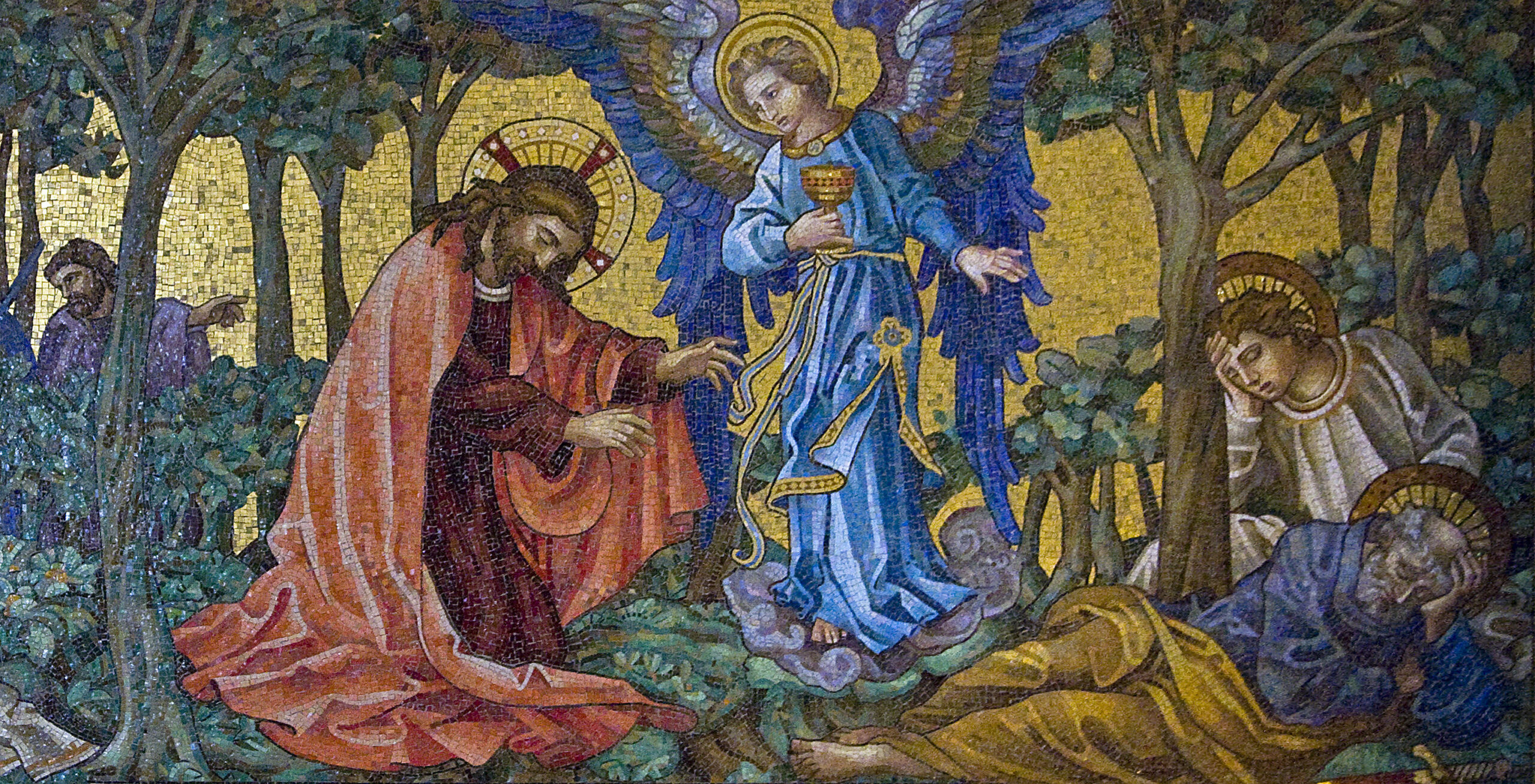
However, in Gethsemane, he is tempted. This is the “opportune time” Satan has been waiting for.
Starting with his baptism, Jesus has let himself “be numbered among sinners,” says the Catechism. Now, at the Last Supper, he has taken on “the sin of the world” by letting us eat his body and drink his blood, uniting us to himself like infected branches grafted on to a sound vine.
Then, in the garden, he begins to suffer the full agony of sin’s chief consequence: separation from God. Tested by Satan in the desert, he had adhered spontaneously and totally to his Father’s will; now he begins to endure the temptation to abandon it. Like a fallen human, infected with our sin, he contemplates the possibility of avoiding the suffering it entails: “My Father, if it is possible, let this cup pass me by”; “take this cup from me.”
Nevertheless, he submits: “Let it be as you would have it, not as I”; “not my will, but yours, be done.” However, the very words of his submission reveal the separation from his Father he expressed from the cross: “My God, why have you forsaken me?”
In the desert, Jesus expresses his own will by simply quoting his Father’s will; in the garden, there is a struggle. In the desert he is tested; in Gethsemane he is tempted, just as we are.
God does not tempt anyone, St. Augustine says. Rather, St. James says, it is “the tug and lure” of our own passions. However, God tests us so that we may know “whether we love him.”
In the desert, Jesus shows us how to treat Satan’s suggestions. In Gethsemane, he becomes our “great high priest” who can “sympathize with our weakness.”
Father Hawkswell is again teaching The Catholic Faith in Plain English. The whole course is available in written form and Sessions 1-22 in YouTube form at beholdvancouver.org/catholic-faith-course. Session 23, “God’s Will,” will be available in YouTube form starting March 6.







